Categories
Artificial Intelligence

Why Data Annotation is the key for productive Artificial Intelligence Solutions?

Are you aware that even the most technically advanced algorithms cannot solve a problem without relevant data? That is why having a massive amount of data won’t completely serve the purpose, you must have access to data with a learnable ‘signal’ which is consistently added at a massive scale. Data annotators effectively bridge the gap between human expertise and combined with machine learning to aid brands across the globe in solving complex data challenges and improve operational efficiency at lower costs. 

The Emergence of Artificial Intelligence

Artificial Intelligence is everywhere, and it has left its footprint in almost all sectors. From logistics to healthcare, AI aims to redefine how data is gathered, analyzed, and integrated. Also, it empowers you with informed insights to deliver better results. Automated systems easily learn and process data quicker than a human, therefore data is equally crucial. Artificial Intelligence utilizes massive amounts of data to identify and learn patterns which humans can’t. It’s the ability of AI in processing data and making informed decisions that often lead to be the game-changer in the industries that rely on massive volumes of data.

The Enterprises require to develop their AI strategy to integrate, link, and supplement their data so they could have an accurate foundation to build and train their machine learning algorithms as algorithms powering artificial intelligence which depend on the quality of data. 

According to an MIT Technology Review, insufficient data quality is one of the biggest challenges for employing AI. Hence, companies should think about AI and machine learning as engines that will help them achieve what they want to accomplish. But, an engine needs fuel to run, and here data is being the fuel.

How Data Annotation is linked to Artificial Intelligence? 

Data annotation is for ensuring that if your artificial intelligence and machine learning projects can scale. It offers the initial setup for training a machine learning model with a proper understanding and differentiation between the various inputs and outputs.

There are different types of data annotation models based on the type of data such as image and video annotation, semantic annotation, text and content categorization. But, humans should identify and annotate specific data so that machines can learn and recognize the data information. Without proper labels, machine learning models would face difficulties in computing necessary attributes. 

Artificial Intelligence Use Cases while performing an annotation task

– Sequence: Time or text series starts from left boundary and ends at right boundary, and the label (ML model) could easily recognize a name in text or identify a paragraph. 

– Categorization: Categorize according to BISAC ontology or categorize an image as offensive or proper. 

– Mapping: Map full text to a summary, map one language to another, map raw data to normalized data, and more. 

– Segmentation: Identifies the paragraph splits, finds an object in a picture, etc. 

Usually, data annotation powered with AI allows you to solve complex problems in sequence or a combination of tasks. For instance, when you unlock your mobile phone with your face, machine learning is utilized to spot your facial features like eyes and nose segmentation etc, and categorize the object if it’s a human or not. Hence, AI and Machine Learning go hand-in-hand to annotate data and offer perfect solutions to your problems.

How Data Labeler can help you with Robust Data Annotation Services? 

Data Labeler brings you the most relevant, accurate, convenient, customized, and quality-labeled datasets for AI and Machine Learning initiatives. It will help you achieve competitive advantage with unlimited support and growth. 

We at Data Labeler offer highly accurate labeled data, guidance on labeling instructions, options on real-time labeling, and more. 

Collaborate with us for seamless data labeling and data annotation solutions. Contact Now – Sales@DataLabeler.com

Categories
Data Labeler

Ten Most Innovative Computer Vision Startups

Artificial Intelligence is one of the most disruptive technologies in the world to achieve hyper-growth targets. With the rising number of applications in computer vision, big data, natural language processing, AI is revolutionizing industries, brands, and the lives of millennials. Computer Vision is a crucial AI application which is seamlessly transforming multiple industries and business operations.

Computer vision startups are attracting the attention of investors worldwide, particularly in the US. In fact, the benefits of computer vision models and artificial intelligence are evident in several countries.

Know how these top 10 Start-up Companies are striving to leave a footprint by their Computer Vision technologies

1. NetraDyne

Headquartered in Bangalore and San Diego, NetraDyne’s innovative computer vision is known as DriveriTM. It is a fleet safety and vision-based driver recognition platform. This application primarily analyses every minute of the driving experience and helps the commercial fleet manager with insights about the positive driving data and opportunities for individual coaching.

It also alerts the drivers about any emergency while driving on a specific route and feeds data on lane driving and traffic rule details.

2. Qualitas Tech

Qualitas Tech offers its clients expert industrial automation solutions. They help the brands automate visual processes in manufacturing. Their services include visually guided robots, bearing inspection, optical character recognition, and code reading, etc.

Qualitas Technologies was founded in 2008 in Redmond, Washington. They deliver immense value to leverage the power of artificial intelligence and machine learning to their customers.

3. Streamoid Technologies

Streamoid was established in 2013 and headquartered in Palo Alto and Bangalore. They offer seamless AI solutions for customizing user-interaction in the retail and fashion industry. Their computer vision solutions focus on offering intelligence on differentiating between “shirt dresses” & “dress shirts”.

Streamoid helps in catering two-way communication channel which is easy to discover, integrate and use. They also offer excellent catalog assistance which works as a knowledgeable assistant for hyper-personalized customer experiences.

4. MintM

MintM is a robotic-powered and computer vision-based data platform that aids businesses with real-time intelligent analysis as well as automation with CCTV and other kinds of cameras.

This computer vision platform recognizes customers and objects for offering services like customer loyalty, footfall counts, omnichannel experience and more. In the logistics sector, their services include number plate tracking, package scanning & reading, etc.

5. Vay

Vay is a unique fitness coach application that makes use of human motions for analyzing the overall track performance. This app also provides real-time feedback to the users during their workout, just like a personal trainer.

It utilizes a computer vision algorithm for tracking and digitizing human movements, changing movement patterns in the form of data that can be analyzed in multiple ways.

6. Roboflow Organize

It is yet another machine learning platform that aims to streamline data preprocesses and trains the computer vision models likewise. Their several annotation files and formats take a bit more time to get the images ready for training.

Roboflow aims to build an architecture between the annotation and training phases that computer vision startups require to implement the data annotation process within less time.

7. Camma.ai

Camma.ai has successfully bridged the gap between reality and augmented reality. This start-up seamlessly created a note-taking augmented reality app that enables you to place notes on real objects through your phone’s camera.

The app utilizes the photo of an object and the user types a note on their phone. So, when the user’s camera sees that object, the respective note will pop up.

8. SuperSense

Supersense is an AI-powered technology that scans your neighborhood, nearby objects, texts, or documents. This is a mobile scanner app that is exclusively built for the visually impaired. Hence, through these apps, these special people could easily find their way in a busy day.

The app makes use of object detection and recognition algorithms via the phone’s camera to identify and dictate to the user whatever it is pointed at.

9. Nanit

Specially built for parents, Nanit has become a significant part of their lives. It is a computer vision platform that produces an advanced baby monitor camera that you could view through an app.

Their AI camera easily tracks the baby’s sleeping patterns and records them. The app allows the user to set alerts on when the baby wakes up and when it would fall back asleep. 

10. Data Labeler

Established in 2018, Data Labeler has expertise in providing advanced and reliable training data sets for AI & ML initiatives. With our sophisticated software and efficient data labeling platform, we make sure that your models get trained properly and deployed faster. We tag data such as texts or objects in images or videos to detect and recognize computer vision and train the AI models through machine learning algorithms for the right predictions.

We offer effective services which include bounding boxes, points for facial recognition and body pose detection, texts for image captioning, and more.

Contact us for Seamless Data Labeling and Annotation Services – Sales@DataLabeler.com

Categories
Data Labeling

How the Global Demand for Data Labeling is set to Increase?

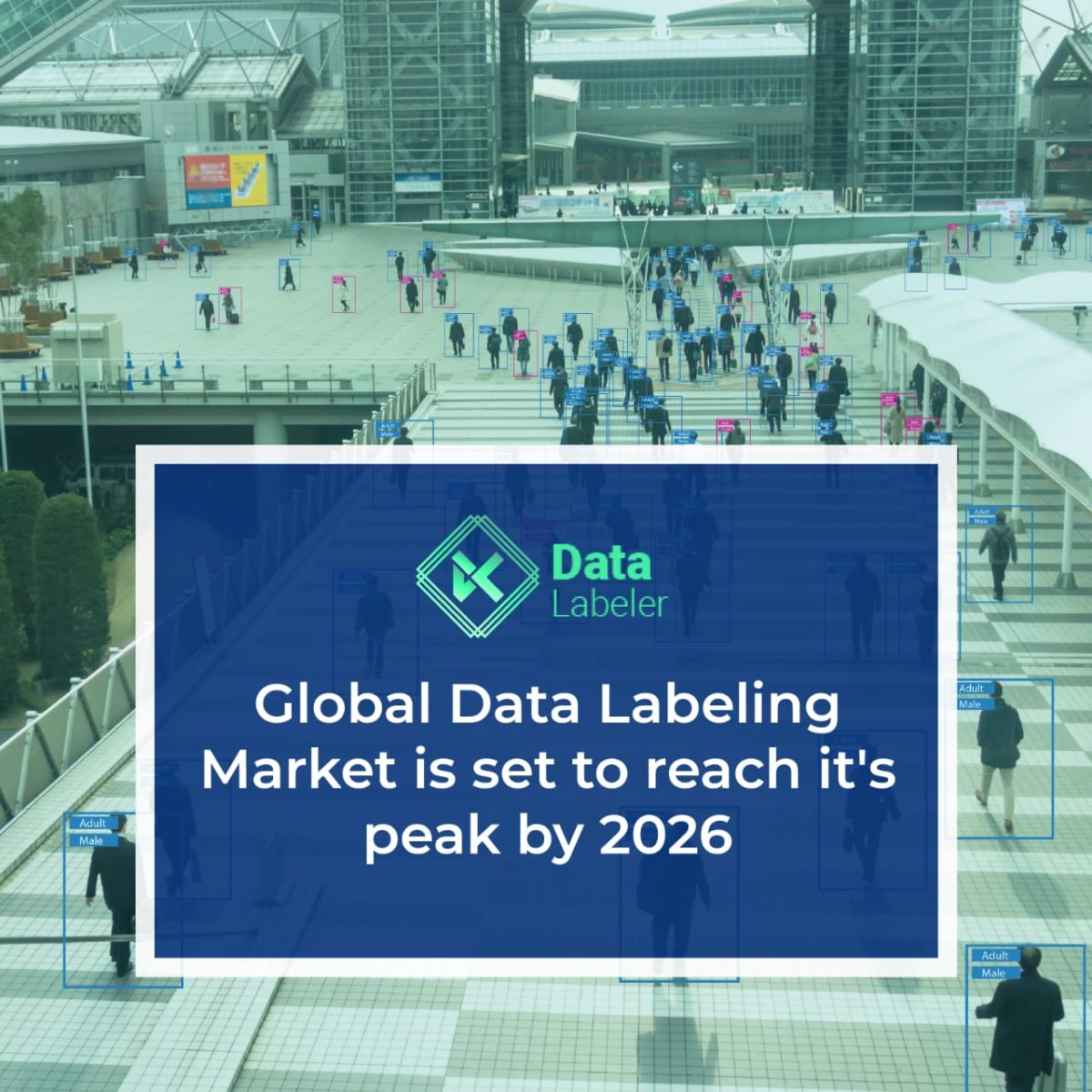
The Global Data Labeling Market is growing at a rate of 28.4% CAGR and is expected to reach 3.5 billion USD by 2026. Hence, most of the brands are outsourcing data labeling services to create robust machine-learning models.

Data labeling is the manual solution for machine learning and artificial intelligence application data with the help of humans. Labeling data is crucial because computers have multiple shortcomings and some of them cannot be overcome without human assistance. A machine can be trained potentially for performing complex calculations and manage tasks that would be strenuous for humans to handle manually, but the same cannot spot the difference between a dog’s or a car’s picture without proper training.

Machines utilize a dataset-based algorithm for understanding what normally involves someone to supervise. This phenomenon is known as supervised machine learning. On the basis of data type, the market is segmented into text, image, video, or Audio and also based on End-user, Retail & Ecommerce, Healthcare, Government, Automotive, and others.

The Rise of Data Labeling & Annotation Tools

Data Annotation tools assist in the crucial improvement of the training data used by smart AI models which allow them to address complex data challenges. Therefore, the market for data annotation tools is witnessing thriving growth as the organizations are deploying these data labeling & annotation technologies.

For example, data labeling tools have enabled automotive manufacturers in the field of smart applications for vehicle to vehicle communication (V2X) and connected car technologies like speech recognition & Natural Language Processing (NLP). Therefore Data annotation tool providers are focusing on developing specialized techniques for facilitating the automation of 2D and 3D annotation for LiDar data and sensors.

The Growing Demand for Data Labeling in Various Sectors

Data labeling will play a significant role in multiple industries and various sectors. For instance, in healthcare, medical imaging makes use of computer vision technology to predict the patterns and detect disease and injury. Data annotation tools help training AI systems in differentiating data among medical images which includes magnetic resonance imaging (MRI), X-ray, or CT scan Images. Also, studies have found out that after the entry of AI into the healthcare sector, error rates have decreased by 15%.

Another area is the cloud advent services and a surge in mobile devices where multiple data processing technologies have emerged. Some of them are data annotation, multilingual speech transcription, and data classification. Several technologies are being introduced to reduce the dependency on manual processing or human efforts.

Regional Insights of the Global Data Labeling Market

Back in 2020, North America dominated the market accounting for more than 38% of the global share. This remained to be one of the most rapid growth of cloud-based services and one of the potential sources of data collection.

The growth of the North American segment is attributed to the rising hub of AI & mobile computing platforms in the sector of e-commerce. Europe is also expected to grow beautifully in this forecast period and advance in the automobile sector.

At the same time, Asia Pacific is expected to reach the peak of highest CAGR in this period. A growing number of smart devices will ultimately boost the need for data labeling as well as annotations. Due to the rapid technological developments and increasing use of mobiles and social networks, data labeling market will be in a boom.

Know how Data Labeler could help you with effective Data Labeling & Annotation Tools

Expertise in offering convenient, accurate, personalized, expedited, and advanced labeled datasets for AI & ML initiatives.

Data Labeler seeks to boost your competitive advantage and enables you to grow seamlessly.

Wondering how? Contact us now Sales@DataLabeler.com

Categories
Machine Learning

How to Label Data for Machine Learning in Python?

Artificial Intelligence is as good as trained data. With the quantity & quality of training data directly determining the success of an AI algorithm, it is not surprising that an average of 80% of the time spent on an AI project is wrangling training data which includes data labeling.

Data labeling in the context of machine learning is the process of detecting as well as tagging data samples and it is crucial when it comes to supervised learning in ML. Supervised learning occurs when both data inputs and outputs are labeled to enrich future learnings of an AI model.

The complete data labeling workflow includes primarily data annotations, tagging, moderation, classification, and processing. So, you’ll need a comprehensive process to convert labeled data into the necessary training data to teach your AI models which recognize the patterns for producing the desired outcome.

For instance, training data for a facial recognition model might require tagging images with particular facial features like mouth, eyes, or nose.

So, Let’s Dive in and Learn How to Label Data in Python…

In machine learning, we deal with several kinds of datasets that contain multiple labels in one or more columns. These labels are in word or number forms. To make it readable by humans, these training data are labeled in words.

Therefore, Label Encoding refers to converting the labels into numeric forms and later converts them into machine-readable forms. Machine learning algorithms could decide how to operate those labels. It is a significant pre-processing step for structured datasets in supervised learning.

Label Encoder performs the conversion of predefined labels of categorical data into a numeric format.

For instance, when a dataset contains a variable called “Gender” with labels like “Male”  and “Female”, then the label encoder would convert these labels into a numeric format and the outcome would be [0,1].

Hence, by converting those labels into integer format, the machine learning model   would have a better understanding of operating datasets.

How to get started with Label Encoding? – the Syntax you should know

Python sklearn library offers you a predefined function for carrying out Label Encoding on any dataset.

Now, let’s create an object of the LabelEncoder class and then utilize it for applying label encoding on the data.

Label Encoding with sklearn

The first and foremost step to encode a dataset is to have a dataset. So, let’s create a simple dataset here…

So, we have created a ‘data’ dictionary and then transformed it into a DataFrame utilizing pandas.DataFrame( ) function.

Now, from the dataset, it is crystal clear that the variable “Gender” has labels as ‘F’ & ‘M’.

Next step is to import the LabelEncoder class and apply it on the ‘Gender’ variable of the dataset.

The fit_transform( ) method is used to apply the function of the label encoder pointed by the objects to the data variable.

So, you see obtaining high-quality labeled data is becoming challenging when more complex models are to be built.

But now, with the advancement of in data annotation, data labeling approaches don’t seem to be a distant dream.

What Data Labeler can do for you?

Data Labeler provides the best data labeling services for improving machine learning at scale. Our clients benefit from our capacity to deliver accurate, customized, convenient, and quality-based datasets for Machine Learning and Artificial Intelligence initiatives.

Increase your competitive advantage, exponential growth, and unlimited support only with Data Labeler. Contact us – Sales@DataLabeler.com