Categories
Data Labeler

How Computer Vision is aiding the Image Segmentation & Data Labeling Industry?

The size of the global market for computer vision was estimated at USD 11.22 billion in
2021, and it is anticipated to increase at a 7.0% CAGR from 2022 to 2030. Computer vision
systems utilizing artificial intelligence (AI) are becoming more and more common in a range
of applications, such as consumer drones and fully or partially autonomous vehicles.


The Role of Computer Vision in Image Segmentation


Recent developments in computer vision, including image sensors, sophisticated cameras,
and deep learning methods, have increased the potential applications for computer vision
systems across a range of sectors. Sectors include education, healthcare, robotics, consumer
electronics, retail, manufacturing, and security & surveillance, among others.


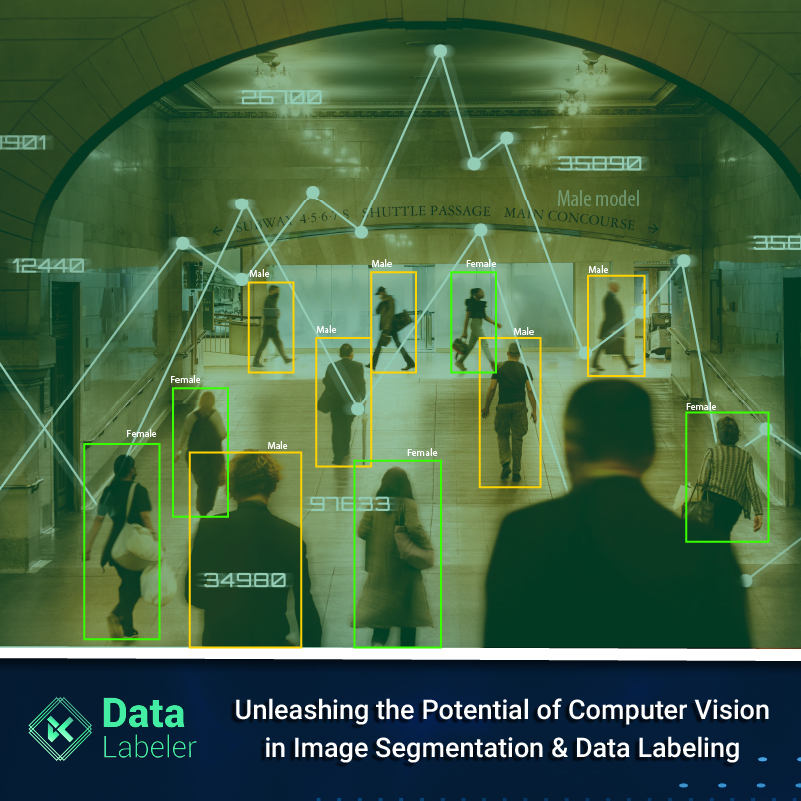
The partition of a digital image into several segments (objects) is known as image
segmentation. Segmentation aims to transform an image’s representation into one that is
more meaningful and understandable. 


Various Image Segmentation Types


Based on the quantity and type of information they communicate, image segmentation
tasks can be divided into three groups: semantic, instance, and panoptic segmentation.  
Semantic segmentation (not instance-based)


The process of semantic segmentation, often referred to as non-instance segmentation, aids
in describing the location of the items as well as their form, size, and shape. 


It is primarily applied when a model needs to know for sure whether or not an image
contains an object of interest and which portions of the image do not. Without taking into
account any further information or context, pixels are simply labeled as belonging to a
certain class. 


Segmentation by Instance 


The practice of segmenting objects by their presence, position, quantity, size, and shape is
known as instance segmentation. With each pixel, the objective is to better comprehend the
image. 
To distinguish between objects that overlap or are similar, the pixels are categorized based
on “instances” rather than classes.


Pan-optic segmentation


Since it combines semantic and instance segmentation and offers detailed data for
sophisticated ML algorithms, panoptic segmentation is by far the most informative task. 

Popular Image Segmentations with Computer Vision in Various Sectors
Due to the complicated robotics tasks that self-driving cars must undertake and the
need for a thorough grasp of their environment, it is particularly well-liked in the field of
autonomous driving. Geosensing for mapping land use with satellite imaging, traffic
control, city planning, and road monitoring are further geospatial uses for semantic
segmentation. 

  • Precision farming robotic initiatives are aided in real-time to start weeding by semantic
    segmentation of crops and weeds. With the use of these sophisticated computer vision
    systems, manual agricultural activity monitoring has been greatly reduced. 
  • Semantic segmentation makes it possible for fashion eCommerce firms to automate
    operations like the parsing of garments that are traditionally quite difficult. 
  • The recognition of facial features is another popular topic of study. By analyzing facial
    traits, the algorithms can infer gender, age, ethnicity, emotion, and more. These
    segmentation tasks get more difficult due to elements like various lighting conditions,
    facial expressions, orientation, occlusion, and image resolution. 


In the context of cancer research, computer vision technologies are also gaining ground
in the healthcare sector. When examples are used to identify the morphologies of the
malignant cells to speed up diagnosis procedures, segmentation is frequently utilized. 


Are you prepping to begin your Image Segmentation Use case? 


Reach out to our professionals in Data Labeler, so they can assist you in quickly and
efficiently producing data that is appropriately labeled.


Data Labeler increases your competitive advantage, provides you with Unlimited support,
and helps you grow exponentially. 

Contact us now!

Categories
Annotation

How Data Labeling & Annotation is aiding and advancing other Industrial Sectors?

Are you aware that almost 90% of data possessed by organizations is unstructured and is expanding
at 55-65% each year?


There is a ton of unstructured data out there. Furthermore, high-quality training data are essential
for completing AI/ML projects, and unstructured data poses security and compliance problems.
So how do businesses deal with this, especially when constructing an AI/ML model and needing to
supply the model with pertinent data so that it can process, give output, and draw inferences?


An AI & ML model’s output, however, is only as good as the data used to train it, as the model can
only produce useful results when the algorithm is aware of the input. As a result, the data must be
aggregated, categorized, and identified precisely. Data annotation is the term used to describe the
process of marking, attributing, or tagging data.


Data Labeling & Annotation with Human Intelligence

By using data annotation, an AI model would be able to tell whether the data it receives is in the
form of a video, image, text, graphic, or a combination of these formats. The AI model would then
classify the data and carry out its responsibilities in accordance with the parameters set and its
functionality.
Your models will be correctly trained thanks to data annotation. So, if you use the model for speech
recognition, automation, a chatbot, or any other operation, you will obtain a fully-reliable model
that produces the best outcomes.
Humans in the loop and human intelligence are vital in the process of identifying, validating, and
correcting problems with the model’s output in order to increase efficiency and allow for
improvisation. Thus, data annotation and labeling can significantly improve an AI or ML program’s
functionality while also reducing time-to-market and total cost of ownership.
As technology develops quickly, data annotations will be necessary across all company sectors and
industries to improve the quality of their systems.


Here is how Data Labeling Affects Different Sectors…

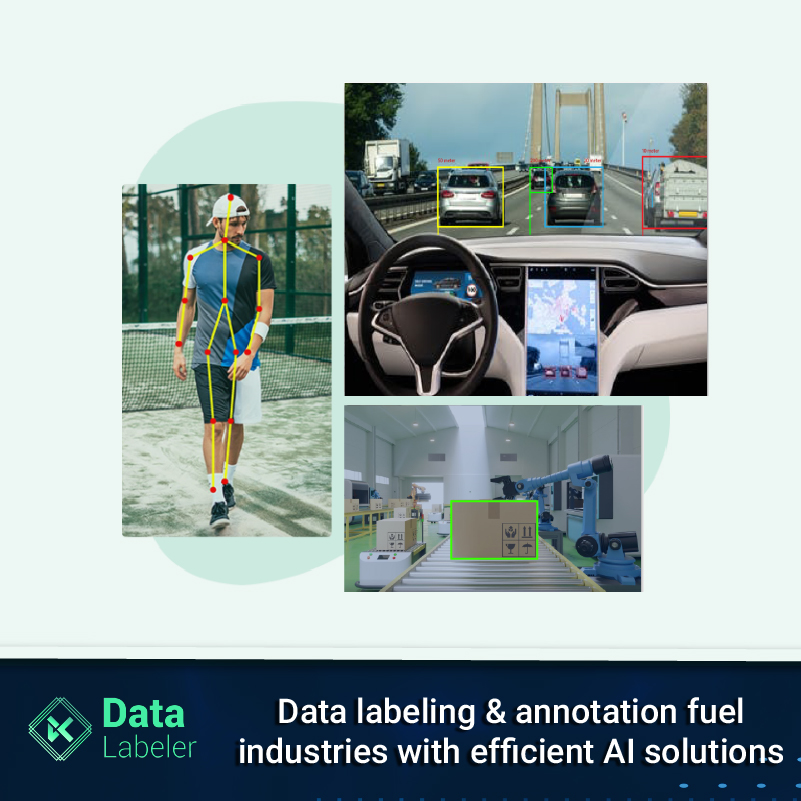
  • Automobile
    Supervised Machine Learning models are crucial to autonomous vehicles, including self-driving
    automobiles, long-haul trucks, and door-to-door delivery robots.
    Large volumes of annotated data are needed for these models in order to power fundamental
    features like lane detection, pedestrian detection, traffic-light detection, etc.

  • Manufacturing
    By 2035, it is predicted that 16 industries, including manufacturing, could experience up to a 40%
    rise in labor productivity because to AI-powered solutions. AI is transforming how manufacturing is viewed in the business, from automated assembly lines to defect identification and workplace security monitoring.

  • Healthcare
    The usage of AI in the healthcare sector is being adopted gradually. Huge amounts of labeled data
    have the potential to revolutionize industries as diverse as drug research and the detection of
    anomalies in MRI and X-ray images.

  • Insurance and Banking
    Banking is already undergoing a fundamental transformation, from automatic check verification to
    the use of AI for fraud detection. AI is being utilized in the insurance industry to automatically assess
    the degree of damage to vehicles, which is another interesting use.

  • Agriculture
    Another sector that is prepared for disruption by AI. Among the applications of AI in agriculture are
    weed detection, crop disease detection, and livestock management.

  • Retail
    The COVID incident revealed how retailers may utilize AI to track customer traffic. AI can also be
    utilized for self-checkout, cart-counting, and visitor sentiment analysis.


How Data Labeler helps in Data Labeling & Annotation Services:
For Machine Learning and Artificial Intelligence (AI) projects, Data Labeler specializes in providing
precise, practical, customized, accelerated, and quality-labeled datasets.

Our Services

  • Highly accurate labeled data
  • Get options for real-time labeling
  • Guidance on labeling instruction
  • Easily scalable
  • Sophisticated workforce management software


Contact us now!

Categories
Annotation

How Data Annotation is Leading the Way to the Best Futuristic Approach to Business?

Our daily lives are significantly influenced by artificial intelligence and machine learning algorithms.
According to a Fortune Business Insights report on the machine learning market, the global machine
learning (ML) market is anticipated to grow from $21.17 billion in 2022 to $209.91 billion by 2029, at
a CAGR of 38.8% over the forecast period. This demonstrates that we will continue to incorporate
more machine learning solutions into our everyday lives, however creating a machine learning
model is not a simple operation and requires a lot of good quality data and many procedures.


A machine learning model can be created via supervised learning, unsupervised learning, semi-
supervised learning, reinforcement learning, and deep learning, for instance. All of these methods of
learning have advantages and disadvantages of their own, and we select them based on our training
data and use cases. Text, image, audio, and video data are frequently used to construct machine
learning models.


Methods like supervised learning necessitate a large amount of pre-labeled training data, therefore
raw data cannot be used or must be transformed into a well-structured form for the machine to
comprehend and anticipate the output based on any use case.


The Technique of Labeling the Data

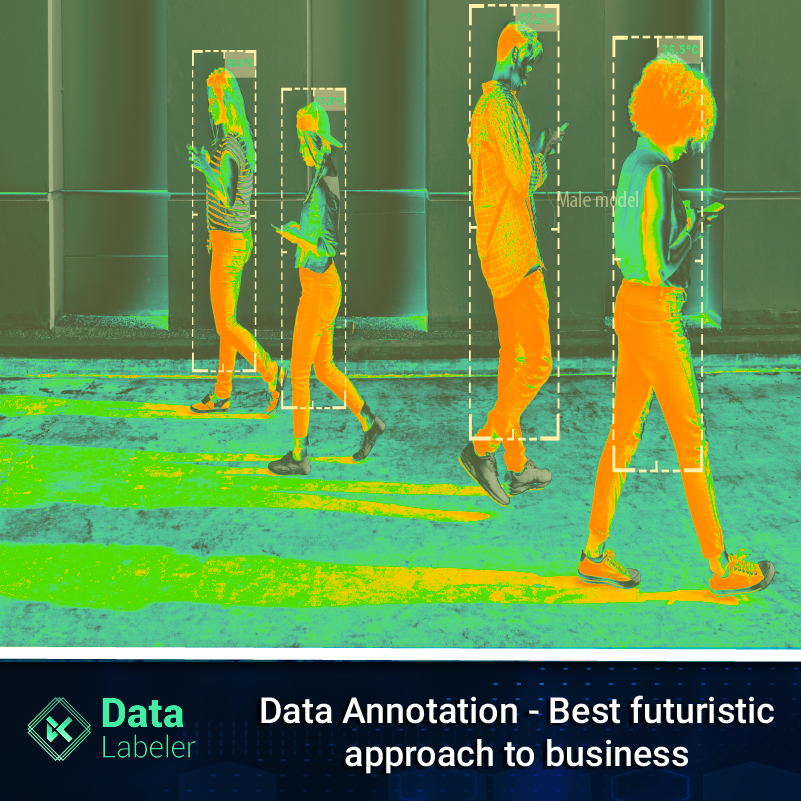
Data annotation is a method of labeling data that is present in a variety of formats, including
photographs, texts, and videos. By labeling the data, computer vision can recognize things, which
helps the system become more proficient. The procedure, in summary, aids the machine’s
comprehension and memorization of the input patterns.


Various data annotation methods can be used to build the data set needed for machine learning. All
of these forms of annotations are primarily intended to aid computer vision systems in text, picture,
and object recognition.


Types of Data Annotations

  1. Bounding Boxes: For the development of object recognition perception models, bounding
    boxes provide the next degree of accuracy for a variety of sectors.
  2. Semantic Segmentation: An image at the pixel level that is employed in computer vision
    applications that demand high accuracy.
  3. Points: This aids in finding and classifying face and skeletal characteristics, facial expressions,
    emotional states, bodily functions, positions, and geographic landmarks that may relate to
    your assignment.
  4. Text: There are many different forms of annotations for text, including relationship, intent,
    semantic, and sentiment annotations.
  5. Polygonal Segmentation: Angled pictures and polygons can be used to annotate items. They
    name pixels in a picture and annotate them with category tags.
  6. Select: Large-scale image and photo classification that is highly accurate and effective.
  7. Machine Learning Applications in Data Annotations Process: Applications and how Data
    Annotations are used in machine learning. Text, time series, and a label are all included in
    sequencing.
  8. Classification: Dividing the data into several classes, a single label, several labels, binary
    classes, and more.
  9. Segmentation: This technique is utilized for a variety of tasks, including finding the points
    where paragraphs diverge and subject transitions.
  10. Mapping: This technique is used for translating from one language to another, for
    summarizing a lengthy document, and for other purposes.
    Future of Data Annotation

Tons of data generated each day is growing exponentially and data annotation is the ultimate
solution of Future Businesses!


Businesses will benefit from Data Annotation by being able to understand and utilize data more
effectively. The majority of Data Annotation Solutions now in use require human input at some
point. We might be able to completely automate this process as technology develops.


As service providers, Data Labelers can make data annotation simpler for brands that are new to the
data business or entities that need to make the most out of their data. Get in touch with us if you
have any questions about data labeling & data annotation.

Categories
Artificial Intelligence Data Labeler

How Artificial Intelligence & Medical Imaging is actively aiding in Tumour Detection?

Radiology and diagnostics in general are being transformed by AI, a cutting-edge technology. In
recent years, the acceptance and application of artificial intelligence (AI) technologies within the
medical field has accelerated. AI is now frequently used to speed up standard, well-defined
processes in the clinical workflow.


Diagnostic imaging is one of the most potential clinical applications of AI, and increasing focus is
being paid to establishing and optimizing its performance to make it easier to identify and quantify a
variety of clinical disorders. Studies using computer-aided diagnostics have demonstrated
outstanding accuracy, sensitivity, and specificity for the diagnosis of minor radiographic
abnormalities, with the potential to enhance public health. However, lesion detection is frequently
used in AI imaging studies to define outcome assessment while ignoring the type and biological
aggressiveness of a lesion, which could lead to an inaccurate assessment of AI’s performance.


The Role of AI in Healthcare


Presently AI imaging studies evaluate sensitivity and specificity to estimate diagnostic accuracy,
while other studies evaluate clinically significant outcomes. More pertinent outcome variables,
however, are new diagnoses of severe diseases, diseases requiring treatment, or conditions likely to
impair long-term survival, as AI frequently picks up even little image variations. Clinically significant
events, such as symptoms, the requirement for disease-modifying therapy, and mortality, have a
significant impact on quality of life and ought to be the subject of AI-based research.


To fully utilize AI, it would be necessary to identify MRI patterns linked with difficult clinical
outcomes, such as severe arrhythmias, hemodynamic instability, and event-specific mortality, as
opposed to a generalized, non-specific diagnosis of myocarditis. When used with echocardiography,
the most frequent type of cardiovascular imaging, AI techniques like convolutional neural networks
could also be used to identify subtle structural and functional heart problems with the significant
clinical association.


Tumour Detection via Medical Imaging

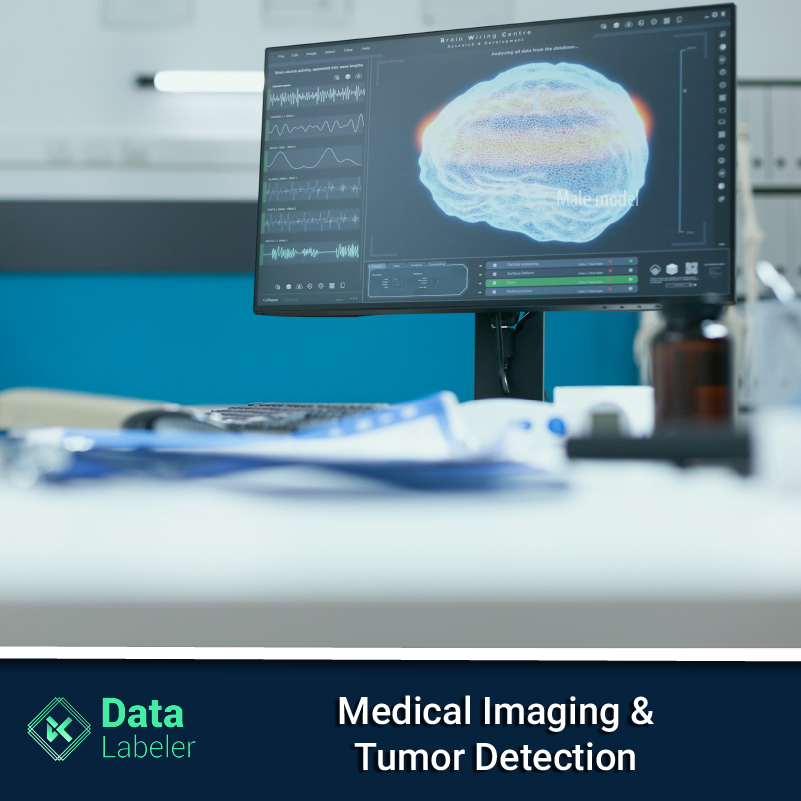
Early brain tumor detection is essential. A biopsy is used to categorize brain tumors and can only be
carried out following successful brain surgery. Medical professionals can discover and categorize
brain tumors with the aid of computational intelligence-oriented tools. AI will allow doctors to
identify tumors with high accuracy in their early stages.


Although preliminary tumor detection is difficult, neuroimaging is essential for the diagnosis and
treatment of brain cancers. The resolution of the segmented image is crucial to detection methods
like image segmentation. Tumor segmentation in magnetic resonance imaging (MRI) has been a
growing research topic in the realm of medical imaging. The brain is a spongy, fragile mass of tissue.
Patterns can enter and interact with each other under stable conditions. A mass of tissue that has
grown unrestrained by the natural controls that keep it in check is, to put it simply, a tumor.
Uncontrolled cell division results in a malignant tumor. A multitude of techniques can be used to find
and segment brain tumors.


Using thresholding and morphological approaches, which are both useful, brain tumors can be
segmented. Through the use of morphological image processing, the tumor can get located and

recognized. Image denoising is the process of removing artifacts from digital images, including noise
and aliasing.


Data Labeler can be your perfect Labeling Partner


Why choose Data Labeler?

  • Highly accurate labeled data
  • Get options for real-time labeling
  • Guidance on labeling instruction
  • Easily scalable
  • Sophisticated workforce management software and more.. Contact us now!