Categories
data annotation

Is In-House Data Annotation right for your Business, or should you Outsource?

Obtaining precise and expandable datasets is frequently a major obstacle for businesses looking to fully utilize artificial intelligence. This is partially because many popular data labeling methods have issues with accuracy, cost, and time commitment.

To generate high-quality annotations, in-house labeling techniques rely on the institutional knowledge of a trained workforce. This method can be costly, time-consuming, and challenging to grow. 

In-House vs Outsourced Data Labeling

Because AI models require substantial annotated data to be operational before launch, companies aim to improve their Machine Learning algorithms. But before they can do that, they have to decide whether to join hands with an experienced Data Annotation Outsourcing Company or build a team internally. Let’s investigate which one is most beneficial.

  • Scalability
  • In-House: The majority of in-house data labeling teams are small and designed to meet a single need. However, over time, there is a fluctuation in the need for datasets. 
  • Outsourcing: Businesses can upgrade or downgrade in line with the need for ML and AI models by turning over annotating tasks to a knowledgeable and experienced professional. 
  • Pricing
  • In-House: Employing a staff to annotate data can be expensive. It is extremely expensive to manage and develop the infrastructure needed to train AI and ML algorithms, particularly for startups and small enterprises. 
  • Outsourcing: From manually labeling data samples to training Machine Learning algorithms, data annotation outsourcing companies provide affordable prices for all of your requirements. Partners in data annotation outsourcing services assist companies in cutting costs without sacrificing precision and quality.
  • Employee Training
  • In-House: Establishing an internal department dedicated to data labeling and annotation necessitates extensive personnel training. Untrained and inexperienced staff members need to be taught how to use annotation tools by seasoned trainers. 
  • Outsourcing: Companies that offer data labeling services have people with training on staff who can quickly adjust to changing needs for datasets. They also know how to use a variety of annotation tools and techniques.
  • Management
  • In-House: Regardless of size, overseeing an internal team responsible for data labeling and annotation may be a challenging undertaking for any company. For annotators, maintaining the quality of training datasets and debugging the tool can also be a burdensome task. As a result, it could divert their attention from the main task.
  • Outsourcing: Annotators’ management responsibilities can be fully assumed by the outsourced partners, freeing them up to concentrate on crafting accurate data labels. Furthermore, skilled employees handle the troubleshooting of annotation tools, responding instantly to resolve any mechanical issue.

What should be considered when selecting an Annotation Partner?

Should you conclude that choosing a data annotating partner is necessary, there are several factors to consider. For your training data plan to succeed, we advise searching for the following qualities in an annotation partner:

  • Possesses a strong annotation platform driven by AI.
  • Possesses a talented labor force.
  • Adheres to adaptable engagement models.
  • Has strict procedures for quality assurance (QA).
  • Follow industry-recognized security procedures.

About Us:

At Data Labeler we are committed to providing the ultimate Data Labeling services. Our group of full-time, extremely productive Data Labelers powers companies worldwide. Our expertise lies in producing high-quality, personalized labeled datasets for machine learning projects. Our staff works nonstop to provide the best possible service to our clients.

With its advanced software, our integrated data labeling platform provides speed, accuracy, efficiency, and consistency. Label auditing, with its simplified job interfaces, makes sure that your models are trained and put into use more quickly.

If you have any Data Labeling requirements, please request a demo today! 

Or have any further queries, send us an e-mail and we’ll get back to you.

Categories
Annotation

Keypoint Annotation: The Game-Changer in Facial Points & Body Pose Research

Imagine a world where machines have human-level perception, interpretation, and understanding of images. Gartner projects that by 2025, 75% of enterprise-generated data will be created and processed outside conventional data centers, with a significant portion of that data consisting of photos and videos. Computer Vision Annotation, an AI technique that lets computers recognize and categorize images, will be important in this scenario.

The image recognition market is anticipated to expand from USD 26.2 billion in 2020 to USD 53.0 billion by 2025, according to MarketsandMarkets. The procedure of Keypoint annotation plays a crucial role in propelling this expansion.

What is Keypoint Annotation?

Labeling particular landmarks on objects in pictures or videos to describe their position, shape, orientation, or movement is known as keypoint annotation. Keypoint skeletons are larger constructions made up of several linked keypoints.

Keypoints can represent different parts of the image, including corners, edges, or certain features, depending on the application. For instance, they can identify the mouth, nose, and eyes in a facial recognition system, and they can represent the body’s joints in a human posture estimation system using keypoints.

They are excellent for getting training data ready for:

  • Recognition of facial expressions
  • Estimating poses in humans and animals
  • Navigation and analysis of driver behavior
  • Monitoring the behavior of livestock
  • Recognition of hand gestures
  • Recognising activities
  • Manufacturing and robotics
  • surveillance footage
  • Athletic analytics
  • 3D restoration

When is A Keypoint Annotation Appropriate?

Some of the most difficult computer vision jobs employ keypoint annotation. Keypoints and Keypoint Skeletons, for example, are crucial for jobs requiring more precision and precise data, such as Facial Recognition, Gesture Recognition, and Body Pose Detection.

Keypoint Annotation is also ideal when examining the spatial interactions between several objects or particles, such as football players on the pitch.

How To Use Keypoint Skeletons to Annotate Datasets?

To offer training data for Machine Learning Models, people frequently annotate keypoints using specialized apps and methods. Keypoint annotation usually entails hand-picking and labeling the pertinent points within a picture or video clip. Although it can take a lot of work, doing this is essential to getting precise and trustworthy outcomes.

A basic Keypoint annotation process involves the below steps:

  • Import the dataset.
  • Make a fresh Keypoint Skeleton.
  • Place the essential points in relation to the appropriate landmarks.
  • Continue the procedure throughout the image or video.
  • Export the information to train a Machine Learning model.

Best Practices for Using Keypoints for Machine Learning

Let’s go through some guidelines to ensure the best possible quality for your keypoint annotations.

  • Write concise annotation guidelines.
  • Include models in your daily operations.
  • Frame interpolation can help you work more quickly.
  • Incorporate review phases to guarantee the superior quality of the annotation.
  • Determine how many views your project requires.

About Us:

At Data Labeler, we provide quality data labeling services to companies worldwide. 

If Keypoint Annotation is something that interests you, please check out our website to find out more about our services. Furthermore, feel free to contact us for a quote on our expert data labeling services or request a demo today!

Categories
Bounding Box

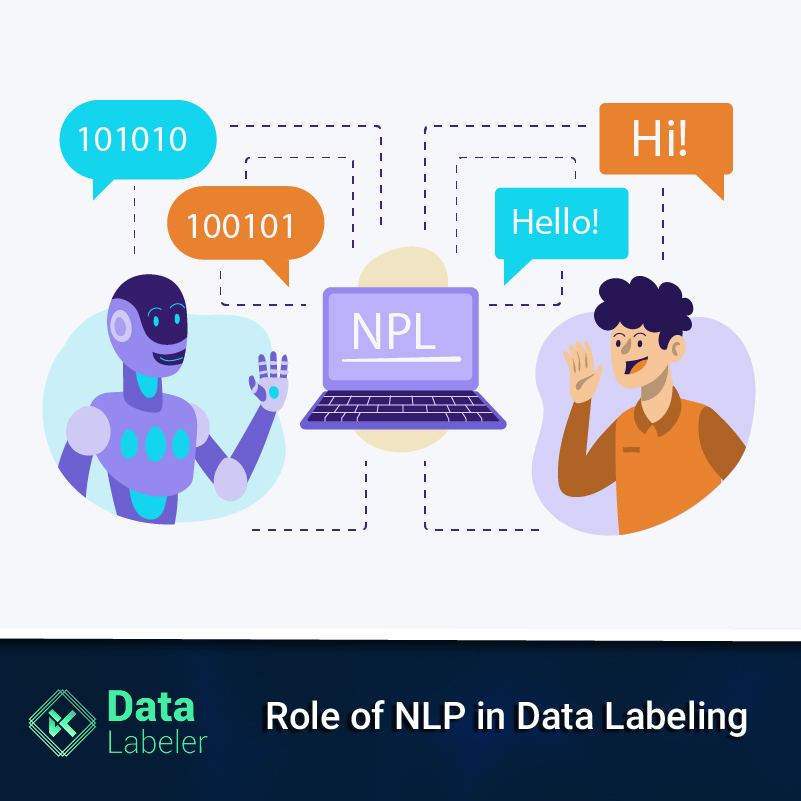
Explore the Complexities of NLP Data Labeling: Challenges and Solutions Unveiled

Text data is ubiquitous these days! While computers find this knowledge difficult to interpret, people can understand it with ease. Natural Language Processing (NLP) is the science that deals with deciphering and learning from textual data. When trying to educate computers to read natural language text data, programmers face some frequent difficulties.

Let’s talk about these challenges in detail and offer some suggestions to help handling NLP easier for you.

  1. Unstructured Data & Big Data

The most frequent problems in NLP are related to big data and unstructured data. Online discussions, tweets, comments, and other forms of data generation produce “big” and largely unstructured data. Processing the data and extracting meaningful information from it is a very difficult task.

The following methods can transform the big data & unstructured data into writing that is helpful or meaningful for machines:

  • Processing of Data – It means removal of unwanted URLs, HTML tags, stop words, numeric and alphanumeric words, punctuation, and special characters. It also includes converting texts into lowercase.
  • Data Standardization – Converting words into standard forms, such as making contractions into full words (e.g., “can’t” becomes “can not”), is known as Data Standardization. 
  • Lemmatization – It is the process of reducing a word to its most basic, meaningful form. For instance, “tries” becomes “tries,”. Thus, the system will treat terms like “tried,” “tries,” and “try” as different occurrences of the same word: “try.” 
  • Word Tokenization – Tokenization is the process of dividing the text into words or phrases. Tokens are these divided units. Tokenization is crucial to NLP since it makes it simple to understand a text’s main ideas through token analysis.
  1. Semantic Meaning of Words

The semantic meaning of words presents another frequent difficulty. Any given language has a fairly large vocabulary, and many words have similar meanings. Thus, those words must be found by machines. Words that frequently occur in the test data but are absent from the training data are used to train an NLP model. As a result, conclusions drawn from test data might not be accurate. 

Machines must be able to comprehend the semantic meaning of words to tackle this issue. The model can interpret unknown words that show up in test data by using the semantic meaning of words it already knows as a base.

  1. Dealing with Spelling Mistakes

Spelling errors are yet another frequent NLP issue. They may make it difficult for the system to comprehend words correctly, which may cause it to miss crucial information from the text.

Numerous factors, such as typos, excessive spaces between letters, or missing letters, can result in spelling errors. When a spelling error is found, one technique used to determine the proper word is Cosine Similarity.

  1. Real-time Data

The speed at which datasets are growing is unsustainable. Fresh data is created every second and existing data is updated instantly. Retraining models repeatedly from scratch for fresh data is challenging. The method known as Transfer Learning saves the day.

Data has become the new oil. Every day it brings with it new opportunities and challenges. Companies, both big and small, are working hard to develop platforms and applications that can comprehend natural language in the same way that people can. These kinds of tactics are part of the basis for the day when we will just talk to all of our devices and tell them what to do.

Data Labeler: Your Companion in Overcoming NLP Labeling Challenges

Data Labeler may be your best ally in overcoming the complexities of NLP Data Labeling if you’re having trouble. Working with Data Labeler gives you the benefit of scale and speed as well as a team that is knowledgeable about the particular difficulties posed by Natural Language Processing. 

Hence, this is the end of your search for the ideal annotated datasets for your advanced NLP models.

For further queries, contact us or request a demo.

Categories
Data Labeling

The Future of Medical Data Labeling: Ensuring Quality for the Healthcare Sector

The market for healthcare data collecting and labeling is expanding significantly as a result of several
opportunities and trends. Decision-making based on data is becoming more and more valuable in
the healthcare sector. To collect, organize, and analyze massive amounts of healthcare data to gain
insights and predictive analytics, there is a rising need for healthcare data collecting and labeling
services.


Have a look at why Labeling Quality Medical Data is Crucial for the Healthcare Sector


Labeling medical data is a necessary step in the training of machine learning models used in the
healthcare industry. Models can learn patterns, anticipate outcomes, and support diagnosis,
treatment planning, and decision-making by accurately labeling clinical texts, medical pictures, and
other data sources. Models can offer insightful information when they can comprehend the context
and meaning of medical data thanks to labeled data.

Improving data analysis:
Labeling medical data makes analysis more effective and efficient. Researchers and medical
practitioners can extract pertinent data, spot trends, and learn more about patient demographics,
disease patterns, treatment outcomes, and other topics by classifying data pieces like symptoms,
diagnoses, prescriptions, and procedures. Data mining is made easier by it, and evidence-based
decision-making is supported.

Facilitating clinical research:
Studies and clinical research benefit greatly from labeled medical data. Labeled data can be used by
researchers to compare treatments, find relationships between variables, and identify cohorts. It
supports the assessment of patient outcomes, the appraisal of interventions, and the identification
of variables influencing the course of a disease or the response to treatment.

Encouraging clinical decision-making:
Correct labeling of medical data facilitates the ability of healthcare professionals to make well-
informed choices. Tagged data helps build decision support systems that can evaluate patient data,
offer suggestions, and enhance clinical reasoning. Utilizing the collective knowledge encoded in the
labeled data, it enhances the precision of diagnosis, planning of therapy, and management of
patients.

Promoting data interchange and interoperability:
Labeling medical data contributes to the standardization and organization of healthcare data, which
encourages interoperability between various healthcare systems. Data can be transferred and
shared more successfully between institutions when standardized labels are used, such as medical
coding systems. This promotes improved population health management, research collaboration,
and continuity of care.

Maintaining patient well-being and treatment quality:
Labeled medical records contribute to both of these objectives. Medication mistakes, negative drug interactions, and allergic reactions can be avoided by accurately labeling drugs, allergies, and patient
histories. It facilitates care coordination, lowers medical errors, and gives medical professionals the
ability to treat patients individually and appropriately.

Standards & Regulations compliance:
In the healthcare industry, it is frequently essential to label medical data to meet standards and
laws. Sophisticated patient information must be properly labeled and protected, as required by
regulations like HIPAA in the US. Accurate billing, reimbursement, and healthcare reporting depend
on adherence to coding and classification schemes.

How Data Labeler Envisions AI and Data Labeling…
The goal of Data Labeler is to make it possible for everyone to benefit from the emerging AI
economy.
We at Data Labeler want to enable communities to earn a living and play a significant role in the
changes that AI is bringing about by offering an all-inclusive platform.
For various AI ML projects in multiple sectors, we assure to provide you with the best quality-labeled
data sets.
Contact us or Request a demo for a detailed discussion!