Categories
Annotation

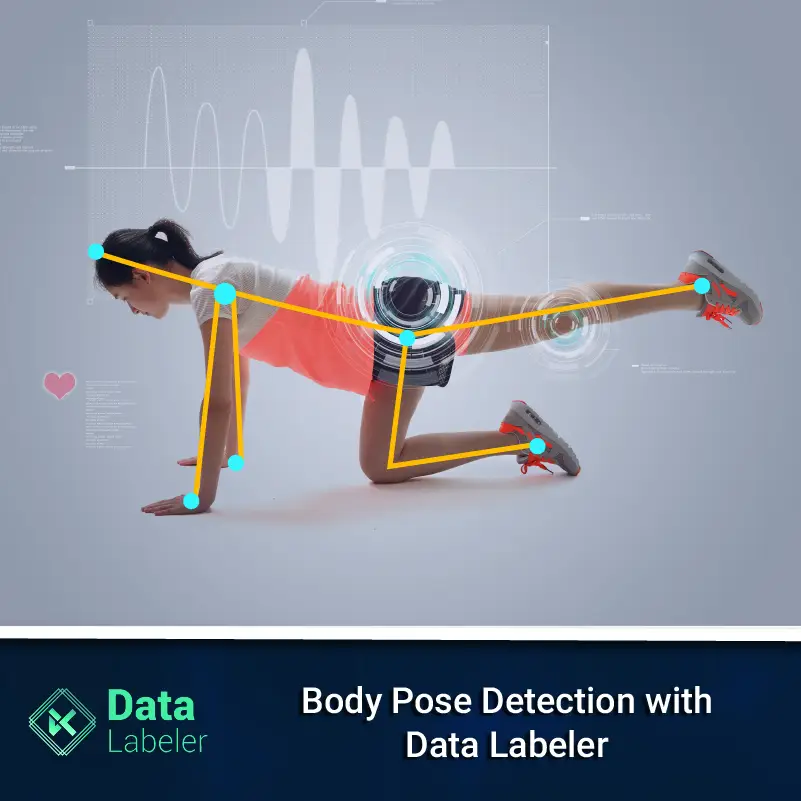
Body Pose Detection via Key Points Annotation has been proven beneficial to business sectors

What possibly could business entities might achieve with the key points annotation approach? 

They can identify particular characteristics or landmarks on objects in pictures or movies. 

It makes difficult tasks like pose estimation, gesture identification, facial expression recognition, and 3D reconstruction possible, in addition to high-precision object detection and tracking.

It offers a thorough comprehension of the form, alignment, motion, and spatial relationships of the objects, which can enhance computer vision models’ functionality and precision and more.

Understanding Human Body Pose Detection which is also known as Key Points Detection

Key points annotation is a technique that allows you to label specific features or landmarks on objects in images or videos. It allows for easy and flexible customization of the annotation schema, depending on the application and the domain. You can define your own key points and skeletons, and adjust the number and location of the points as needed.

So, what is Key Points Detection?

As computing power and resources continue to rise, computer vision tasks like Human Pose Estimation (HPE) and tracking are becoming more manageable. To estimate and track human poses and motions, massive computational resources and highly accurate algorithmic models are required. 

Semantic key points are identified, associated, and tracked in pose estimation. Important features on the face, such as the corners of the lips, eyes, and nose, are prime examples of this. or knees and elbows. Computer vision machine learning (ML) models enable the tracking, annotation, and estimation of movement patterns for people, animals, and vehicles through the use of pose estimation.

How to estimate a human pose via Key Points Detection?

Pose estimation refers to the process by which annotators, machine learning algorithms, models, and systems identify and track the location of a person or groups of people in an image or video by using human poses, orientation, and movement.

It is often a two-step process. To detect and estimate the position and movement of joints and other elements, a bounding box is first constructed, and then key points are utilized.

Deep learning models can identify and examine human body movements and their interactions with the surroundings in movies or photos for additional training thanks to human posture estimation. 

Sectors where Human Pose Detection or Key Points Detection works…

  • Healthcare to examine, diagnose, and treat patient movements during post-injury or post-surgical rehabilitation; to examine gait for neurological and orthopedic evaluations.
  • Sports and fitness to monitor and evaluate exercise form and technique to avoid injuries; to develop virtual fitness coaches for individualized training regimens.
  • To facilitate gesture-based control in virtual reality (VR) applications and video games, entertainment and gaming are included.
  • Retail and e-commerce to boost augmented reality (AR) shopping applications and virtual try-on experiences for apparel and accessories.
  • Systems that enable users to operate technology and gadgets with gestures and body language are being developed using gestures and communication.
  • Improved pedestrian recognition and avoidance in self-driving cars; improved driver monitoring systems to guarantee safety and attentiveness; and much more can be achieved with autonomous vehicles.

Conclusion:

Being one of the best data labeling & annotation service providers in the US, Data Labeler offers distinct key points annotation for human body pose detection

Airports and law enforcement organizations (such as the FBI to look into and update portraits) identify a match by using this model to compare calculations to other faces in their database.

Also, points can be used for face recognition tools and applications, such as smartphone apps that employ facial recognition as a filter or to determine the correct position.

Interested to know more about Data Labeler and our offerings

For further information contact us or request a demo today!

Categories
Artificial Intelligence

Human-in-the-Loop: How Does AI Training Get Better with Human Involvement?

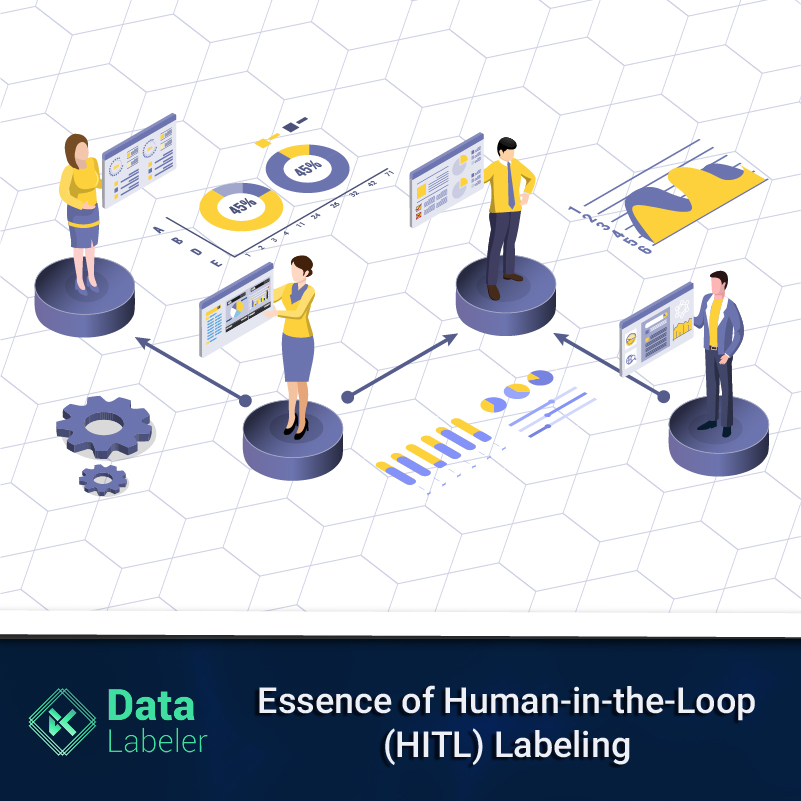
People can verify whether a Machine Learning model’s predictions were accurate or inaccurate during training by using Human-in-the-loop machine learning, or HITL ML.

HITL enables training with information that

  • lacks any labels
  • is challenging to tag automatically
  • continuously changes

Let’s examine this Machine Learning methodology.

How Machine Learning models are trained?

Acquiring knowledge entails being able to reduce mistakes. A child learns that something went wrong when they touch a hot stove because of the heat and subsequently the discomfort. If the child never touches the hot stove again, we can declare that he has learned.

Something similar happens with Machine Learning. Based on a picture of a person’s face, a machine may infer their emotional state. The computer can forecast being neutral, joyful, sad, furious, or enthusiastic. The machine is rewarded if its prediction comes true and penalized if it makes a mistake.

Three elements must be present in the machine learning loop for a machine to learn:

  • The capacity for forecasting.
  • A means of determining the accuracy of the prediction.
  • The capacity to enhance its forecasts.

One of two methods is available to the model to verify the accuracy of its prediction after it is made:

  • Validation data: Verify using a dataset that has already been tagged.
  • Human in the loop: Permit people to confirm or refute the forecast.

It’s this second method that aids Machine Learning with human help.For example, on website login forms, the CAPTCHA graphics are used to verify that the user is human and not a computer. The purpose of these CAPTCHAs is to enable users to tag picture databases. It would be utilizing HITL ML if their stream of annotated photos is directly linked to a Machine Learning model.

The Rationale for Human Involvement in ML

There are various reasons why human-in-the-loop training may be necessary for a machine-learning model.

  • A labeled set of data is absent: If there isn’t already a data set, one needs to be made. One can be made using the Human in the Loop technique.
  • The set of data is rapidly evolving: The model needs to adapt quickly if the environment that the data is meant to represent changes quickly. Models can be kept current with validation datasets from current trends with the use of Human-in-the-loop learning.
  • It is challenging to label the data automatically: Sometimes the only method to identify unlabeled data when it’s difficult to do so automatically, is using a pair of human eyes.

Various Approaches to HITL ML

  • Only the Model is Constructed by Humans

ML models occasionally require pre-training, before deployment. If the goal of the design is to construct the model, you can create simulators that let a model forecast and show that forecast to an observer.

  • The Model is Trained by Humans

When training a HITL model, it is assumed that the model will make poor predictions at first, but it will be gradable by humans. The goal is for the model to begin operating at or above human performance through human judgment.

  • Data is Labeled by Humans

One technique to include people in the creation of a Machine-Learning model is through data labeling. An ML model requires labeled data. (Some datasets have labels applied already.) People must label data for HITL Machine Learning, and a lot of data needs to be classified.

About Us:

We at Data Labeler strive to help organizations free up time and space and become Autonomous Digital Enterprise by providing several AI ML solutions. 

If you are interested in such a venture, feel free to visit our website.We can also be reached at Sales@DataLabeler.com or contact us.

Categories
data annotation

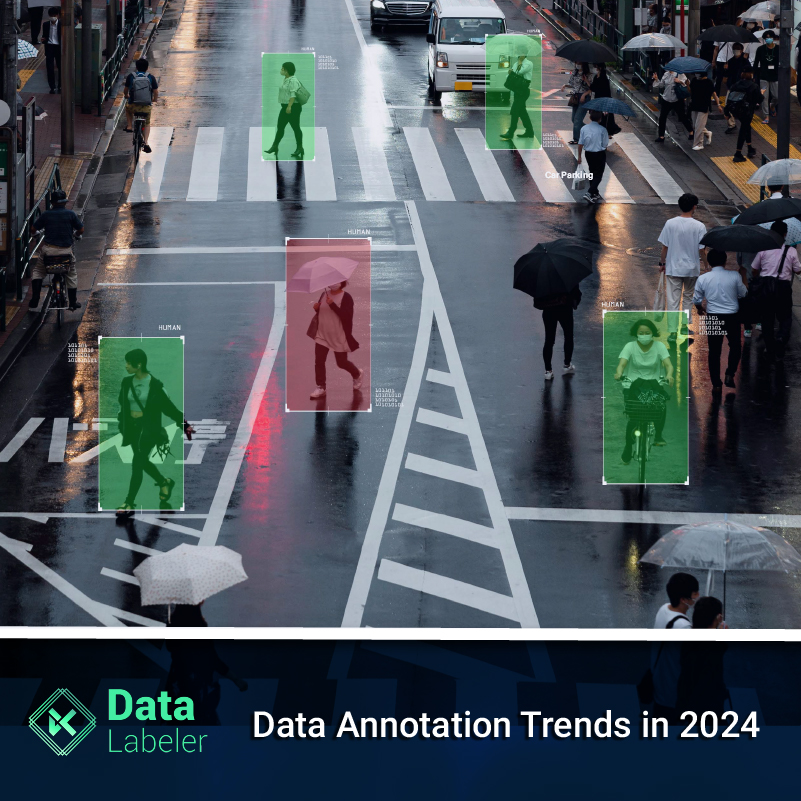
Unveiling the Power of Data Annotation in 2024: The Way for Computer Vision

In the fields of artificial intelligence and computer vision, data annotation is an essential procedure that forms the basis for training machine learning models. Fundamentally, data annotation is classifying or labeling unprocessed data—such as pictures, videos, or text—so that artificial intelligence (AI) algorithms can comprehend and utilize it. This painstaking procedure is necessary to teach AI systems how to correctly understand and react to real-world data, which is the foundation of many AI applications, such as autonomous vehicles and facial recognition.

The importance of data annotation in AI and computer vision has increased significantly as we approach 2024. As technology continues to expand the possibilities of artificial intelligence, there is an increasing demand for precise and high-quality annotations. Not only has there been an increase in the amount, but also in the complexity and diversity of data needed, which has made data annotation an important and constantly changing topic. 

In the rapidly developing field of artificial intelligence, organizations, developers, and researchers must understand since it can improve the precision and dependability of AI systems.

Significant Role of Data Annotation in Computer Vision

The development of computer vision technologies—a major field in artificial intelligence that focuses on enabling machines to interpret and comprehend visual input from the surrounding world—begins with data annotation. To train machine learning models, this procedure entails carefully labeling or classifying pictures, videos, and other visual data. 

Data annotation is a vital ongoing process that continuously improves and expands the capabilities of computer vision technologies, guaranteeing their continued effectiveness and dependability as they develop. It is not merely a preliminary stage in the building of AI models.

Future Trends of Data Annotation in 2024

According to Grand View Research, the global data annotation market was worth USD 695.5 million in 2020 and was predicted to increase at a compound annual growth rate (CAGR) of 26.6% from 2021 to 2028.

  • The Evolution of Data Annotation in Computer Vision: As we approach 2024, data annotation remains a driving force in the field of computer vision. This year has seen tremendous breakthroughs in data annotation technology, thanks to novel techniques and cutting-edge software. These advancements are not only improving annotation precision and efficiency, but they are also altering the workflow of computer vision engineers.
  • Automated and AI-Powered Annotation Solutions: AI is increasingly being integrated into data annotation solutions. AI-powered annotation tools, according to a new study, are likely to reduce manual annotation time by up to 50% while enhancing accuracy. This advancement is critical in dealing with the ever-increasing datasets required for sophisticated computer vision applications.
  • Machine Learning for Better Quality: Machine learning techniques are increasingly being used to improve the annotation process. These algorithms can learn from previous annotations, enhancing the quality and speed of the annotation process over time. This is especially useful in complex settings where high precision is required.
  • Growth of Specialized Data Annotation Services: There is an increasing need for these services. Businesses are looking for services that provide high-quality, domain-specific annotations in addition to volume. The demand for more precise and nuanced data in industries like medical imaging and autonomous driving is driving this development.

Conclusion:

In conclusion, technical innovation, enhanced efficiency, and the growing significance of specialized, high-quality annotations characterize the data annotation landscape of 2024. These developments are not only expanding computer vision’s potential but also having a significant impact on several industries, including healthcare and autonomous cars.

Interested to know more about Data Labeler and our offerings? For further information contact us or request a demo today!
Categories
Annotation

How Does Data Annotation Assure Safety in Autonomous Vehicles?

To contrast a human-driven car with one operated by a computer is to contrast viewpoints. Over six million car crashes occur each year, according to the US National Highway Traffic Safety Administration. These crashes claim the lives of about 36,000 Americans, while another 2.5 million are treated in hospital emergency departments. Even more startling are the figures on a worldwide scale. 

One could wonder if these numbers would drop significantly if AVs were to become the norm. Thus, data annotation is contributing significantly to the increased safety and convenience of Autonomous Vehicles. To enable the car to make safe judgments and navigate, its machine-learning algorithms need to be trained on accurate and well-annotated data.

Here are some important features of data annotation for autonomous vehicles to ensure safety:

  • Semantic Segmentation: Annotating lanes, pedestrians, cars, and traffic signs, as well as their borders, in photos or sensor data, is known as semantic segmentation. The car needs accurate segmentation to comprehend its environment.
  • Object Detection: It is the process of locating and classifying items, such as vehicles, bicycles, pedestrians, and obstructions, in pictures or sensor data.
  • Lane Marking Annotation: Road boundaries and lane lines can be annotated to assist a vehicle in staying in its lane and navigating safely.
  • Depth Estimation: Giving the vehicle depth data to assist it in gauging how far away objects are in its path. This is essential for preventing collisions.
  • Path Planning: Annotating potential routes or trajectories for the car to follow while accounting for safety concerns and traffic laws is known as path planning.
  • Traffic Sign Recognition: Marking signs, signals, and their interpretations to make sure the car abides by the law.
  • Behaviour Prediction: By providing annotations for the expected actions of other drivers (e.g., determining if a pedestrian will cross the street), the car can make more educated decisions.
  • Map and Localization Data: By adding annotations to high-definition maps and localization data, the car will be able to navigate and position itself more precisely.
  • Weather and Lighting Conditions: Data collected in a variety of weather and lighting circumstances (such as rain, snow, fog, and darkness) should be annotated to aid the vehicle’s learning process.
  • Anomaly Detection: Noting unusual circumstances or possible dangers, like roadblocks, collisions, or sudden pedestrian movements.
  • Diverse Scenarios: To train the autonomous car for various contexts, make sure the dataset includes a wide range of driving scenarios, such as suburban, urban, and highway driving.
  • Sensor Fusion: Adding annotations to data from several sensors, such as cameras, radar, LiDAR, and ultrasonics, to assist the car in combining information from several sources and arriving at precise conclusions.
  • Continual Data Updating: Adding annotations to the data regularly to reflect shifting traffic patterns, construction zones, and road conditions.
  • Quality Assurance: Applying quality control techniques, such as human annotation verification and the use of quality metrics, to guarantee precise and consistent annotations.
  • Machine Learning Feedback Loop: Creating a feedback loop based on real-world data and user interactions to continuously enhance the vehicle’s performance.
  • Ethical Considerations: Make sure that privacy laws and ethical issues, like anonymizing sensitive material, are taken into account during the data annotation process.

Conclusion:

An important but frequently disregarded component in the development of autonomous vehicles is data annotation. Self-driving cars would remain an unattainable dream if it weren’t for the diligent efforts of data annotators. Data Labeler provides extensive support with annotating data for several kinds of AI models. For any further queries, you can visit our website. Alternatively, we are reachable at sales@DataLabeler.com.