Categories
Artificial Intelligence

Remote Patient Monitoring & Telehealth Services Evolving with New AI Technologies

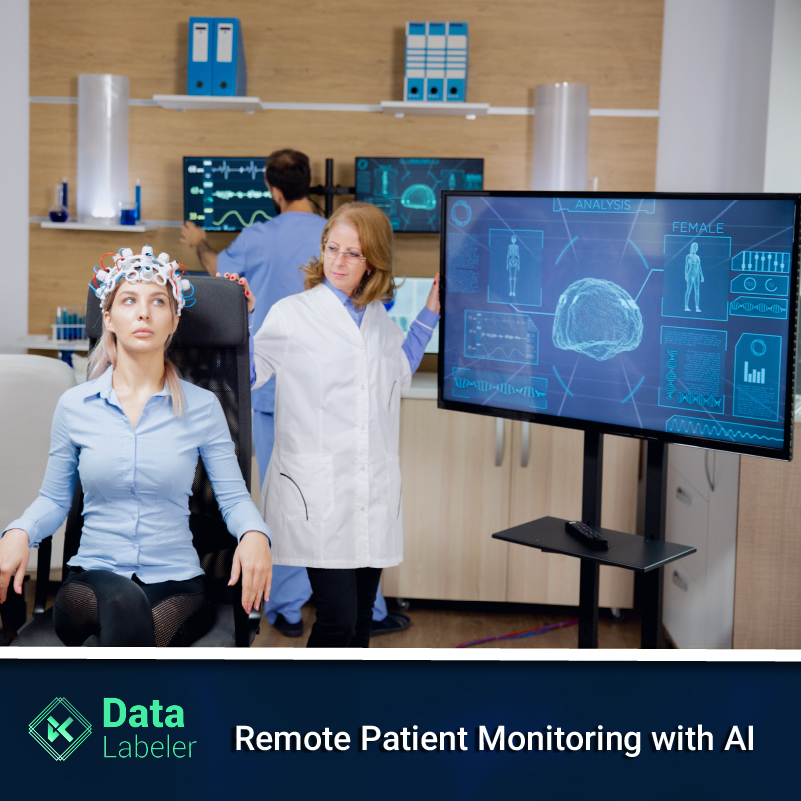
Artificial intelligence (AI) is increasingly being used in healthcare. One of the popular healthcare applications, remote patient monitoring (RPM), helps clinicians keep track of patients with acute or chronic illnesses in far-flung locales, elderly individuals receiving in- home care, and even hospitalized patients. The analysis of medical imagery and the correlation of symptoms and biomarkers from clinical data using artificial intelligence (AI) algorithms have been used to define an illness and predict its outcome.


Instances of AI application in Telemedicine


Artificial intelligence (AI) is already widely employed in healthcare settings and interactions involving health since so many computer technologies and digital platforms used by physicians and patients already have AI capabilities built in. In order to analyze patient data and warn of crises, it is employed in ICU command centers. Patients are monitored by AI-powered gadgets both inside and outside of hospitals. AI helps with patient triage, diagnosis, and treatment planning even in the clinical setting.


Remote patient observation. AI examines a patient’s vital signs and notifies the appropriate parties if any readings are abnormal. AI frequently examines data from heart monitors, blood pressure cuffs, and other medical devices to look for irregularities.


Medical image analysis and patient diagnosis. AI assists physicians in making the most precise diagnosis and correctly interpreting the results of medical imaging by using both individual patient data and bigger sets of historical data.


Plans for treatments. Based on the examination of a patient’s specific profile, AI can tailor the best course of medical intervention.


Patient participation. Chatbots and other AI-driven technology make it easier to provide information, schedule appointments, and manage intake for clinical visits.


Controlling long-term illnesses. AI can assist with patient monitoring, feedback, and alerting to early illness development warning indications.

AI’s contributions to telemedicine


According to reports, healthcare professionals are in favor of using AI. According to a 2019 study by MIT Technology Review Insights and GE Healthcare, 75% of medical staff members who utilize AI say it has made disease prognoses more accurate. Additionally, 79% of medical workers indicated AI has prevented healthcare worker burnout while 78% reported workflow benefits. The majority of respondents also stated that AI frees them up to focus on medical operations rather than administrative work and other similar activities.


Reallocate time from administrative work to health care. Time spent on administrative duties can be diverted from providing direct patient care. These jobs can be completed by AI instead.


Quicken the course of therapy. AI provides insights based on data by rapidly gathering, combining, and analyzing data from various sources. Using this information, clinicians may decide on the best course of action for their patients with accuracy and speed.


Increase the accessibility of healthcare. AI-powered medical technology, such as remote patient monitoring tools, enables doctors to treat patients in rural areas with few or no medical facilities as well as in their homes.


Create more individualized treatment schedules. To identify the best course of treatment, algorithms examine both past data and the unique medical information of each patient.


Handle illnesses and chronic problems. AI is able to generate individualized treatment plans and keep track of patients as they adhere to their regimens.

These advantages have a favorable cumulative effect on healthcare.


“With more precise diagnosis, more efficient treatment plans, and quicker delivery of those services, AI can improve overall patient experience and patient outcomes,” stated Amar Gupta, a research scientist at MIT’s Computer Science and Artificial Intelligence Lab.


AI will be used considerably more in various businesses in the near future. The medical
fields won’t regress in this area. Our professionals at Data Labeler may be your ideal choice
if you’re seeking AI solutions and data labeling. Kindly reach out to us.

Categories
Data Labeling

Agricultural AI: The Future of Farming is here !

After all, even the most fundamental AI was not invented until a few decades ago, whereas agriculture has been the foundation of human civilization for thousands of years, providing nourishment as well as fostering economic growth. Nevertheless, new concepts are being introduced in every sector, including agriculture. Globally, agricultural technology has advanced quickly in recent years, transforming farming methods.


As global issues like climate change, population increase, and resource scarcity threaten the sustainability of our food system, these technologies are becoming more and more crucial. By utilizing AI, many problems are resolved and many drawbacks of conventional farming are lessened.


Data rules the world of today. Artificial intelligence in agriculture can support investigations into soil health to gather information, keep track of weather patterns, and suggest when to apply fertilizer
and pesticides.


Wondering how AI brings in the magic to boost the Agricultural Sector?
Here’s how..


The enhancement of automatic irrigation systems :


Crop management is autonomous thanks to AI algorithms. Algorithms can decide in real-time how
much water to deliver to crops when linked with IoT (Internet of Things) sensors that track soil
moisture levels and weather conditions. An autonomous agricultural irrigation system is made to
promote sustainable farming methods while preserving water.


Detecting disease and pests :


Computer vision can identify pests and diseases in addition to soil quality and crop growth. In order
to discover insects, rot, mold, and other dangers to crop health, AI is used to scan photos. Together
with alert systems, this enables farmers to take swift action to eradicate pests or quarantine crops to
stop the spread of disease.
Apple black rot has been successfully detected by AI with a 90% accuracy rate. It is equally accurate
in identifying other insects, such as flies, bees, moths, etc.


Monitoring of crops and soil :


The health and growth of crops can be significantly impacted by the incorrect balance of nutrients in the soil. Farmers may quickly make the necessary modifications by identifying these nutrients and evaluating how they affect crop productivity using artificial intelligence.


While the accuracy of human observation is constrained, computer vision models can monitor soil conditions to collect precise data. The health of the crop is then assessed using data from the study
of plants, and yields are predicted while specific problems are noted.


Application of pesticides using intelligence :


Farmers are already aware that there is room for improvement in pesticide use. Unfortunately, there are significant drawbacks to both human and automated application processes. While manually applying pesticides might be slow and laborious, it allows greater precision in aiming at specific locations. Although automated pesticide spraying is faster and less labor-intensive, it frequently lacks accuracy, contaminating the environment.


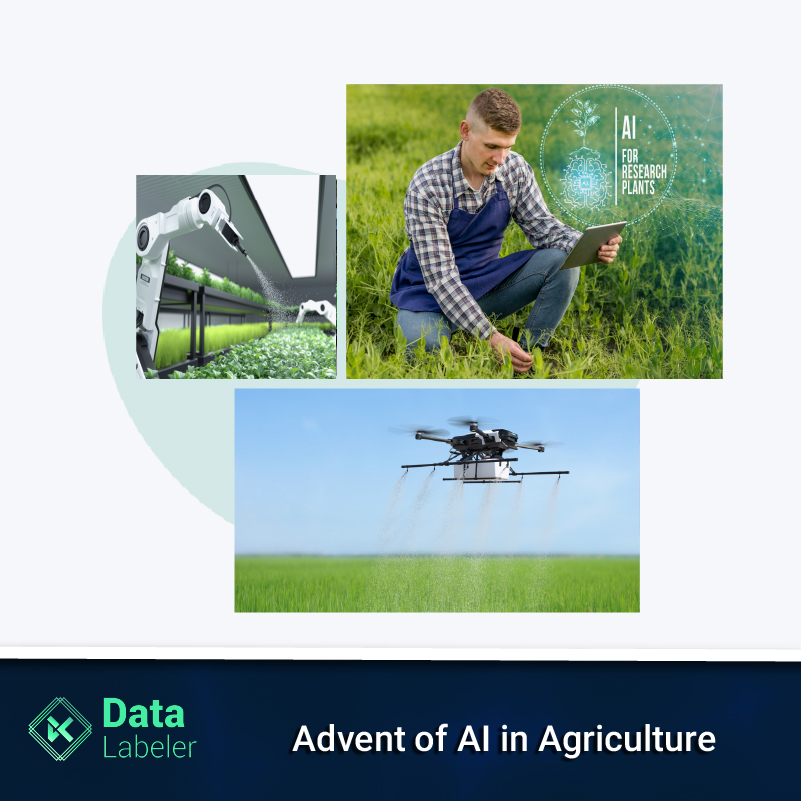
Drones driven by AI offer the best benefits of each strategy while avoiding their disadvantages.
Computer vision is used by drones to calculate how much insecticide should be applied to each
region. This technology is still in its infancy, but it is developing quickly.

Keeping track of livestock health :


Although it may appear simpler to identify health issues in cattle than in crops, in reality, it can be
very difficult. Thank goodness, AI can assist with this. Drones, cameras, and computer vision are all
used in a method developed by AI applications to remotely check the health of livestock. It
recognizes actions like giving birth and recognizes unusual behavior in cattle.


In order to assess the effects of nutrition and environmental factors on livestock and to offer useful
insights, AI and ML solutions are used. Farmers can use this information to better the health of their
cattle in order to increase milk production.


Automatic harvesting and weeding :


Computer vision may be used to identify weeds and invasive plant species, much like it can identify pests and illnesses. Computer vision examines the size, shape, and color of leaves in conjunction with machine learning to discriminate between weeds and crops. Robots that perform robotic process automation (RPA) activities, like autonomous weeding, can be programmed using such systems. In reality, a robot of this kind has already been employed successfully. Smart bots may eventually be able to completely weed and harvest crops as these technologies become more widely available.


While AI in agriculture has many advantages, it is unable to work without other digital technologies
like big data, sensors, and software that are already in use. Similar to how AI is required for other
technologies to function successfully. The data itself in the case of large data isn’t all that valuable.
What matters is how it is handled and put into practice.


About Us:


Over the next few years, AI will undoubtedly play a bigger part in agriculture and food sustainability.
Searching for AI implementation strategies for your farming operations? Data Labeler can be best
option for you. Let’s discuss.


Contact our data labeling specialists to take the next significant step toward a sustainable future.

Categories
Artificial Intelligence

What major role does Artificial Intelligence play in US National Security?

The national security landscape is being quickly altered by artificial intelligence (AI). Nations
are relying more and more on AI to protect their interests in a time when technology is a
central part of our lives. The importance of striking a balance between innovation and
security is explored in this blog, which digs into the relationship between AI and national
security.


Artificial intelligence’s (AI) effects on the national security of the United States cannot be
overstated in this constantly changing technological environment. AI has enormous
potential but also raises serious safety and security issues as it develops at an
unprecedented rate. AI is altering the national security scene in ways we never believed
were feasible, from military applications to cybersecurity.


AI’s Growing Role in National Security


Formerly only found in science fiction, artificial intelligence has emerged as a crucial
instrument for maintaining national security. Governments all across the world are utilizing
AI to improve their infrastructure for security, intelligence gathering, and defence.
AI-Powered Surveillance: Protecting Privacy while Providing Security


The trade-off between security and personal privacy is critically questioned by the
incorporation of AI in surveillance systems. Authorities can monitor possible threats more
efficiently thanks to advanced facial recognition and monitoring technologies, but these
tools also put our ideas of personal freedom to the test.


Using AI to Protect Against Digital Threats in Cybersecurity


Cyberattacks are a danger to national security in a connected society. AI is leading the fight
against these dangers, using machine learning algorithms to quickly identify and respond to
cyberattacks.


Concerns with Ethics and Strategy for Autonomous Weapons


AI-powered autonomous weapons development raises moral and tactical concerns.
Although these weapons can reduce the number of human casualties, worries about their
possible abuse and lack of human control are quite real.


How does Artificial Intelligence play a crucial role in US National Security Systems?


The US is making significant investments to create “next-generation air dominance”
technologies, which may include drones and sixth-generation fighters. Examples include AI-

based initiatives like Project Maven, the Squad X Experimentation program run by the
Defense Advanced Research Projects Agency (DARPA), and the OFFSET program, which has
been effectively used to detect rebels in Iraq and Syria. 


Other applications that the US is successfully developing and implementing include
cyberspace operations, autonomous vehicles like the Loyal Wingman program (autonomous
F-16), RCVs, and swarm drones. Military logistic software is one example (IBM Watson
software for predictive maintenance of aircraft and Ground vehicles—Stryker fleet). Federal
attempts to identify individuals, collect geolocation data, and analyse signals and adversary
communications for high-value information are supported by AI-enabled software and AI,
respectively.


In 2018, the US published its National Defence Strategy, which listed AI as one of the crucial
technologies that will guarantee future US warfighting and victory. In its 2019 AI Strategy,
the US declared that “it is paramount for the US to remain a leader in AI, to increase its
prosperity and national security.”


Conclusion:


AI development will gradually increase the hazards, difficulties, and opportunities in terms
of national security. AI has a revolutionary potential for the military because it can be used
to automate weapon systems and improve cyberwarfare. Numerous AI-enabled
technologies are available with both state and non-state actors due to their dual-use nature,
which is a worry for preserving strategic stability and deterrence. The creation of a healthy
AI ecosystem faces substantial problems in the areas of governance, ethics, data bias, and
legislation.


If you too are working on some AI project and if you’re looking for the best Data Labeling services,
please feel free to reach out to us!

Categories
Data Labeling

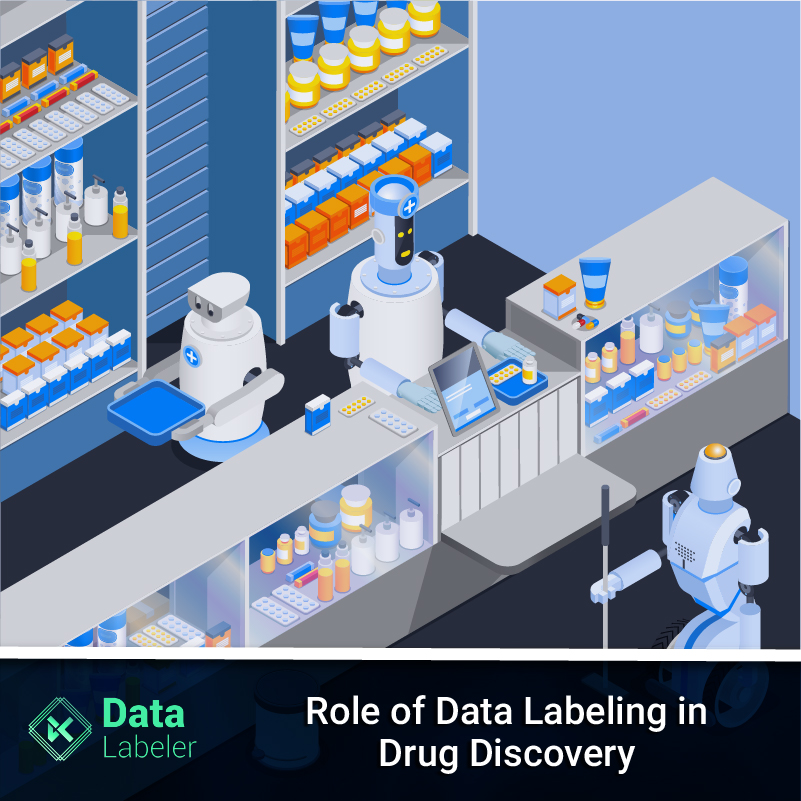
Data Labeling In Pharma Industry

How AI / ML & Data Labeling are accelerating the Drug Discovery
process?

The FDA (Food and Drug Administration) acknowledges the growing usage of AI/ML throughout the drug development life cycle and in a variety of therapeutic areas. In fact, the FDA has noticed a notable increase in the quantity of medication and biologic application submissions employing AI/ML components in recent years, with more than 100 applications recorded in 2021. These contributions cover the entire spectrum of pharmaceutical development, including drug discovery, clinical research, post-market safety surveillance, and advanced pharmaceutical manufacturing.

Data Labeling in Drug Discovery

The pharmaceutical industry is increasingly utilizing Machine Learning and Data Labeling in several areas, including Drug Discovery, which has improved the sector as a whole. The growing number of businesses whose business models depend heavily on Data Labeling is evidence of the technology’s success. Major pharmaceutical corporations have also looked into using the same techniques for drug development.


The capabilities of Data Labeling and their value in the field of Drug Discovery, they must be incorporated into any future developments in this area. The goal is to apply high-throughput screening technology to minimize the asset and work seriousness of drug disclosure. Data Labeling may one day eliminate, at least substantially reduce, the necessity for live animal testing. These results demonstrate the value of machine learning as a method for discovering novel medications.

Data Labeling throughout a Pharmaceutical product’s lifespan

Data Labeling can help with rational drug design, support decision-making, identify the best course of treatment for a patient, including personalized medicines, manage the clinical data generated, and use it for future drug development. Hence, it is quite reasonable to assume that it will play a big role in the development of pharmaceutical products in the upcoming period.

Future scope of Data Labeling in the Pharma industry

Data Labeling’s key potential in the pharmaceutical sector is to lower costs and boost productivity. Numerous studies have shown that dynamic learning may distinguish Data Labeling models with a high degree of accuracy while using half or less information than conventional AI and information subsampling techniques. 


It seems that less repetition and predisposition, as well as acquiring more significant knowledge to overcome decision restrictions, are critical factors in this greater execution. As a result, screening costs seem to be lowered by as much as 90% without accounting for the anticipated mechanical overhead for actually carrying out dynamic learning activities.

How Data Labeler can help with the best Data Labeling services?

  • By creating the datasets required to power your algorithms, Data Labeler aims to provide a
  • crucial service that enables businesses to concentrate on their primary AI/ML activities.
  • Below are the data labeling services and data annotation provided by us.
  • Bounding Boxes for Object Detection
  • Polygons for Semantic and Instance Segmentation
  • Points for facial recognition and body pose detection
  • Texts for image captioning
  • Select for image classification
  • Multi-Select for more complex image classification


For further information, please contact us.