
Categories
Annotation Artificial Intelligence Artificial Intelligence Services Bounding Box Computer Vision Data Labeler Data Labeling Deep Learning Image Captioning Image Classification Machine Learning Machine Learning and Deep Learning Machine learning service Natural Language Processing Natural Language Processing and Deep Learning others Points Polygon

Autonomous Vehicle Technology Data Annotation

Vehicles that are autonomous or semi-autonomous are equipped with a variety of technology that significantly improves the driving experience. The existence of several cameras, sensors, and other systems makes this possible. A tonne of data is produced by all of these elements. The Advanced Driver Assistance Systems(ADAS), which relies on computer vision, is one such instance. It makes use of a computer to understand the visuals at a high level and warn the driver by helping him make better decisions by assessing various situations.

Why is annotation used?

The numerous sensors and cameras found in modern vehicles generate a lot of data. These data sets cannot be used effectively unless they are correctly labeled so that they can be processed further. In order to create training models for autonomous vehicles, these data sets must be employed as a component of a testing suite. The data can be labeled using various automation methods because doing so by hand would be incredibly laborious.

Data annotation and AV safety

We are contrasting viewpoints when we contrast a computer-driven car with a human-driven car. The National Highway Traffic Safety Administration in the US estimates that there are more than six million auto accidents each year. In these collisions, more than 36,000 Americans perish, and another 2.5 million end up in hospital emergency rooms. Even more astounding are the figures on a worldwide scale. Annotation can be done using polygons, boxes, and polylines. Different modes namely interpolation, attribute annotation mode, and segmentation among others.

Types of data annotation

Data annotation is the process of tagging or classifying objects captured in a frame by an AV. Deep learning models are fed with this material that has been further curated, manually labeled or tagged, or both. In order for AVs to learn to see patterns in data and effectively classify in order to make the best conclusion, this approach is necessary. In

order to get the best possible data, it is crucial to use the proper type of annotation. Some of the various data annotation kinds for AVs are as follows:

The future

Driverless cars are already on some highways, altering transportation as a result of the tremendous improvements brought on by the push for AVs. Innovative thinkers will always need access to high-quality, affordable data to advance at this rate. We have a huge chance to work with people, processes, and technology to deliver the greatest datasets as data annotation experts. Data annotation suppliers and developers must innovate to address edge circumstances and create data-driven systems that are impenetrable and perceptive if AVs are to become a mainstream reality.

About Data Labeler

By leveraging the advanced tools and technologies, Data Labeler offers best-in-class data labeling services in computer Vision projects. We at Data labeler believe in providing jobs to underserved communities and making them financially independent. We are on a mission to help them earn a living through the major changes brought by AI & ML, empowering businesses all over the world.

Increase your competitive advantage with unlimited support and exponential growth through our Data Annotation Services.

Categories
Annotation Artificial Intelligence Artificial Intelligence Services Bounding Box Computer Vision Data Labeler Data Labeling Deep Learning Image Captioning Image Classification Machine Learning Machine Learning and Deep Learning Machine learning service Natural Language Processing Natural Language Processing and Deep Learning others Points Polygon

Picking the way to a better asparagus future with robotic harvesting

Fruits are picked automatically by a harvesting robot under specific climatic conditions. Machine vision research based on harvesting robots is still in its early stages. The growth of artificial intelligence technology has made it possible to gather and interpret 3D spatial data about the target.

One of the most often used robotic applications in agriculture is harvesting and picking due to the accuracy and speed that robots can achieve to increase yields and decrease waste from crops left in the field.

Agriculture is already highly mechanised and automated. In fact, the sector has decreased to less than 2% of the labor force in the U.S., which is undoubtedly a result of the development of machines. And harvesting is included in that. The machine learning model can sense its environment, form opinions, and respond in another way thanks to data labeling services.

Harvesting Robots Are Making Big Leaps at the Right Time

For the asparagus sector, which now relies mainly on labor-intensive manual plucking of asparagus, robotic harvesting will be a game-changer. It is tough to find individuals to undertake the task because an average picker walks 10 kilometers daily. Access to a commercial robotic harvester will also significantly reduce expenses and ensure that we can keep serving locally grown, fresh asparagus on our plates.

Use automation to reduce your labeling time

It goes without saying that a lot of data is needed in order to create and maintain an effective ML model. However, labeling training data from scratch can take a lot of time, requires professional labeling and review teams, and quickly add up in cost, especially for organizations still working to establish best practices. It can be difficult to effectively accelerate the data tagging process. Automation is helpful in this situation. One of the best methods to quickly produce high-quality data is incorporating automation into your workflow.

Labor accounts for 50% of the cost of growing asparagus. In the 1980s and 1990s, asparagus exports were booming, but because of rising expenses, particularly for labor, exports have nearly completely ceased. Given that farmer returns have been declining, no investments have been made in the future of the sector. Advancing the

project to a commercially available asparagus harvester will help increase grower returns and exports

About Data Labeler:

By leveraging the advanced tools and technologies, Data Labeler offers best-in-class data labeling services in computer Vision projects. We at data labeler believe in providing jobs to underserved communities and making them financially independent. We are on a mission to help them earn a living through the major changes brought by AI & ML, empowering businesses all over the world.

Increase your competitive advantage with unlimited support and exponential growth through our data annotation services.

Categories
Annotation Artificial Intelligence Artificial Intelligence Services Bounding Box Computer Vision Data Labeler Data Labeling Deep Learning Image Captioning Image Classification Machine Learning Machine Learning and Deep Learning Machine learning service Natural Language Processing Natural Language Processing and Deep Learning Points Polygon

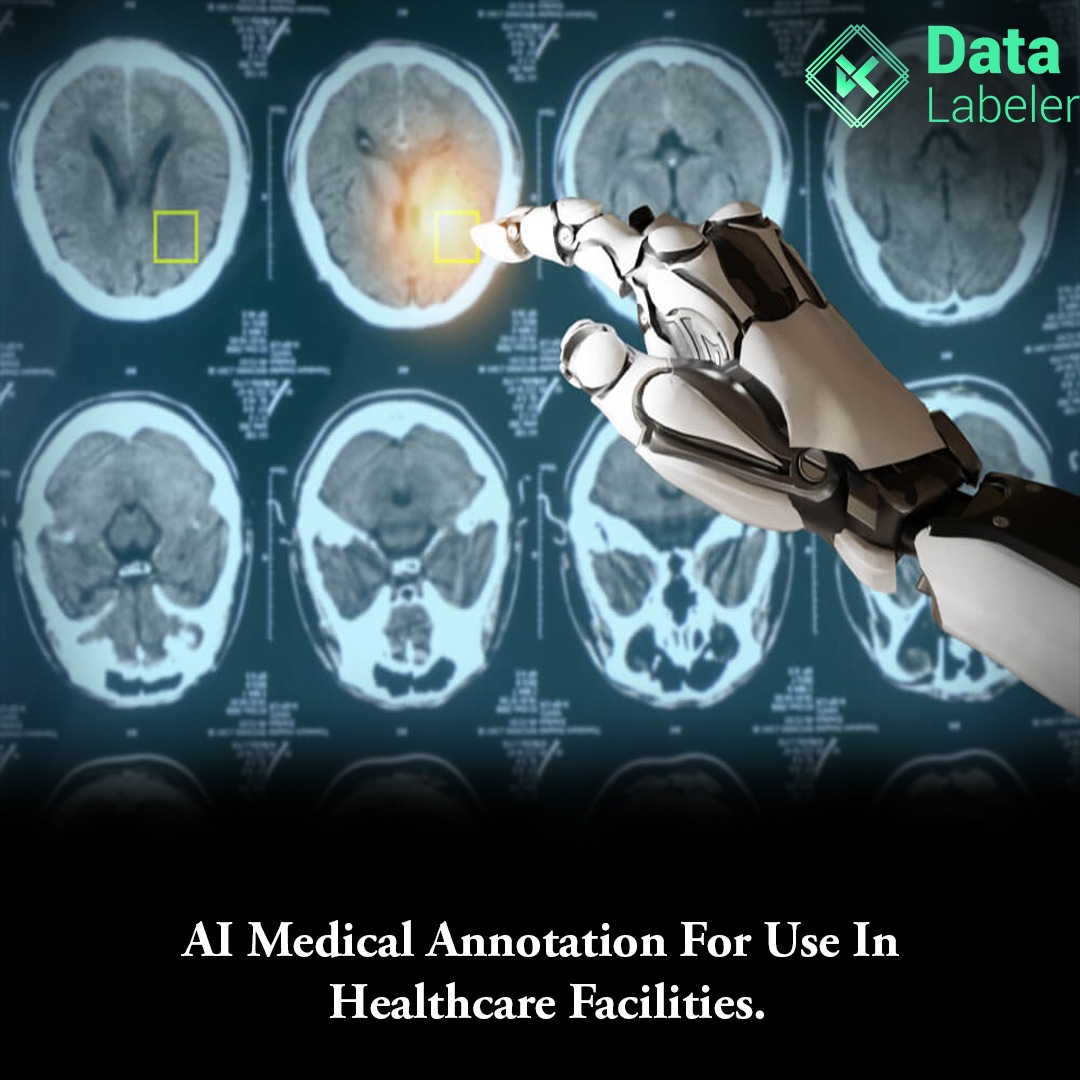
AI Medical Annotation For Use In Healthcare Facilities

Artificial intelligence (AI) is becoming essential in many, if not all, projects where healthcare is offered offline or online. Despite the variety of situations, each has particular requirements. There are examples of AI deployment and use in the healthcare delivery system, however, there is little proof that using AI tools in a clinical setting leads to better outcomes or processes.

In clinical settings, AI can be effectively implemented with accurate medical annotation to engage patients in a thoughtful manner. Clinical data transformation and manipulation techniques and tools have advanced steadily and significantly, and increasingly sophisticated data sources have given rise to unique AI applications in some healthcare contexts.

1.      AI to Improve Software as a Medical Device in Traditional Clinical Settings

Giving advice or clear instructions regarding a diagnosis or prognosis at medical institutions, specifically at the point of service, is referred to as a decision support procedure. AI-powered automation can completely alter the landscape when it comes to implementing effective, safe, and efficient interventions in conventional healthcare facilities. With its unstoppable potential, artificial intelligence can revolutionise traditional healthcare settings by automating medical imaging, diagnosis, and surgical processes.

Software as a Medical Device, which has a high scope of integrating medical data annotation for high-quality clinical training data development, can provide cloud-based automated systems for measuring, monitoring, and managing every clinical process and procedure in healthcare practice. Cloud-based automated systems can be provided by Software as a Medical Device (SaMD), which has a large scope for integrating medical data annotation for the development of high-quality clinical training data and can measure, monitor, and manage every clinical process and procedure in healthcare practice.

2.    Healthcare Data Processing and Management

The amount of clinical and scientific data produced by experts has recently become overwhelming for practitioners. Overwhelmed by information, healthcare professionals

get unsatisfied and medical mistakes are more likely to happen. Despite developments in clinical cognitive science, such as the comprehension of how medical information is regularly evaluated during the provision of treatment and how this knowledge might be conveyed to improve the workflow, this understanding has not yet been implemented in practice.

There have been significant improvements in the medical image annotation techniques for some time with the advancement in AI training data development technologies.AI is therefore anticipated to alter the entire healthcare system with precise and appropriate data management through AI integration, speeding up not only healthcare delivery with fast-paced data processing.

3.     AI Programs That Pay Attention to Patients’ and Caregivers’ Needs

Applications for patients and caregivers integrate the provision of healthcare with open-source hardware and software. In essence, it refers to the space where patients and caregivers can use programs and equipment directly. Tools and software in this area facilitate patient engagement with health care delivery systems. Smartphones and mobile applications have revolutionised patient participation, engagement, and reminders, particularly in the healthcare industry. These applications could possibly make it easier to communicate fresh, crucial information to healthcare professionals in addition to making recommendations for treatment, facilitating risk classification, and averting consequences linked to chronic conditions.

Access to high-quality medical datasets and the availability of accurate medical image and video annotation services are likely to break the traditional boundaries of tasks now performed during face-to-face appointments.

Conclusion

Face-to-face encounters with patients can be viewed as the foundation for a substantial portion of the delivery of health care. A complex network of people and services is needed to provide direct care, and they frequently produce and use a lot of data. Lab tests, pathology, and radiography are the most often used diagnostic techniques. As a result, they produce clinical information, such as detailed imaging, as well as interpretations and treatment suggestions that need to be well explained to patients and providers.

About us

If you are looking for accurate data labeling, real-time labeling, guidance on labeling, and a distinct workforce management software. You are just at the right place.

We at Data Labeler offer the best customized labeled datasets for your Artificial Intelligence

and Machine Learning Projects.

Categories
Annotation Artificial Intelligence Artificial Intelligence Services Bounding Box Computer Vision Data Labeler Data Labeling Deep Learning Image Captioning Image Classification Machine Learning Machine Learning and Deep Learning Machine learning service Natural Language Processing Natural Language Processing and Deep Learning

The 6 essential techniques for AI teams to hasten up the creation of AI data

A survey revealing that 85% of AI projects fail to deliver on their promises to businesses highlights the significance of AI project management, or more specifically, managing AI initiatives.

The management of an AI project is distinct from the management of a regular software development project because AI projects are unique. This essay discusses 6 essential aspects that can help you better your management of AI projects in order to aid in the process.

1: To manage AI projects successfully, be aware of how AI insights will be applied.

Even while it may seem clear to understand the issue at hand, the data that could be helpful to construct a predictive model, and how that model would be used inside the business, teams frequently struggle in this area. In fact, a lot of teams immediately start talking about utilising machine learning services to create a certain model with a particular set of traits.

An essential consideration that should not be ignored is taking the time to step back and comprehend the actual organisational or commercial difficulty that could be resolved with the help of an AI or labeling in machine learning solution. The team will be able to properly brainstorm and prioritise the entire spectrum of tasks in this context is provided (e.g., what data might be useful, what to predict, and how to analyse if an AI predictive model is useful).

2: Be familiar with the project’s conceptual design for AI.

It is useful to think of the system as three major, interdependent parts while developing an AI solution. There is a front-end component (such as a user interface) and a back-end component, just like with software systems (e.g., store and access data). However, ML is also a part of AI systems (e.g., generate and use predictive models).

For instance, a recommendation system, like those used by Amazon or Netflix, comprises a front-end component that displays the user interface and a back-end component that keeps track of various users (e.g., movies that you might want to watch). The movie suggestions are produced by the ML component.

We might only display the most well-liked episodes or prior movies the user has seen for a “regular” software system. The front-end user interface would receive this kind of data from the back-end. However, machine learning algorithms are crucial for predictions (such as what the individual would wish to watch)!

3. Know the project management and execution life cycle you’ll employ for AI projects.

Fewer resources are accessible to assist you to comprehend the life cycle needed to design a machine learning predictive model, despite the fact that numerous publications explain the SDLC (software development life cycle). At a high level, the group will have to repeat the following procedures:

  • Understand the business problem and the that might be data available
    • Clean and “munge” the data
    • Use Machine Learning to build a predictive model
    • Deploy the model
    • Observe and analyze how the model performs

4. Be able to coordinate between and among the teams working on your IT and AI projects.

Although knowing how to develop a predictive model is helpful, there needs to be a procedure to coordinate efforts both within an AI/Data science endeavor and across the team. The Scrum and Data-Driven Scrum frameworks both outline how the team might operate in an agile manner, with brief work iterations and meetings after each iteration to discuss lessons learned, suggest next steps, and prioritise potential future work.

5. Understanding when and how to grow the solution

It is usually advisable to begin small and then build up the solution over time. The data science/ML team shouldn’t be “throwing the code over the wall” to an IT DevOps team in order to achieve this gradual scalability. The DevOps team must collaborate with the

data science team.It is important to consider how the group will provide “machine learning operational support” as a whole at the beginning of the project and to make adjustments as the project grows in usage.

6. Active AI project management can be used to investigate potential model bias.

Model bias can result from using a training dataset that is not completely representative of the population where the model will be employed. This bias could, for instance, result from not receiving the complete spectrum of applicants. The team should consider where bias might be introduced and how to limit any potential bias, even though it is challenging to completely eradicate bias.

About Us:

Data labeler aids various AI and ML initiatives. With an efficient workforce management team, we have vivid experience in creating high-quality and personalized labeled datasets according to your requirements.

If you’re looking for an integrated data labeling platform or data annotation services

contact us now.