Categories
others

Camera Manufacturers are making the best use of Computer Vision

One of the most advanced and powerful kinds of artificial intelligence is computer vision and we have already experienced it in various ways in our life. Computer vision is the field of computer science that focuses on mimicking various parts of complex human vision systems which enable computers to process and identify objects in images and videos in the same way that any human can do and computer vision today is working at various levels.

Why is Computer Vision Sky-rocketing?

With recent advances in the artificial intelligence sector and innovations and the deep learning and neural networks, the field has been able to take great leaves in the last few years which have been able to separate humans in various tasks related to object detection and labelling.

Another reason behind the growth of computer vision is the massive data which fish and rate every day and then is used for training and making computer vision better. The field of computer vision is expanding with various hardware algorithms so is the accuracy rates of object identification in less than a decade.

Present-day systems have reached 99% accuracy from 50% in making them more appropriate than humans at quickly interpreting visual inputs. Combined with computer vision cameras have become constant reliable sources of data that helps us solve various problems in our day to day life.

How does computer vision work in a camera?

There’s a strong relationship between how our brains work and how we can approximate that with our algorithms of machine learning. The reality is that there are fewer working comprehensive theories of brain computation although neural nets are supposed to mimic how the human brain works.

The same paradox holds the truth of computer vision and how the brain works and processes images that are difficult to approve and how well the algorithms are used in the production of internal processes.

Computer vision is all about recognizing the battles so one way to train a computer is how to understand visual data or to feed the images lots of images, massive data sets required which has to be labelled and then the subject goes to various software techniques or algorithms that will allow the computer to hand down the patterns in various elements that relate to those levels.

Camera Manufacturers are taking the help of Computer Vision for making better products:

  • Advanced camera technology provides observations that recognize objects and motion also and at the same time provides deep insights into the situations or behaviours.

For instance, if you feed a computer with a million images of a dog it will subject them all to algorithms that let them analyse the colours, photo shapes and distances between the shapes on the borders with each other which identifies the profile of what a dog means. And when it is finished the computer will be able to use the experience on other images to find the ones that are of a dog.

  • As technologies are evolving, so is the camera technologies. Customer demands have become more sophisticated and camera manufacturers are trying to make the best use of AI and computer vision in their service offerings.

For instance, monitoring life stocks for farmers with Optical Sensors for detecting invincible hazardous gas leaks with infrared capabilities, all began with cameras and computer vision models. Camera manufacturers today build, train and deploy computer vision models to meet customer needs for valuable and actionable insights. Also, if the businesses want to recognize their workplace risks such as equipment proximity to workers or hazardous materials to consumers that need to recognize visitors, monitor backwards track pets, etc.

Conclusion:

Camera manufacturers are meeting ever-increasing visual world demands seamlessly. Now hence, the smart camera market is growing at a rate of 19.17%, according to a report released by Verified Market Research. This means that consumer demands in both industrial smart camera markets as well as consumer demands are at an all-time high now.

Data Labeler is the best place for high-quality personalized labeled data sets.

We perform accurate data annotation that might be difficult when you don’t know what you’re looking for.

Contact us to know more – sales@datalabeler.com

Categories
Data Labeling

Outsourcing Data Labeling and Annotation Service

Everything you should know about outsourcing Data Labeling and Annotation Service

The global data labeling market size was estimated to reach 1668.7 million USD by 2028. The market is also expected to surge in the adoption of the technology owing to the benefits of data labeling and data annotation services. A data annotation technique is used for making objects understandable as well as recognizable for machine learning models. It is critical for the developing machine learning industries like face recognition, aerial drone, autonomous driving, and other robotic applications.

The data annotation sector is led by the increasing growth of the AI industry. Presently, the commercialization of AI has reached the peak of basic maturity in computing algorithms. Hence, to cater efficiently data annotators have to reach the specific pain points in the industry.  

Advancement of Data Labeling and Annotation Market

Today, data determines the success of AI implementation, and data products in the future are highly customized data services that would become mainstream of the industry’s advancement.

After years of development, the data annotation industry has begun flourishing with massive growth. With the continuous expansion of the labeling market, there is an increased number of participants as well as competitors as hyped the data labeling and annotation market. With the improvement of the technical threshold, increased labor costs, changing demands of AI enterprises will face increasing cost pressure.

The Massive Industry Competition

There is a continuous extension of the market; there is a low entry threshold and increasing human resources. Today lots of small or medium-sized data service providers are clustered in the industry. And given the latest data, in the next two years, the industry is likely to usher in a wave of the shuffling period.

AI companies also put a lot of effort into offering new requirements for data service suppliers. The refinement, quality, and personalized data services are more popular demands. While on the supplier side, technical strength, aligned management, and more have brought new challenges.

Addressing the Customer Pain points is Challenging

The Data Annotation industry relies on high dependence on humans. Most data annotation services revolve around data classification, picture frame, annotation, and creating tags with certain labeling tools. But, due to inaccuracy data labelers do not encourage human-machine cooperation capability.

How to go for outsourcing Data Annotations services?

Machine learning projects usually need thousand of images and texts to be annotated and hiring a team must be very costly. It is much better to spend on core functions. Hence, outsourcing your data annotation projects empowers you to get more annotation work at a much less price. And joining hands with an experienced service provider will guide you through the implementation process. They also offer best-practice insights as they have many years of expertise in actualizing data annotation projects.

Let’s look at the five best benefits of outsourcing data labeling and annotation works

– Helps you cut down your budget

– High-quality annotation work

– Improved time management

– Better scalability

– Efficient data security

If you’re interested in Outsourcing Data Labeling and Annotation Services, Data Labeler is your go-to guy!

Data Labeler is the best place for high-quality personalized labeled data sets.

We perform accurate data annotation that might be difficult when you don’t know what you’re looking for.

Contact us now for more information – sales@datalabeler.com

Categories
Artificial Intelligence

How to bring in training data for your AI and ML Projects?

Are you too deciding on investing in Artificial Intelligence for your organization? And you have already identified a use case as well as a proven ROI? That’s great. However, you do not have a dataset ready, do you? Most brands are struggling to build an excellent AI-ready dataset, but it is not rocket science. With the best-proven ideas, you could easily begin building your data set.

Let’s discuss what is a Dataset:

A Dataset is a collection of data that corresponds to the contents of a single database table or a single statistical data matrix. In a dataset, every column of the table represents a specific variable where each row corresponds to the respective member of the data set.

Therefore, in Machine Learning projects, we need training data set. And it is crucial to train your data sets for utilizing the model for performing several actions.

Why you need data set?

Machine Learning depends on data massively, without data Artificial Intelligence cannot learn. It is the significant aspect that makes algorithm training possible. No matter how great your AI team is your project might fail.

Here are three simple ways to get started with training data for your AI or Machine Learning Models:

  1. Free Sources 

Free sources provide datasets for free. And there are multiple directories, portals, search engines, forums, and websites to source your datasets. These sources might be archives, public, or data that have been made public after several years with explicit permissions. Have a look at these sources for your quick reference

  • Kaggle: It is an important resource for data scientists and Machine Learning experts. These data sets are of good quality available in multiple formats and also easily downloadable
  • Public and Government Datasets: These are some of the prominent resources offering datasets from the industrial sector like agricultural agencies, complex networks, and more. This data are highly recommendable as these are relevant and available through government websites.  

2. Internal Sources

Yet another significant data source is the internal databases. You might not find what you are searching for in a free source. And in this situation, you should look into your organizational data. Precisely recent data might be relevant to your projects.

Hence, you should customize your data for various use cases. And internal sources could be the data that are produced from your social media handles, CRM, and web analytics.

3. Paid Sources

Unique datasets are not available for free or in internal sources. Hence you have to obtain it through paid sources. Paid sources are built by brands that work closely on generating datasets that you require for your projects according to your specific requirements and needs.

Hence, you need data annotation. Data annotation is a process of adding additional data like description and metadata to your datasets for making them easily recognizable by the machine. No matter where your data comes from, it will be in raw format. To begin with, it has to be cleaned and then annotated using precision techniques for ensuring AI training data for your Machine Learning models.

Data annotation is the best strategy for training your datasets. So, if you are looking for an ideal data annotation service provider, Data Labeler is your go-to guy.

Data Labeler- The Best Human-Powered Data Labeling and Annotation Services

Data Labeler empowers you with accurate, personalized, and quality-labeled datasets for your AI and Machine Learning initiatives.

We at Data Labeler provide options for real-time labeling and guidance on labeling with our robust workforce management.

Contact Us now – sales@datalabeler.com

Categories
Bounding Box Polygon

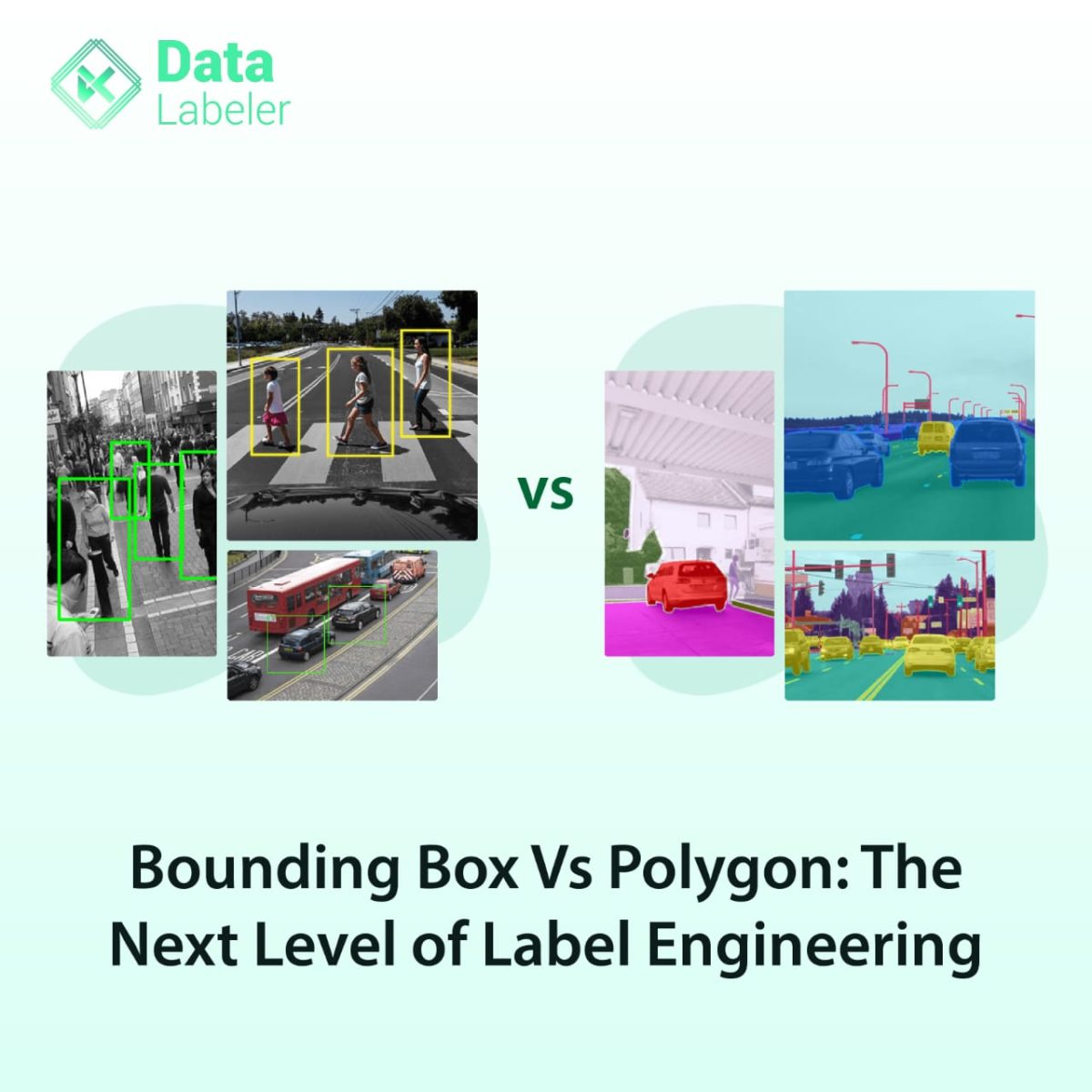
Bounding Box Vs Polygon: The Next Level of Label Engineering

Why do you think Labeling matters?

It matters as it improves accuracy and allows you to build a custom prediction model. Labeling helps you with enhanced accuracy as the machine learning models reflect user data and tailor the model to your specific business needs such as website or app. Moreover, a fully professional labeling solution provides the relevant type of labels according to the requirement of the brand or the software that prints the right labels effortlessly.

Why labeling solution is a critical component? 

  • Simplified Compliance

A professional labeling solution creates label changes very easily and helps in ensuring compliance. A centralized management portal and remote maintenance also make it easier for updating the label formats. This helps the companies cut costs of expensive fines or recalls.

  • Branding Standards

An advanced labeling solution offers a better chance of productivity and accurate labels on which brands could easily rely on which could be quite costly as well as unreliable in terms of supply. Hence, you need your labeling to reflect your brand needs properly. This includes a company’s certification, patents, trademarks, or other critical data expected from your label.

  • Enhanced Responsiveness and Flexibility 

Labeling solutions provide multi-language capabilities and other simple label changes that make the work of the employees easier. This would allow you to personalize your labels for your clients from other regions and deliver unique branding needs respectively.

There are several types of labels available, and based on your requirement you could utilize them.

Such as bounding boxes, Polygons, points, text, select, semantic segmentation, and more. All these data labeling are used for various user-specific purposes.

However, while setting up a project of object detection, you might have to choose the annotation tool. And one of the most commonly used tools in artificial intelligence and machine learning projects are bounding boxes. Apart from that, Polygons exist. Let’s discuss which one you should choose when you have an object detection project to handle.

Bounding Boxes Vs Polygon

Bounding boxes are rectangles drawn by the annotators. Just like any rectangle, a bounding box is defined by two points. The user has to click at the given point and drag it to the second point while drawing a bound box. In other cases, a bounding box is sufficient for defining the position of an object on an image. But, when images are not rectangle-shaped, bounding boxes failed to detect it precisely, so you need something else.

While a Polygon tool is refined but, complex to draw. As Polygons have an arbitrary number of points they can accurately cover an object on an image. The only catch is, it is difficult to draw a Polygon and even more complex for an annotator to use.

Bounding boxes are apt for most cases, you could utilize them efficiently and it simple to draw. Moreover, it has been proved that utilizing Polygons for rectangular objects does not lead to the enhancement of the model’s performance. Hence, Polygons should be used for projects where objects do not fit in a rectangular box. This might be due to the irregular shape or orientation in the picture. Here are two use cases of Polygons, one is geospatial data and the other is autonomous driving. Geospatial data mostly comes from drones or satellites. It is one of the common tasks of annotators where the use of Polygon is a must. In the case of autonomous driving, multiple objects have asymmetric shapes and cannot be annotated with a bounding box.

If you are about to begin an annotation project, it is crucial to define the best tool for annotation. Most of the machine learning models provide good accuracy with bounding boxes and some require Polygons for best results.

Here’s how Data Labelers could help you:

Data Labeler specializes in building quality-labeled datasets for artificial intelligence and machine learning projects. We provide highly accurate labeled datasets, optional real-time bidding, effective guidance on labeling, and sophisticated workforce management software.

Contact us for seamless data labeling and annotation services – sales@datalabeler.com