Categories
Data Labeling

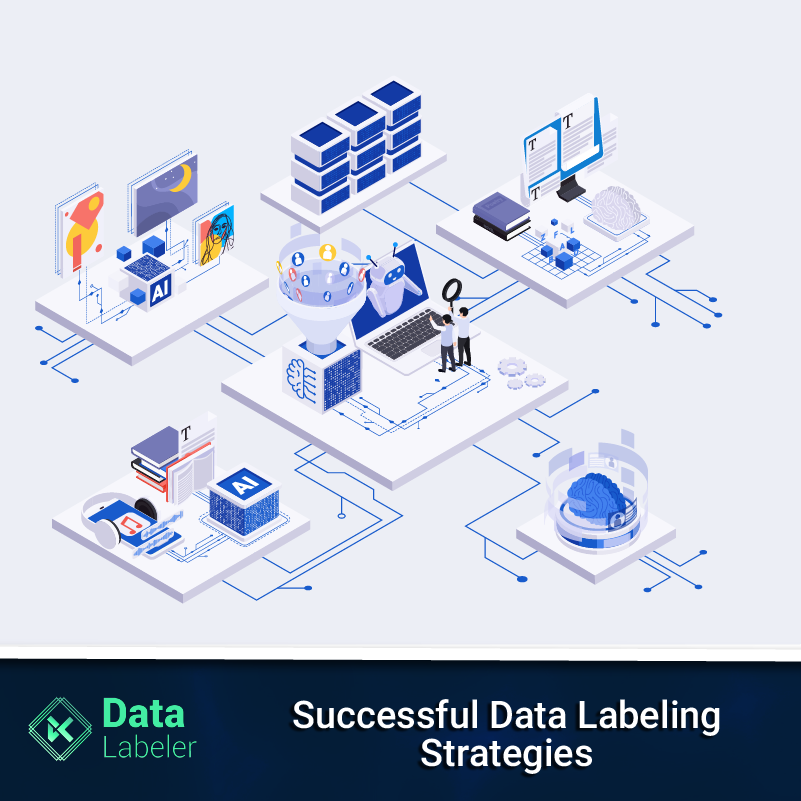
5 Strategies to make way for Successful Data Labeling Operations

The global market for data annotation and labeling reached USD 0.8 billion in 2022 and is
projected to grow at a CAGR of 33.2% to reach USD 3.6 billion by the end of 2027. Data
labeling activities are now a crucial part of creating and training a computer vision model.


Managing the entire lifecycle of data labeling and data annotation, from sourcing and
cleaning through training and creating a model production-ready, is the responsibility of the
function known as data labeling operations.


Engineers in machine learning and data science aren’t all-powerful. Data operations teams
are a group of hardworking individuals who work behind the scenes to get computer vision
projects ready for production.

Let’s now examine 5 methods for designing efficient Data Labeling Operations

1).Recognize the use case :


Data ops and ML leaders must be aware of the issues they are attempting to address for a
given use case before starting a project. Creating a list of questions and discussing them
with senior leadership is a useful activity for figuring out the goals of the project and the
best ways to achieve them.
Now it’s time to start putting together a team, methods, and workflows for data labeling
activities once you’ve gone through the answers to these questions.


2).Create instructions and documentation of labeling workflows :


If you approach data operations from a data-centric perspective, you can treat
datasets—including the labels and annotations—as a component of your project’s and
organization’s intellectual property (IP). making it much more crucial to record the entire
process.
Labeling process documentation enables the development of SOPs, which increases the
scalability of data operations. Additionally, it is crucial for keeping a data pipeline that is
transparently auditable and compliant as well as protecting datasets from data theft and
cyberattacks.

Before a project begins, operational workflows must be designed. If you don’t, once the
data starts streaming through the pipeline, the entire project is at risk. Clarify your
procedures.
Before the project begins, get the necessary operating procedures, budget, and senior
leadership support.


3).Make your ontology extensible to account for the long term:


It’s crucial to make your ontology expandable whether the project requires video or picture
annotation, or if you’re employing an active learning pipeline to quicken a model’s iterative
learning process.
An extendable ontology makes it simpler to scale, regardless of the project, use case, or
industry, including whether you’re annotating medical image files like DICOM and NIfTI.


4).Iterate quickly and incrementally:


Start small, learn from tiny failures, iterate, and scale your data labeling operations routine
are the best ways to ensure success.
If not, you run the danger of attempting to annotate and categorize too much data at once.
Because annotators make mistakes, there will be more mistakes to correct. Starting with a
larger dataset and trying to annotate and classify it will take more time than if you start with
a smaller dataset.
You can scale the operation after everything is functioning properly, including the
integration of the appropriate labeling tools


5).Implement quality control, use iterative feedback loops, and keep getting better:


Quality assurance/control and iterative feedback loops are essential to developing and
putting into practice data operations.
Labels must be verified. Make sure the annotation teams are using them properly. Check
the model for bias, mistakes, and problems. There will always be mistakes, inaccurate
information, incorrectly labeled picture or video frames, and bugs.
You may lessen the quantity and effect of errors, inaccuracies, incorrectly labeled photos or
video frames, and bugs in training data and production-ready datasets by using suitable AI-
powered, automated data labeling, and annotation technology.

Select an automation technology that works with your quality control workflows to hasten
the correction of defects and errors. This will provide you with more time and more efficient
feedback loops, especially if you’ve used micro-models, active learning pipelines, or
automated data pipelines.

Create More Efficient Data Labeling Operations with Data Labeler

You can create data labeling operations that are more productive, safe, and scalable
with Data Labeler, an automated tool used by top-tier AI teams.
Data Labeler was developed to increase the effectiveness of computer vision projects’
automatic image and video data labeling. Additionally, our system reduces errors, flaws, and
biases while making it simpler, quicker, and more cost-effective to manage data operations
and a group of annotators. Contact us to know more!
Categories
Data Labeler

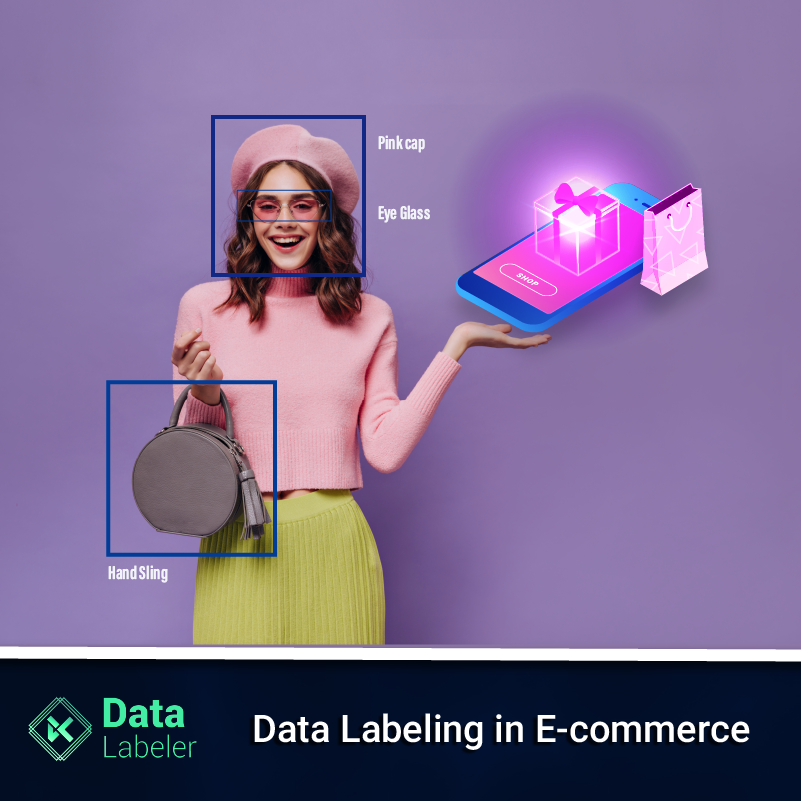
How Data Labeling is Advancing & Benefitting the E-commerce World?

The report predicts that by 2028, the global market for data annotation will be worth USD 8.22 billion. Additionally, a CAGR of 26.6% is predicted for the global market for data annotation services through 2030; by that time, it is likely to be worth US$ 5.3 billion. The traditional supply of intensive manual labeling has not been able to keep up with the rising demand for labeled data.

Three variables account for a substantial portion of the market’s need for Data Annotation Tools..

  1. Tools for automatically classifying data and an increase in the utilization of cloud computing services.
  2. Companies are adopting data annotation tools more frequently to precisely classify vast amounts of AI training data.
  3. To enhance driverless ML models, there is a growing requirement for well-annotated data as investments in autonomous driving technologies rise. Data annotation is anticipated to advance significantly and become increasingly more integrated as the digital environment changes in the twenty-first century. The development of mobile computing and digital image processing is a significant driver of such changes.

Here’s how Data Labeling is paving the way for E-commerce Sector

Data labeling in new retail has been hailed as a revolutionary idea and is now being sold commercially in some areas. It can save labor expenses, enhance customer service, streamline business operations, and increase consumer insights. Due to its seamless blending of the physical and digital worlds, new retail is quickly taking over as the dominant model in our culture.

  1. Object recognition
    Models for object recognition and classification in unmanned stores aid in automating the
    entire shopping process. In order to assist a virtual checkout, machine learning models for
    automatic product recognition, for instance, can determine which items a customer has in
    their cart. To grasp what goods are on each image, which article numbers correspond to
    each product, which brand, which packaging size, supplier information, etc., these models
    first need to be fed with thousands of tagged images.
    Additionally, inventory management and visual merchandising can be automated, making it
    simpler to identify when items need to be restocked on the shelf or alerting the visual
    merchandiser to adjust how their products are displayed in-store.
  2. Customer data

Without clean and pertinent data, the e-commerce industry cannot grow. Consider the data
on the consumer and their preferences for the product or brand, as well as the underlying
information about the costs, special offers, payment options, etc. This data contains the
customer’s interactions with and impressions of the website where the good or service is
offered.
E-commerce firms and merchants must explore the various client categories in order to
better serve customers. Which segments of consumers behave the best? What are their
tastes, and which extra item are they likely to add to their basket along with the current
one? These data points can be categorized or labeled to assist define customer categories
and better service customers.

  1. Facial Recognition
    For a more individualized customer experience, facial recognition technologies can be
    utilized to identify consumer profiles, behaviours and produce predictive styling. Consumer
    analysis can be completed and saved for use in persona profiling and subsequent visits.
    Sadly, not all client segments have been adequately represented in the datasets that already
    exist, leading to outliers, access denials, or biased data insights. Therefore, it’s crucial that
    databases for facial recognition are impartial, diversified in all respects, and indicative of the
    people who actually go to that particular place or store.
  2. Visual Search
    Using recognition software, visual search is a developing technique that enables users to
    take photos of apparel or advertisements and link them straight to product pages. Because
    it’s now much simpler to find the item you’re looking for, this greatly enhances the
    consumer experience.
  3. Receipt Transcription
    A significant amount of data, including information on purchases, shipment, and handling, is
    produced through receipt transcription. The back-end system will be simplified and labor
    expenses will be reduced thanks to the automatic transcription and labeling of this data
    from the POS system. Data labeling will thus greatly lessen the workload of store workers
    and reps.

Want to engage your AI projects by taking the initial step and gaining access to precise, high-
quality data sets?
Data Labeler delivers high-quality, annotated training data with the help of qualified experts
in order to deliver the finest services possible.
To learn how Data Labeler can assist you on this path, get in touch with us.

Categories
Data Labeling

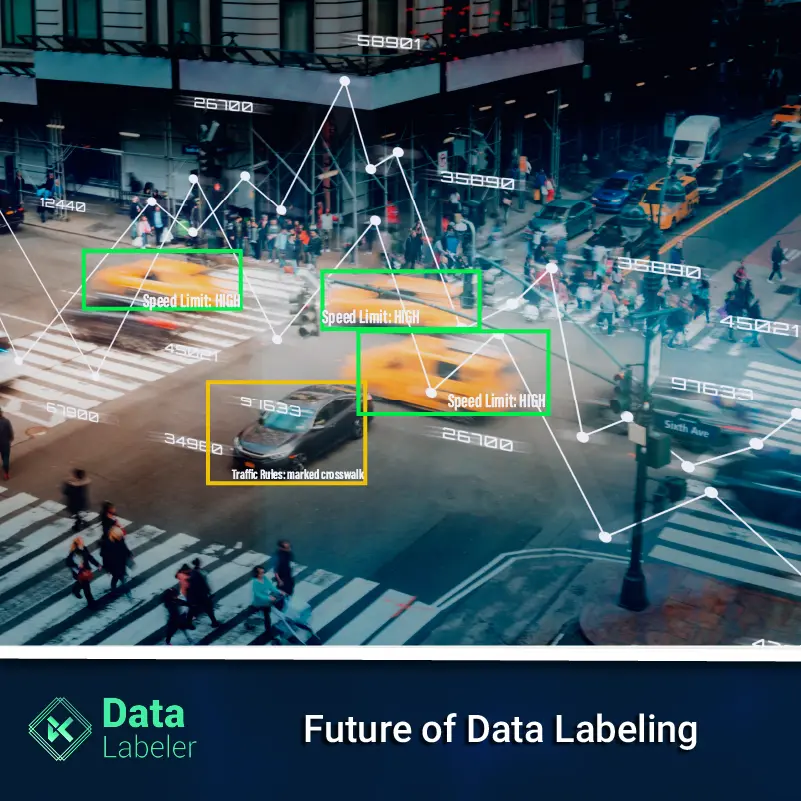
What is the future of Data Labeling and how it matters?

Over the years, authors of science fiction have created vivid images of future societies in
which robots and artificial intelligence (AI) are integral parts of daily life. Nowadays, it is
feasible to deploy AI because of the technological advancements that have been created. AI
is pervasive, addressing issues in business, manufacturing, customer service, medical, and
even people’s everyday lives.
Another element that has been crucial in this case, in addition to advancements in
processing technology and internet infrastructure, is the accessibility of big data and data
labeling services. In this blog article, we’ll examine the part data labeling services play in
improving AI and influencing the future.

Data Labeling: What is it?

It takes a lot of data to develop AI. When developing AI, researchers attempt to replicate
the human learning process. Machine learning is a whole branch of AI science that is
devoted to this procedure.
Data labeling and data annotation are the same thing. Both terms refer to the same method
of annotating text, video, and images with the aid of specialized text annotation software
and image annotation tools.
Data labeling is the process of preparing unprocessed data for AI creation. Using specialist
software tools, it entails tagging and labeling the data with relevant information. The type of
data used can vary depending on the AI use case – text, images, and videos can all be
improved through proper data labeling.

Labeled vs Unlabeled Data

The accuracy of the data utilized to train AI models is crucial. The data collection that
accurately depicts reality is referred to as “ground truth” in AI data science. It is the
foundation for a future AI platform’s training. Future AI workflows will be impacted if the
ground truth is faulty or wrong.
Developers spend a lot of time choosing and curating training data because of this.
Gathering and assembling training data is thought to account for 80% of the work put into
an AI project.
The “Human in the Loop” paradigm (HITL) has been a constant in AI research over the years.
The key theory guiding the development of AI is its potential to displace people from risky,
monotonous, and time-consuming tasks.
One of the paradoxes of AI development is that some of its most important components
need a lot of manual labor. Data labeling is the primary illustration. You need high-quality
data sets to develop algorithms that are more effective and error-free.

Advent of Data Labeling Services

Services for data labeling are necessary to “teach” algorithms how to recognize particular
items. Businesses employ a variety of cutting-edge ways to create training data sets. One
method effectively provides software eyes to observe the world, while the other offers it
the ability to comprehend spoken and written language from people. They have already had
a significant impact on modern human life as a whole.

  • Bounding Boxes: For Object Detection
  • Polygons: For Semantic & Instance Segmentation
  • Points: For Facial Recognition & Body Pose Detection
  • Texts: For Image Captioning
  • Select: For Image Classification
  • Semantic Segmentation: For More Complex Image Classification

Wondering how Data Labeler can help you?

Data Labeler digitally delineates and identifies an object in an image or video so that the AI
can later learn to recognize it. To increase its capacity to correctly identify the object
without any tags in the future, the AI needs a wide variety of samples of tagged data
because objects like vehicles can arrive in a variety of shapes, sizes, and colors.
Our data labeling specialists have many hours of expertise working on computer vision,
natural language processing, and content services projects for the geospatial, financial,
medical, and autonomous vehicle industries.
Contact us for the best Data Labeling Services !

Categories
Data Labeler

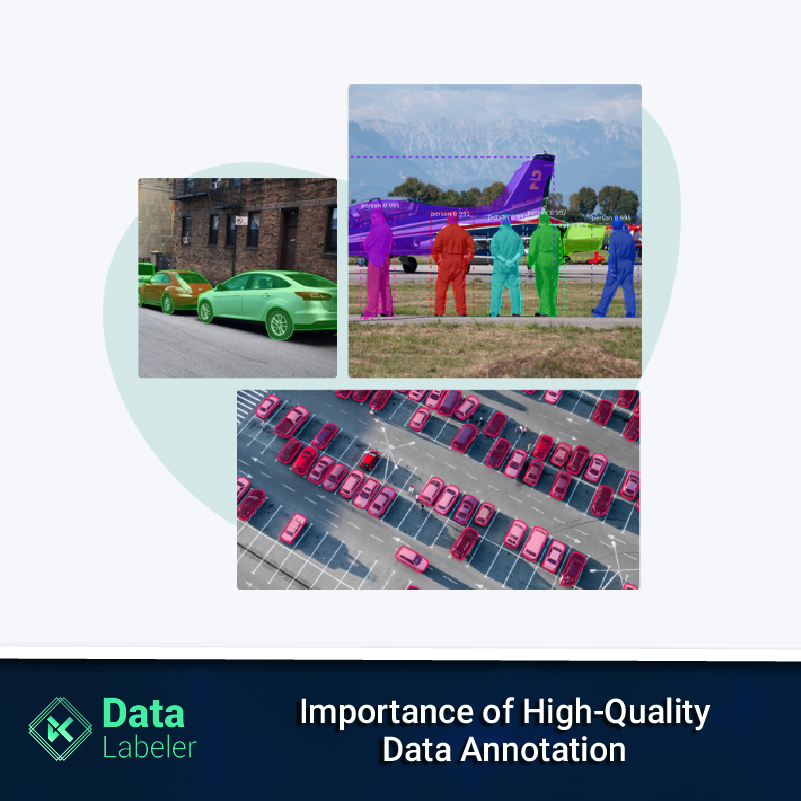
Realize the Real Power of High-Quality Data Annotation in AI Development

Today’s businesses depend on data to function, but as many businesses are learning, the
quality of that data is becoming more important than the quantity. For machine learning
projects to be successful, it is essential to have highly reliable training data. Businesses that
seek to train models using less reliable data are discovering that accuracy eventually
decreases. These models are actually never able to become fully optimized and useful with
even a little bit of incorrect, inaccurate, or obsolete data.

Consequences of Poor Data Annotation

The low quality of the data is the cause of many algorithmic issues. Data annotation, or the
practice of labeling data with certain attributes or characteristics, is one technique to
increase the quality of the data for ML algorithms.


To give an algorithm in identifying other unlabeled objects, an archive of photographs of
fruits, for instance, may be manually labeled as apple, pear, watermelon, and so on.
Although data annotation can be a time-consuming, manual task, it can become increasingly
important as datasets grow enormous and complicated.


Because models must be continually constructed, retrained, and run, the effects of
improperly labeled data can be both frustrating and expensive.

Significance of Data Annotations & Training Data

Giving labels and metadata tags to texts, videos, photos, or other content forms is a
component of the training data process known as data annotation. Because they lay the
foundation for building machine learning models, data annotations are the foundation of
every algorithm. Technical representations, procedures, different tool kinds, system
architecture, and a wide range of ideas unique to training data alone are just a few of the
factors that are involved in the process.


The process of data annotation involves finding and interpreting the desired human aim into
a machine-readable format using high-quality training techniques or data. The relationship
between a human-defined goal and how it relates to actual model usage determines how
effective a solution is. The effectiveness of the model’s training, adherence to the
objectives, and the capacity of training data are the main factors.


When the circumstances are actual and accurate, training data is effective. Long-term
results may be impacted if the conditions and raw data do not fully reflect all variables and
scenarios.

Use Case: Annotated Training Data in Healthcare

In healthcare high-quality training data is crucial for AI-based operations. In some
application areas, including medication research, gene sequencing, treatment predictions, and automated diagnosis, annotations in AI and machine learning in healthcare are necessary.


To provide high-quality diagnostic solutions, one needs precise and accurate data that has
been tagged and annotated. For example, imaging files, CT or MR scans, pathology sample
data, and other databases are utilized to construct algorithms in the healthcare industry.
Annotation is also used to identify tumors by identifying cells or ECG rhythm strip
designations.

Three major applications for this technology in Healthcare

  • Perception exercises
  • Diagnostic support
  • Treatment techniques

High-quality Data Sets and Data Labeling Service

Businesses need high-quality training data that might be used to feed the machine
algorithms in order to achieve the desired results. Firms need experienced labeling partners
who can perform data training jobs quickly and provide first-rate services to obtain data sets
with that degree of quality.


When it comes to providing the best services available, Data Labeler offers high-quality,
annotated training data with the assistance of qualified experts.


Take the first step in creating compelling AI projects and gain access to accurate and high-
quality data sets. Contact us to know how Data Labeler can help you on this journey