Categories
Artificial Intelligence

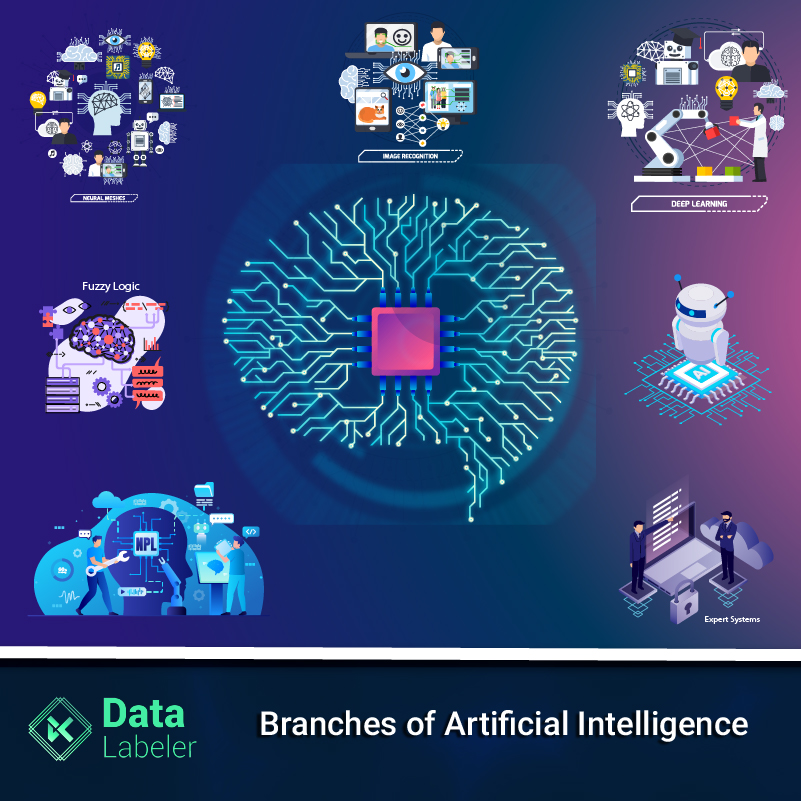
Top 7 branches of Artificial Intelligence you shouldn’t Miss Out on

This new and emerging world of big data, ChatGPT, robotics, virtual digital assistants, voice search,
and recognition has all the potential to change the future, regardless of how AI affects productivity,
jobs, and investments.
By 2030, AI is predicted to generate $15.7 trillion for the global economy, which is more than China
and India currently produce together.


Many different industries have seen major advancements in artificial intelligence. Systems that
resemble the traits and actions of human intelligence are able to learn, reason, and comprehend
tasks in order to act. Understanding the many artificial intelligence principles that assist in resolving
practical issues is crucial. This can be accomplished by putting procedures and methods in place like
machine learning, a subset of artificial intelligence.

  1. Computer vision
    The goal of computer vision, one of the most well-known disciplines of artificial intelligence at the
    moment, is to provide methods that help computers recognise and comprehend digital images and
    videos. Computers can recognise objects, faces, people, animals, and other features in photos by
    applying machine learning models to them.
    Computers can learn to discriminate between different images by feeding a model with adequate
    data. Algorithmic models assist computers in teaching themselves about the contexts of visual input.
    Object tracking is one example of the many industries in which computer vision is used for tracing or
    pursuing discovered stuff.
  • Classification of Images: An image is categorised and its membership in a given class is correctly predicted.
  • Facial Identification: On smartphones, face-unlock unlocks the device by recognising and matching facial features.
  1. Fuzzy logic
    Fuzzy logic is a method for resolving questions or assertions that can be true or untrue. This
    approach mimics human decision-making by taking into account all viable options between digital
    values of “yes” and “no.” In plain terms, it gauges how accurate a hypothesis is.
    This area of artificial intelligence is used to reason about ambiguous subjects. It’s an easy and
    adaptable way to use machine learning techniques and rationally mimic human cognition.
  2. Expert systems
    Similar to a human expert, an expert system is a computer programme that focuses on a single task.
    The fundamental purpose of these systems is to tackle complex issues with human-like decision-
    making abilities. They employ a set of guidelines known as inference rules that are defined for them
    by a knowledge base fed by data. They can aid with information management, virus identification,
    loan analysis, and other tasks by applying if-then logical concepts.
  3. Robotics

Robots are programmable devices that can complete very detailed sets of tasks without human
intervention. They can be manipulated by people using outside devices, or they may have internal
control mechanisms. Robots assist humans in doing laborious and repetitive activities. Particularly
AI-enabled robots can aid space research by organisations like NASA. Robotic evolution has recently
advanced to include humanoid robots, which are also more well-known.

  1. Machine learning
    Machine learning, one of the more difficult subfields of artificial intelligence, is the capacity for
    computers to autonomously learn from data and algorithms. With the use of prior knowledge,
    machine learning may make decisions on its own and enhance performance. In order to construct
    logical models for future inference, the procedure begins with the collecting of historical data, such
    as instructions and firsthand experience. Data size affects output accuracy because a better model
    may be built with more data, increasing output accuracy.
  2. Neural networks/deep learning
    Artificial neural networks (ANNs) and simulated neural networks (SNNs) are other names for neural
    networks. Neural networks, the core of deep learning algorithms, are modelled after the human
    brain and mimic how organic neurons communicate with one another. Node layers, which comprise
    an input layer, one or more hidden layers, and an output layer, are a feature of ANNs. Each node,
    also known as an artificial neuron, contains a threshold and weight that are connected to other
    neurons. A node is triggered to deliver data to the following network layer when its output exceeds a
    predetermined threshold value. For neural networks to learn and become more accurate, training
    data is required.
  3. Natural language processing
    With the use of natural language processing, computers can comprehend spoken and written
    language just like people. Computers can process speech or text data to understand the whole
    meaning, intent, and sentiment of human language by combining machine learning, linguistics, and
    deep learning models. For instance, voice input is accurately translated to text data in speech
    recognition and speech-to-text systems.
    As people talk with different intonations, accents, and intensity, this might be difficult. Programmers
    need to train computers how to use apps that are driven by natural language so that they can
    recognise and understand data right away.

About Us
Are you looking for Object Recognition or any other Data Labeling service?
To improve the performance of your AI and ML models, Data Labeler offers best-in-class training
datasets.
Check out few Use Cases and contact us if you have any in mind.

Categories
Data Labeling Object Segmentation

Meta AI’s Unidentified Video Objects transforms Object Segmentation Sector within the Data Labeling Industry

One of the most active subfields in computer vision research in recent years is object segmentation.
That’s because it’s important to accurately recognize the objects in a scene or comprehend their
location. As a result, various techniques, such as Mask R-CNN and MaskProp, have been put forth by
researchers for segmenting objects in visual situations.


For purposes ranging from scientific image analysis to the creation of aesthetic photographs,
computer vision significantly relies on segmentation, the act of identifying which pixels in an image
represents a specific item. But to create an accurate segmentation model for a specific task,
technical specialists are often required. They also need access to AI training infrastructure and
significant amounts of meticulously annotated in-domain data.


Unidentified Video Objects by Meta AI: What is it?


Unidentified Video Objects (UVO), a new benchmark to aid research on open-world segmentation, a
crucial computer vision problem that seeks to recognize, segment, and track every object in a video
thoroughly, was created. UVO can assist robots emulate humans’ ability to recognize unexpected
visual objects, whereas generally machines must acquire specific object concepts to recognize them.
A recent Meta AI study describes an initiative named “Segment Anything,” which seeks to
“democratize segmentation” by offering a new job, dataset, and model for picture segmentation.
Their Segment Anything Model (SAM) and the largest segmentation dataset ever, Segment Anything
1-Billion mask dataset (SA-1B), were developed.


Earlier there are two main categories of Segmentation


In the past, there were primarily two types of segmentation-related tactics. The first, interactive
segmentation, could segment any object, but it needs a human operator to adjust a mask. However,
predetermined item groups could be segmented thanks to automatic segmentation.


Nevertheless, training the segmentation model requires a significant number of manually labeled
items, in addition to computer power and technological know-how. Neither technique provided a
completely reliable, automatic segmentation mechanism.


Both of these more general classes of procedures are covered by SAM. It is a unified model that
carries out interactive and automated segmentation operations with ease.


By simply constructing the suitable prompt, the model can be utilized for a variety of segmentation
tasks thanks to its adaptable prompt interface. SAM is trained on a wide variety of task that are high-
quality dataset of more than 1 billion masks, which enables it to generalize to new kinds of objects
and images. Because of this capacity to generalize, practitioners will often not need to gather their
segmentation data and modify a model for their use case.


With the help of these features, SAM can switch between domains and carry out various operations.
The following are some of the SAM’s capabilities:

  1. With a single mouse click or the interactive selection of inclusion and exclusion locations,
    SAM makes object segmentation easier. Another stimulus for the model is a boundary box.
  2. SAM’s capacity to provide competing legitimate masks in the face of object ambiguity is a
    key characteristic of real-world segmentation issues.
  3. Any object in a picture can be instantaneously detected and hidden with SAM.
  4. SAM can instantaneously build a segmentation mask for any prompt after precalculating the
    picture embedding, enabling real-time interaction with the model.
    SAM allows for the rapid collection of new segmentation masks. It takes only roughly 14 seconds to
    complete an interactive mask annotation. This model is 2.5 times faster than the previous greatest
    data annotation effort, which was also model-assisted compared to previous large-scale
    segmentation data collection efforts.
    SAM is all set to empower future applications from several sectors which would require object or
    image segmentation.

About Us:
Data Labeler
, an emerging Data Labeling & Annotation Entity, offers accurate, convenient,
customized, expedited, and high-quality labeled datasets for Machine Learning and AI initiatives.
Do you have a specific use case in mind? Contact us now!

Categories
Data Labeling

Know how to ensure best Data Labeling Practices & Consistency

When we refer to “quality training data,” we mean that the labels must be both accurate and
consistent. Accuracy is the degree to which a label conforms to reality. The degree of agreement
between several annotations on diverse training objects is known as consistency.


Emphasizing the fundamental law with training data for projects involving the creation of artificial
intelligence and machine learning by mentioning this. Poor-quality training datasets that are
provided to the AI/ML model might cause a variety of operational issues.


The ability of autonomous vehicles to operate on public roads, depends on the training data. The AI
model is easily capable of mistaking people for objects or vice versa when given low-quality training
data. Poor training datasets can lead to significant accident risks in either case, which is the last thing
that makers of autonomous vehicles would want for their projects.


Data labeling quality verification must be a part of the data processing process for high-quality
training data. You will need knowledgeable annotators to correctly label the data you intend to
employ with your algorithm in order to produce high-quality data.


Here’s how to ensure consistency in Data Labeling process


Rigorous data profiling and control of incoming data


In most cases, bad data comes from data receiving. In an organization, the data usually comes from
other sources outside the control of the company or department. It could be the data sent from
another organization, or, in many cases, collected by third-party software. Therefore, its data quality
cannot be guaranteed, and a rigorous data quality control of incoming data is perhaps the most
important aspect among all data quality control tasks.


Examining the following aspects of the data:

  • Data format and data patterns
  • Data consistency on each record
  • Data value distributions and abnormalies
  • Completeness of the data
  • Designing the data pipeline carefully to prevent redundant data
    Duplicate data occurs when all or a portion of the data is produced from the same data source using
    the same logic, but by separate individuals or teams most likely for various later uses. A data pipeline
    must be precisely specified and properly planned in areas such as data assets, data modeling,
    business rules, and architecture in order for an organization to prevent this from happening.
    Additionally, effective communication is required to encourage and enforce data sharing throughout
    the company, which will increase productivity overall and minimize any possible problems with data
    quality brought on by data duplication.

  • Accurate Data Collection Requirements

Delivering data to clients and users for the purposes for which it is intended is a crucial component
of having good data quality.

It is difficult to show the data effectively. It takes careful data collection, analysis, and
communication to truly understand what a client is searching for.
The need should include all data situations and conditions; if any dependencies or conditions are not
examined and recorded, the requirement is deemed to be lacking.
Another crucial element that should be upheld by the Data Governance Committee is the
requirement’s clear documentation, which should be accessible and easy to share.
Another crucial element is having clear requirements documentation that is accessible and
shareable.


Compliance with Data Integrity


Not all datasets are able to reside in a single database system when the volume of data increases
along with the number of data sources and deliverables. Therefore, applications and processes that
are defined by best practices for data governance and integrated into the design for implementation
must be used to ensure the referential integrity of the data.


Data pipelines with Data Lineage traceability integrated


When a data pipeline is well-designed, the complexity of the system or the amount of data should
not affect how long it takes to diagnose a problem. Without the data lineage traceability integrated
into the pipeline, it can take hours or days to identify the root cause of a data problem.


Aside from data quality control programs for the data delivered both internally and externally, good
data quality demands disciplined data governance, strict management of incoming data, accurate
requirement gathering, thorough regression testing for change management, and careful design of
data pipelines.


Boost Machine Learning Data Quality with Data Labeler


Maintaining consistency, correctness, and integrity throughout your training data can be logistically
feasible or dead simple.


What distinguishes them? Your data labeling tool will determine everything. Data Labeler makes it
simple to assess data quality at scale thanks to features like confidence-marking and consensus as
well as defined user roles. Contact us to know more!