
Categories
Artificial Intelligence

The Opportunities and Challenges in Artificial Intelligence Sector

Have you noticed the presence of Artificial Intelligence being a part with us now? From camera auto-focus in smartphone devices to quick suggestions on Google, AI has become an essential part of our daily lives. Companies around the world are rigorously working towards automating their business operations to save time and budget in enhancing their effectiveness. The opportunity for innovation and development in AI is thriving, and with time it will only continue transforming the world in the diverse way possible. 

A report by the European Commission reveals that the global AI market is expected to grow to 59 billion USD by 2025. Everyday automation and AI technologies are transforming the global workplace with smart devices and algorithms performing the tasks. Presence of AI in the workplace has enhanced the efficiency of several organizations and help them reduce costs. As a result, many professions or human roles may disappear as others adapt to technology-oriented roles. 

Talking about seamless AI integration and its effectiveness, there are several risks and challenges associated with it. As the old saying goes, where there is light, there is darkness. This means, with ample opportunities in AI there are several challenges that come with it. 

Here are the primary challenges that businesses face while integrating Artificial Intelligence:

1. Not So Advanced Computing System 

Machine learning and deep learning techniques need series of calculations done in a very short time preferably in microseconds or nanoseconds, which require a lot of processing power. Hence, various organizations lack the potential resources to implement these AI techniques.

2. Highly Specialized Program

AI implementations are highly specialized. Also known as “Applied AI,” it is built for performing a single task and learning to improvise every day. 

Hence, AI needs to be properly trained to ensure their solutions do not cause any major issues/errors. However, those areas are yet to be considered. 

3. Data Security and Privacy 

AI applications depend on massive volumes of information to learn and make strategic decisions. Machine learning systems depend on data that are either personal or sensitive.

Due to this systematic learning, these ML systems can become more vulnerable to data breaches and identity theft. 

There are multiple risks involved with Artificial Intelligence, but it also provides plenty of opportunities. 

Let’s have a look at the opportunities in AI:

1. AI in Marketing 

Every small or big business want to maximize its marketing budget and concentrate on achieving great marketing strategies. Most businesses would like to implement marketing activities that deliver the highest ROI.  

Machine learning enables analysis of live campaign data with the help of sentiment analysis algorithm and suggests distribution of marketing activities that gives the best results. 

2. Effective AI Techniques

It is crucial to keep track of your competitors but, it is not a viable option when you have to do it on your own. As a result, AI tools come in. 

There are several tools available in the market which track competitors through various channels like websites, apps, or social media. These AI tools help you with the competitor’s data, that in turn help the brands with their marketing planning like price changes, PR activities, and more. 

3. AI-enabled Customer Support Solutions 

AI chat systems permit businesses to scale their customer service efforts and free their resources needed for complex interactions. 

Therefore, AI-based customer service solutions suggest and automate answers for incoming queries. This helped various organizations save time and achieve productivity in the team. 

Hence, we can understand that the era of AI has finally begun. The adoption of AI might have been uneven across different verticals. However, it still looks promising on various operational ends. 

Contribution of Data Labeler in Artificial Intelligence Technology

Data Labeler are provided with accurate labeled data, labelling guidelines and high-end workforce management software.

We provide high-level datasets for AI and ML initiatives. Contact us for detailed info – Sales@DataLabeler.com
Categories
Artificial Intelligence

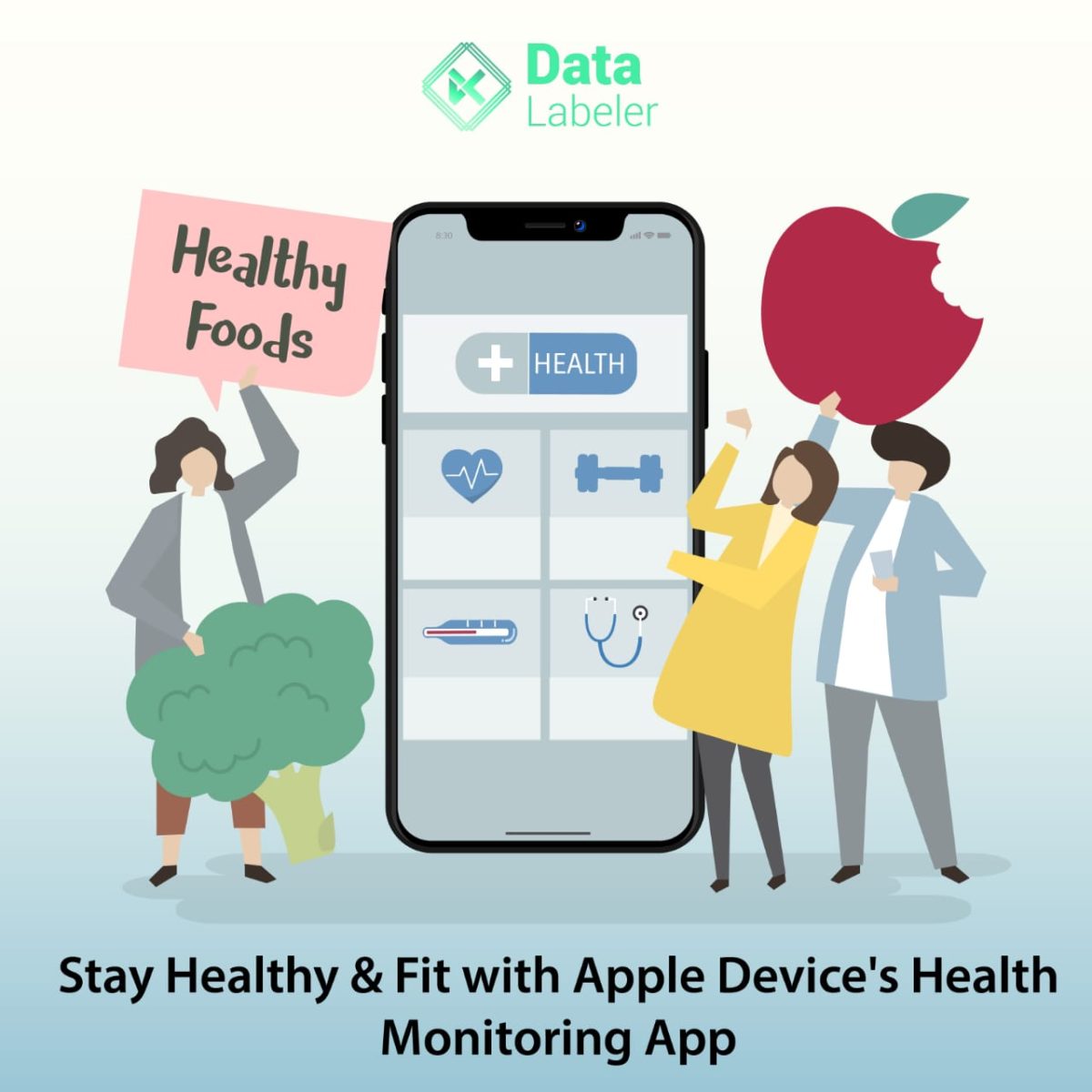
Stay Healthy & Fit with Apple Device’s Health Monitoring App

Do you know what is the USP of the Apple Smartwatch? It’s a health-tracking app and monitors your daily activities, sleeping habits, and other medical conditions. Not only that, iPhone has multiple health-tracking features too. 

You might be aware that you can track your footsteps with various smartphone applications. However, iPhone’s in-built Health app enables you with lot more features. It can track how long you practice mindfulness via a third-party app, determines how much time you spent while sleeping or resting, your walking speed, etc.  

You must be wondering how iPhone could play a role in keeping you healthy. Well, here’s how:

Researchers reveal that iPhone data could help them alter the course of severely advancing diseases. They say that it is possible, because an individual would use their iPhone most of the time. It can track your heart rate too. There are various third-party apps available on the iPhone where you can log your steps, food habits and in various cases, you can also log your wellness too. 

If you willingly share your personal data, the apps could create your entire health and social profile in your iPhone. In this way, they create individual predictive health and wellness profiles that estimate the tendency of a person falling sick and stop spreading diseases too.

Let’s look at the examples of how the iPhone can be your Health watchdog:

  • Access your Health Records

You must be seeing a physician from time to time and having your health records. Apple Health keeps it organized for you. All you have to do is to integrate your health records with Apple Health. It allows you to have a look at all your medical records such as blood test results, immunizations, past medical procedures, etc. 

  • Review Health Checklist

Apple provides you a feature called health checklist. This checklist lets you create a medical ID on your iPhone. Hence, vital information like your Blood Type, the kind of allergies you have, if you’re an organ donor, what medication you are taking, your weight, height, etc. You can enter all these data by yourself. 

The health checklist feature lets you set up an Emergency SOS that will automatically call emergency services. Apart from that, when the call ends, your Apple Watch sends your emergency contacts a text message with your current location,

  • Step Tracking & Mindfulness

The iPhone’s health app could track the number of footsteps you take in a day. It also tracks the number of stairs you climb and the total distance you covered. 

Apple doesn’t have its meditation app, but you can use other third-party apps which help you calm down or yoga workouts. However, the health app might keep a record of how long you spend on meditation. When you download these apps, Apple Health will seek the permission of saving your information. In this way, they could keep track of your mediating periods. 

  • Menstrual Cycle Tracking 

If you are a woman, the Apple Health app could track your cycles and predict your next period and fertility option. Also if you log your period details every month, it could analyze the symptoms and provide advice as to if it’s necessary to share the information with your doctor or not. 

  • Wind Down Feature

This feature of the iPhone lets you keep a track of your sleep. Though it is not detailed information, you can get a rough idea of your sleep patterns. The wind-down feature automatically puts your iPhone into Do Not Disturb mode and dims the screen light.  

Conclusion:

This is how you can turn your iPhone into an amazing Health Assistant. You can stay healthy and fit with your little efforts. And all this is possible through Artificial Intelligence!

Data Labeler specializes in creating, sustainable growth with outstanding AI and ML initiatives.

Data Labeler can provide you with the best quality training data. Contact us – Sales@DataLabeler.com

Categories
Annotation

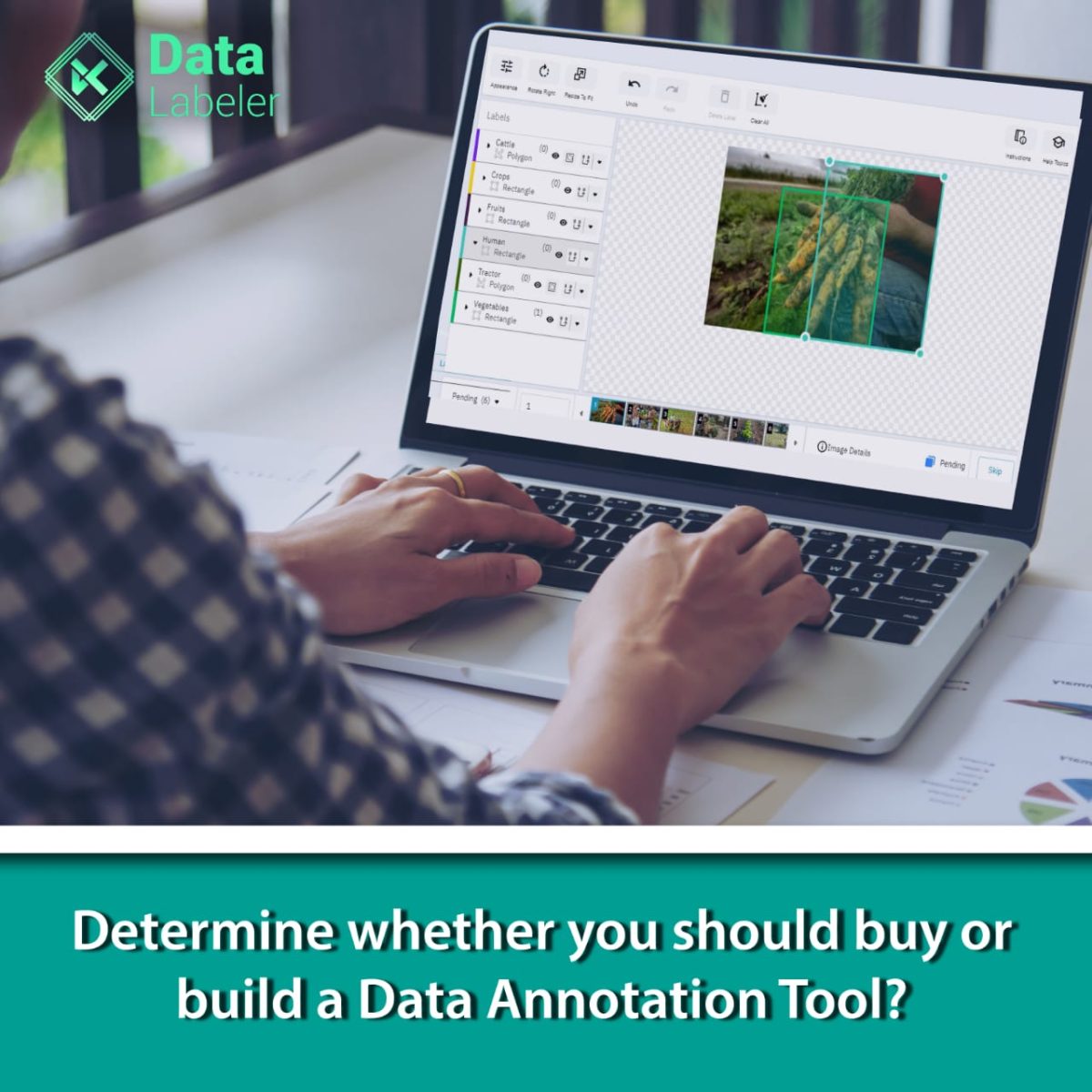
Determine whether you should buy or build a Data Annotation Tool

The global market of Data Annotation tools is expected to grow at 15.1% CAGR from 2021 to 2030. This fast-paced growth is due to the high digitization of consumer products and services. Starting from facial recognition in smart devices to online rendering services, every step towards digitalization brings in more demand for Data Annotation tools. Also training the AI models using Data Annotation tools has seen a surge in the demand for IoT.

Deploying efficient human intelligence needs to be trained by experts of AI and ML. To achieve a robust Artificial Intelligence performance, you need to go through several experimentation and optimization cycles. By leveraging advanced AI systems and mature data labeling infrastructure, you will be able to train your data consistently and accurately. However, there are considerations to be made before you build or buy your Data Annotation tool. 

Below are few considerations to follow:              

  • Right Time to Market

Reaching production is a crucial consideration for your AI application, and adopting a purpose-built platform might get you to value quickly compared to creating an internal solution altogether. The opportunity costs are also ignored as they might be rather expensive for the organization. 

  • Annotation and more

Data labeling tools that are created internally are mostly built for short-term purposes. It does not quite fulfill the parameters like scalability, usability, and cross-team support. Therefore, the key to attain high-quality training data is to have QA/QC capabilities which also includes consensus, task queuing distributions, and reviews workflow. To have all these you need to invest a significant amount of money, apart from just annotating data. 

  • Actual Benefits

You need an advanced Data Annotation tool that has proven customer success as well as increases your tendency to realize similar benefits. A Data Annotation tool is built, scaled, and tested based on multiple cases which yield more value than just a solution.

  • Cost of Ownership

Internal tools are often built to serve a specific function with new business demands, which tend to cover the future costs of enhancement expenses. Added with the high costs of ongoing maintenance, technical debt increases with time. All this is due to developing product demands, engineer turnover, or product neglect. 

  • Evolving Opportunity

You need resource allocation, planning, and preparation for the future while developing an internal product. As training data platforms are new, it is difficult to measure the scope and build a tool for its requirements across the product and engineering teams. 

  • Annotation of Data is Cross-functional

Turning raw data into accurate and consistent training data requires a Teamwork. A team that comprises of engineers, domain experts, managers, and more people playing distinct roles. Data Annotation must provide information and unique interfaces for every role. 

  • Security is a Big Factor

Buying a Data Annotation tool lets you define your security protocols and expertise from a third party.

So, the decision of buying or building a Data Annotation tool is up to you or the  organization. However, investing time and energy in exploring the aspects as discussed above would help your organization in realizing it to its core.

Also, if you are considering a Data Annotation platform to partner with, Data Labeler would be your best support.

How Data Labeler can help you with advanced Data Annotation Tools?

At Data Labeler, we combine our expertise human-assisted approach with Machine Learning assistance to provide you with the best quality training data. We offer cost-effective solutions for high-quality labels which undergo constant quality checks. 

Why choose us? 

We provide extended support to make sure your datasets meet your expectations. Also, we do not have any minimum purchase limit. Contact us at Sales@DataLabeler.com

What are you waiting for?  Partner with us for Data Labeling Services or Become a Reseller.

Categories
others

Everything You Should Know About Social Entrepreneurs

Social entrepreneurs identify resources where people only see problems. They view the villagers as the solution, not the passive beneficiary. They begin with the assumption of competence and unleash resources in the communities they’re serving.

-David Bornstein, Author

How to Change the World: Social Entrepreneurs and the Power of New Ideas. We see how beautifully social entrepreneurs have been defined by Bornstein. Social entrepreneurs combine commerce as well as social causes to improve the lives of people interconnected with the cause. They do not measure their success only with the metrics of profit, but also how much they have contributed to the world. 

What is the meaning of the term “Social Entrepreneur”?

There are differing opinions on what social entrepreneurship is made of. Many believe that business entities make money and work for solving a designated problem by selling few products to their customers. While others say that business owners who work for solving a social cause make an issue of grants or government money are also known as social entrepreneurs. 

People are often attracted to a business that utilizes the social entrepreneurship model as they tend to solve a social problem when they spend money to find a solution to the problem. 

Attributes of a Social Entrepreneur:

– Focus on the ecological or social changes and at the same time make money as they support the change

– Aim to achieve a massive social change. 

– Offer innovation and solutions for any social cause. 

– Utilize feedback to fine-tune their actions.

Social Entrepreneur Vs Entrepreneur

People often confuse Social Entrepreneur with Entrepreneurs; hence it is necessary to understand the underlying difference. One of the most evident difference between them is their distinct end goals. As entrepreneurs measure their success through high-profit margins whereas Socialpreneurs define their success through successful operations in the community interest. 

Several social enterprises run only through volunteers and do not have the typical organizational structure. Those are primarily standalone ventures and entrepreneurs could begin with start-for-profit businesses that fund programs that support social causes. 

To understand the Industrialist better let’s go through some live examples:

  • Ben & Jerry’s

It is an ice-cream firm that also dedicates a whole lot to make social good. As they say, their mission is “to create linked prosperity for everyone that’s connected to our business: suppliers, employees, farmers, franchisees, customers, and neighbors alike,” and they are strongly committed to the cause. 

The entity supports positive changes in organically cultivating and manufacturing processes, LGBTQ+ issues, and racial justice. 

  • Books to Prisoners

This is a traditional non-profit organization based in Seattle, Washington. It aims to end the cycle of recidivism inside the prison walls. They accept book donations from community members, establish bookstores and repackage them, and send them to incarcerated individuals. 

Monetary donations are also utilized for supporting the operational costs such as renting office spaces and buying supplies to mail the books. 

  • 734 Coffee

It is a place of refuge. They dream of building a better future for the displaced people of Sudan living in Gambela, a region in Ethiopia. Their coffee is harvested by cultivators in the Gambela region and then it is brought to the US and the proceeds go to fund education programs and scholarships for refugees of Sudan. 

They say their mission is simple, they make coffee for the greater good.

  • Good Eggs

It is an online meal kit delivery and grocery service that sets itself apart with freshly grown local produce and meals for multiple occasions. They are on a mission to produce most of the food, wine, and spirits that are locally sourced. 

They also promote transparent business practices and reinforce their commitments towards the health and safety of their employees and communities they work with. 

Are you interested to become a Social Entrepreneur? You can’t pick a better time for it. Also, if you are a tech enthusiast you can check other DL blogs. 

Contact us for more advanced Data Labeling Services. –  Sales@DataLabeler.com