Categories
Artificial Intelligence

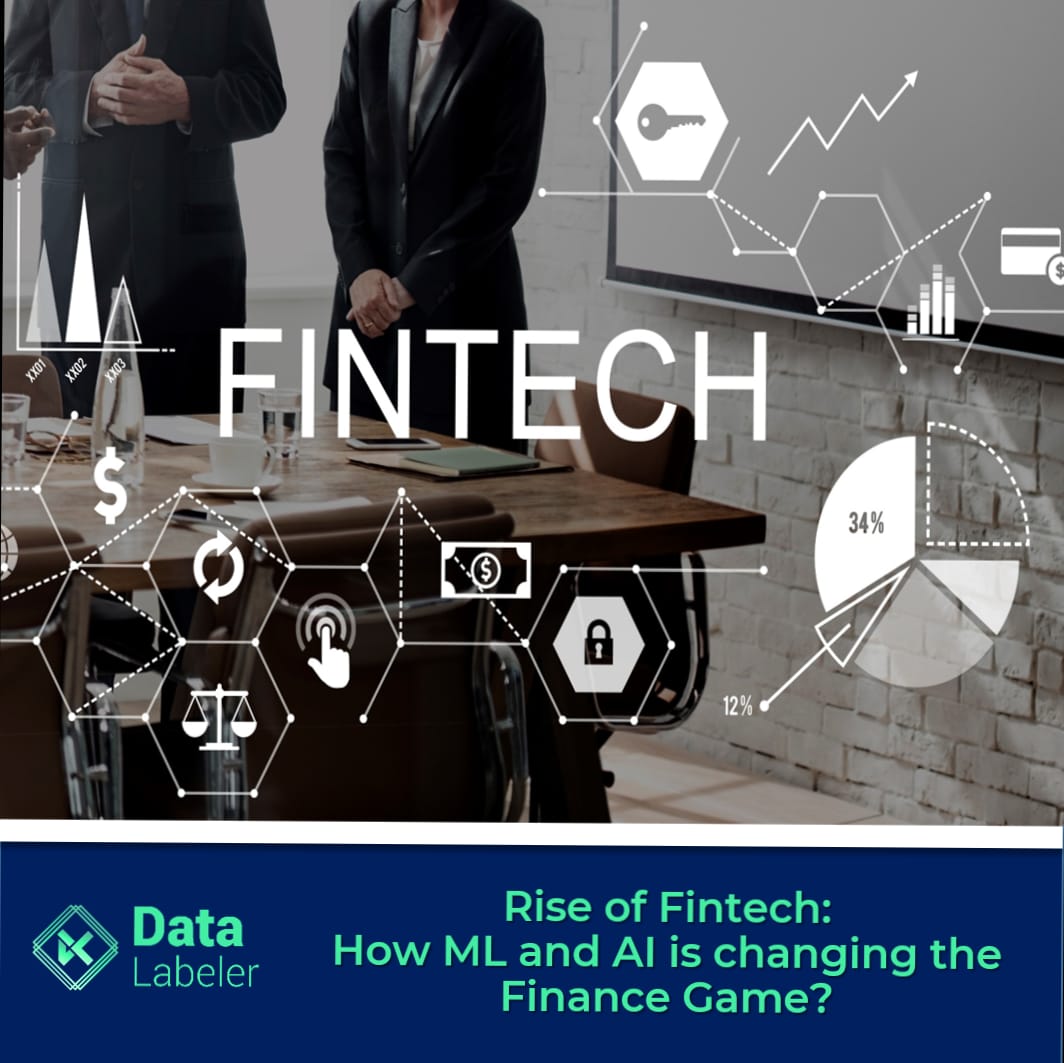
How ML and AI is changing the Finance Game?

Rise of Fintech:

Financial Services and Financial Technology companies are rampantly utilizing artificial intelligence solutions to meet their business goals increase their efficiency lower their budgets and improve their operations effectively. Machine Learning in banking is gaining wide popularity in the Fintech sector starting from public relations to investment decisions and minimum. But, how exactly finance companies today are incorporating Artificial Intelligence technology to drive desired results.

Present-day personalized Machine Learning development is utilized in multiple industrial sectors. In the world of finance, there is an aggressive rise of artificial intelligence applications which are predicted to reach 7305.6 million USD by end of 2022. Machine Learning algorithms are widely used in financial work for pattern identification fraud detection financial analytics platform insurance and expense management and more.

Here’s how Machine Learning and Finance today is going hand in hand:

  • Insurance and InsurTech

Now detect customers’ risks profile and provide the right plan to them and all this you can do is by leveraging Machine Learning algorithms and quoting optimal prices and helps in managing the claims easily. It also helps you improve your customer satisfaction and reduce cost-effectively.

  • Financial Analytics Platform

Financial analytics helps you with differing perspectives on multiple financial data of a given business. Provides relevant insights that facilitate strategic decisions as well as actions that could improve your overall performance of the business. It is a unified solution that combines technologies to meet business requirements across the end-to-end analytics lifecycle, from data storage, data preparation determiners, and other data analytics processes.

These analytics platforms help the data scientist in discovering various data sources and hardware across the organization. It also helps in improving and integration by deploying models which can be assessed by any environment via an API.

  • Regulatory Compliance

By utilizing natural language processing for the fast scan of legal and regulatory documents for various compliance issues Machine Learning algorithms and artificial intelligence technologies come in handy while doing so at a massive scale. These technologies manage thousands of paperwork without any human interactions seamlessly with the least errors.

  • Detection of Fraud

Machine Learning and artificial intelligence technologies seamlessly detect fraudulent and abnormal financial behavior in general regulatory compliance matters as well as and workflows. It improves the compliance matters as well as the workflows with its efficient ability to detect any fraud or errors. Hence, it decreases your operation cost and limits your exposure to fraudulent documents.

  • Artificial Intelligence Chatbot

With the rise of artificial intelligence chatbots and mobile application assistant applications, you can monitor your personal finances effectively. You can get your own finance assistant and set your savings goals and spending rates according to your wish. Moreover, your finance assistant will also handle your finances and provide you with the insights to reach your desired financial targets in no time.

Conclusion:

Machine Learning in Fintech can evaluate massive data sets of simultaneous transactions in real-time and their ability to learn from the results and update models minimizes human output.

Partner with Data Labeler to bring projects to market safely, quickly, and successfully.

Data Labelers save your time and money by combining deep subject matter expertise with AI and deliver you high-quality personalized datasets to train your Machine Learning models seamlessly.

Want to know more? Contact us – sales@datalabeler.com
Categories
Artificial Intelligence

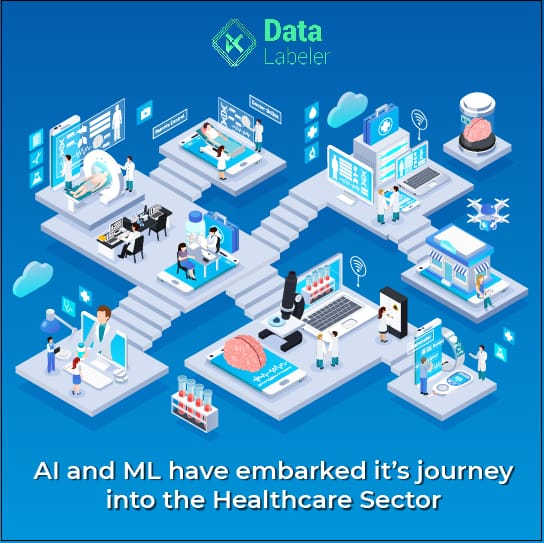
AI and ML has embarked its journey into the Healthcare Sector

Deep Learning applications are looking for more data every day. And the more quality and high labeled data a developer feeds into an AI model the more accurate is the inferences. However, creating datasets is one of the biggest challenges developers and data scientists are facing today while building their machine learning models and Artificial Intelligence initiatives.

But today there are a lot of startups that are rising and have successfully created a web platform that can help the researchers as well as companies manage and analyze data labels in workflow and also utilize AI-enabled segmentation tools for improving the quality of their training data sets. Hence when the labels are accurate Artificial Intelligence models launch quickly and reach a high level of accuracy in no time.

A lot of Artificial Intelligence and Machine Learning startups are seamlessly building new initiatives for the healthcare sector. For example, how NVIDIA T4 GPU has its inference in Google Cloud contributed in Healthcare radiology by speeding up the customer labeling by 10x and reduced the labeling error rate by 15% or more.

Let’s dive deep into understanding how data annotation and machine learning are helping in the advancement of the modern Health Sector:

  • Trainingdata.io

Trainingdata.io chose to develop its platform on a cloud-based platform used to scale up and down usage seamlessly based on client demand. Companies are making the most of this tool which can choose whether to use the interface online or connected to the cloud in the backend or also use a containerized application for running on their own premises of the GPU system.

Artificial Intelligence themes in Healthcare sectors must make sure that the information of the patient is secure. Balzano, a Switzerland-based startup that is building deep learning models for a geologist with the help of training data dot link to an open promisors server of Nvidia v100 tensor GPU. For developing advanced data sets for musculoskeletal orthopedics-related tools. The company has labeled more than a hundred radiology images each month and has adopted training data.in saving the company a lot of engineering efforts for building a similar solution from scratch.

Trainingdata.io also allows the startup to annotate and segment the features of the knee and cartilage more effectively. As they are ramping up their annotation process they are certain that the platform will empower them to leverage AI capabilities to their best and ensure the segmented images are of high quality.

  • Viz.ai

Viz.ai is yet another robust Artificial Intelligence platform who are improving the Healthcare sector with their inclusion software system. One of the primary features of the software is the promise to reduce the time of the treatment, improve the access to care, and speed up the diffusion of medical innovation. They tend to accelerate the time-saving and increase the provider productivity and with more time the providers could treat additional patients or recharge effectively. Patients with multidisciplinary needs can coordinate and improve outcomes for patients. Viz.ai was founded by Dr. Chris Mansi, a neurosurgeon who was frustrated by the delays and processes in the medical industry to make the best use of Artificial Intelligence to transform the healthcare sector to work effectively.

Viz.ai specializes in using Artificial Intelligence to synchronize the stroke in the systems and reducing systematic delays which stand between the patient and the life-saving treatments. It is a remarkable way of making the best possible use of cutting-edge technology to transform stroke workflow and patient care. Please dot status products that detect an alert stroke to the teams to suspected large vessel occlusion stroke and complete CT perfusion studies in their network itself just within minutes. Later, the stroke team consults in real-time through a HIPAA-compliance mobile interface driving the treatment as fast as possible to save the patient’s life.

About Us:

Data Annotation and Labeling is a thriving need in the industry and if you have not thought about it till now, who knows you might be lagging.

Data Labeler unleashes a wide range of services for your respective business needs. Contact us now to know how we can help you grow your business with AI and ML – sales@datalabeler.com

Categories
Data Labeling

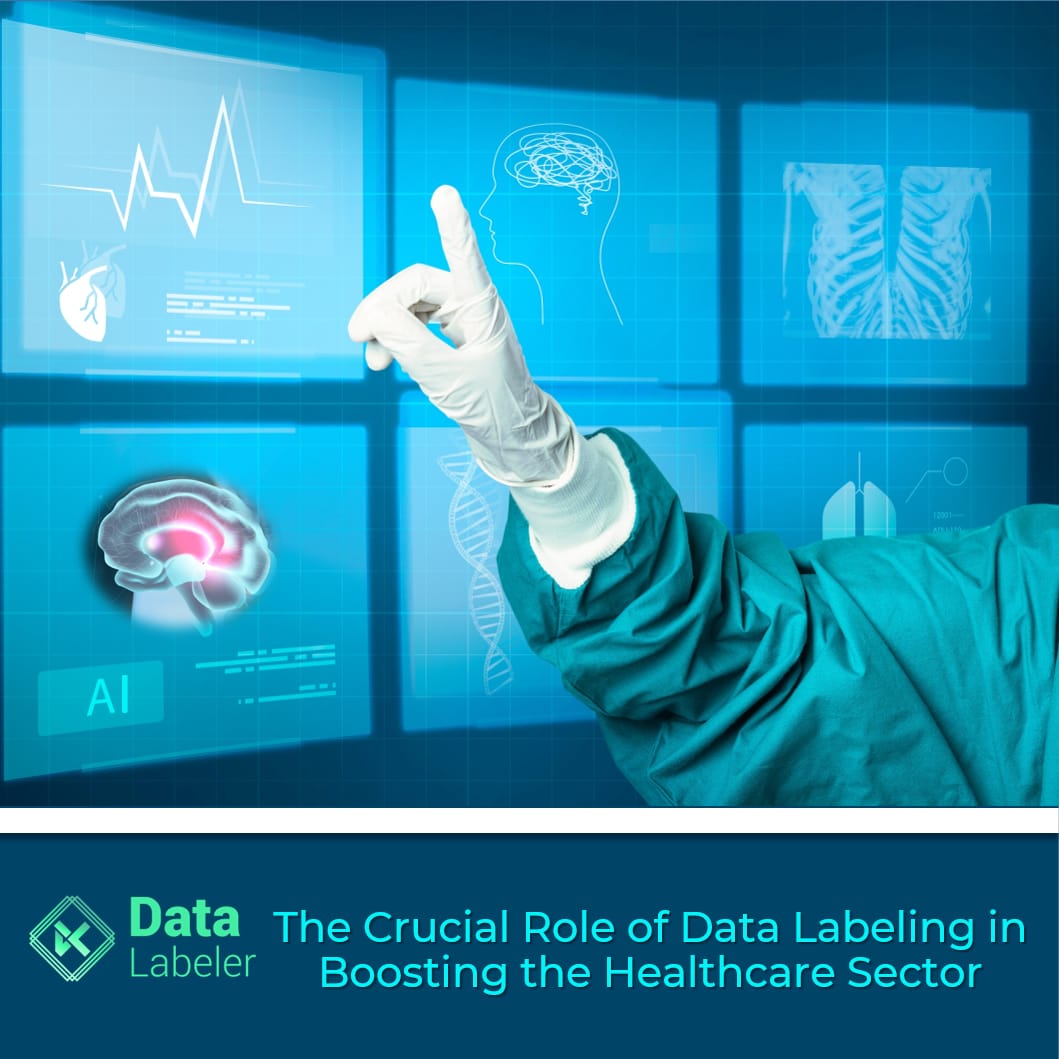
The Crucial Role of Data Labeling in Boosting the Healthcare Sector

The unexpected hit of the pandemic has thrown several challenges to the global medical sector. Health workers are working day and night to fight against the deadly disease. However, to boost the healthcare facilities AI and ML have been contributing in multiple healthcare areas such as disease prevention and control, medical research or diagnosis, patient treatment, and management. Artificial Intelligence and machine learning empower the system to improve its capacities and effectiveness by automating various health care activities. Presently AI and ML are helping robots and digital assistants with real-time analysis which is empowering doctors for providing effective and personalized treatments seamlessly.

The rapid growth of the data labeling industry as well as striving integration of machine learning and artificial intelligence has touched almost all sectors. This is because unlabeled raw data is everywhere and present in huge quantities. Most machine learning and artificial intelligence algorithms need data labeling and annotation to learn and train themselves.

What is a Data Labeling?

A data labeling platform has transformed the industrial sectors through advanced tools for real-time workflow management. Developers could define and begin a data labeling process that provides API for data transfer. These platforms enable users to audit the data quality.

Hence, data labeling is a procedure by which annotators tag several data types like images, videos, text, audios with the help of computers, and once it is finished the manually label datasets are fed into machine learning algorithms to train AI models. This is why data annotation is not only laborious work but it is also a time-consuming process. Most of the time companies buy labeling tools, opt for data labeling services or pick in-house teams.

Here’s how the Healthcare sector is benefited by Data Labeling and Annotation Services:

  • Medical Image Labeling

High-quality training data is crucial for creating machine learning models which aid in improving the medical imaging diagnosis. But there is a great challenge in the availability of high-quality training data. More precisely medical imaging annotations are performed by specialists who are both time-consuming coffee. Therefore, cleaning the data is one of the most important parts and also 80% of the work. Hence the lack of good quality data sets arises as a big challenge in the machine learning industry limits the availability of providing the specific answer to a specific question only if the right data is available.

Now retinal images are developed via automated Diagnostic systems for conditions like diabetic retinopathy or age-related macular in this way massive medical images are being labeled under various conditions. This identification of small structures usually takes a lot of time for experts with high accuracy. Thus medical image labeling helps a great deal.

A few of the common applications are artificial intelligence semantic segmentation which is used for diagnosis in the liver and brain. Polygon Annotations are used in multiple dentistry applications, bounding boxes are used in detecting kidney stones. Medical image annotations provide appropriate results with great accuracy in the early detection of the diseases. Medical imaging diagnosis is also regarded as one of the powerful methods of future applications in the healthcare sector.

How is labeling transforming today’s healthcare sector?

  • Data being the Key

As machine learning is the study of computer algorithms that enhance automatically that enhances your experiences automatically it is also a part of artificial intelligence. It empowers the algorithm’s ability to learn from the training data and also identify patterns as well as make decisions with very little human intervention.

Many organizations and enterprises make use of AI in their business practices where data plays a big role because while training your algorithm needs high-quality level data. Hence data is the key and there are few labeling tools in the medical industry such as Regional Segmentation, Key Points, and Medical OCR.

About Us:

Data Labeler is a human-powered data annotation service provider that caters to high-quality training for your multiple machine learning and artificial intelligence projects. We at Data Labeler provide results that are thoroughly assessed and analyzed by a robust human workforce as well as machines.

We affirm the maximum accuracy rate of data labeling and annotation. Personalized high-quality annotation services according to the customer requirements and demands apart from that we assure you of no data leak as the data is compressed and preprocessed.

Contact us for more information – sales@datalabeler.com

Categories
Artificial Intelligence

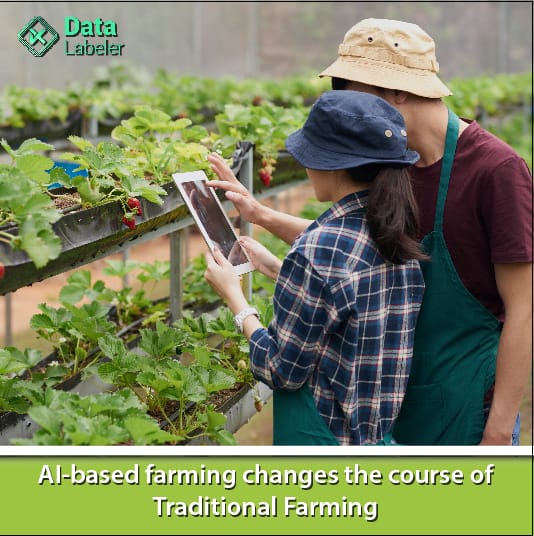
AI-based farming is changing the course of Traditional Farming

Cultivation and farming are some of the ancient professions of the world and humanity have come a long way over the years in the way we farm and cultivate our crops with the use of cutting-edge technologies today. As the world population grew and the land became scarce we need to come up with creative ideas to become more efficient in the way of farming and use less land to produce more crops. This will increase productivity and yield the cultivated acres of land.

Over time agriculture has grown to 25 Trillion USD industries today and where AI Technologies help in healthy crop farming, monitor soil, growth conditions, control pests, and organize data for the cultivators or farmers and help them with the workload with the wide range of AI-based agricultural task force.

Why do we need AI-based farming methods over traditional methods of farming? 

Climatic factors such as temperature, rainfall, and humidity play a crucial role in the life cycle of agriculture, and due to the increase in deforestation and pollution, there is a huge climatic change. Due to which farmers face a huge deal in taking decisions regarding the preparation of the soil, sowing the seeds, and harvesting. Also, different crops require farming methods and climatic conditions.

There is also an increase in production cost when the crops absorb nutrients from the soil which leads to deficiency of nutrients in the soil. These are the everyday challenges a farmer faces while cultivating with traditional agricultural methods. Due to this agricultural sector has turned towards artificial intelligence Technologies which help them sow healthy crops and monitor their growing conditions, etc.

Here’s how Artificial Intelligence helps in day-to-day farming:

  • Tackles seamlessly with the Labor challenge 

Traditional farms have numbered workers and which are mostly seasonal for harvesting crops to protect the crop. Therefore, farms almost all the time faces challenges of workforce shortage. Therefore they help them run the farm more efficiently with fewer workers like never before.

With the use of AI and cognitive technologies farms of all sizes can operate and functions keeping our world fed. And with the growing use of Agricultural and Cognitive Technologies farms are running appropriately and producing the fundamental staples to support your lifestyles every day.

  • Effective Analysis of Farm Data 

Farms produce massive data points every day. And with the help of artificial intelligence farmers, today analyze multiple things in real-time such as temperature, climatic conditions, water usage, soil conditions, and more. In this way, they could make better decisions in the future in various fields of the farming process. For instance, AI Technologies at present is helping the farmers optimize and plan their large fields by planning their crops and making a decision whether to go for various hybrids or resource utilization 

AI systems are helping the farmers improve quality as well as accuracy which is also known as Precision agriculture. Precision agriculture is the phenomenon where AI technology helps by detecting the disease in the plants of pest or the poor plant nutrition in the farm. AI sensors detect and target weeds and decide which herbicides are needed for the better performance of the crops. In this way, it helps the farmers provide the better application of herbicide and less interference of toxins in the crop.

Conclusion:

Therefore, with AI-enabled operations farms are cultivating and producing 70% of the world’s crops today. AI-farming is used for improving agricultural accuracy as well as increasing productivity too.

About Us:

If you are looking for an AI application to support your agricultural farm or any other data annotation and labeling services, Data Labelers is your go-to guy.

We at Data Labelers provide the most accurate, customized, convenient, and high-quality data sets for your machine learning and artificial intelligence initiatives or projects.

Contact us now for a one-stop shop of Labeling and Training quality labels – sales@datalabeler.com