Categories
Data Labeling Object Segmentation

Meta AI’s Unidentified Video Objects transforms Object Segmentation Sector within the Data Labeling Industry

One of the most active subfields in computer vision research in recent years is object segmentation.
That’s because it’s important to accurately recognize the objects in a scene or comprehend their
location. As a result, various techniques, such as Mask R-CNN and MaskProp, have been put forth by
researchers for segmenting objects in visual situations.


For purposes ranging from scientific image analysis to the creation of aesthetic photographs,
computer vision significantly relies on segmentation, the act of identifying which pixels in an image
represents a specific item. But to create an accurate segmentation model for a specific task,
technical specialists are often required. They also need access to AI training infrastructure and
significant amounts of meticulously annotated in-domain data.


Unidentified Video Objects by Meta AI: What is it?


Unidentified Video Objects (UVO), a new benchmark to aid research on open-world segmentation, a
crucial computer vision problem that seeks to recognize, segment, and track every object in a video
thoroughly, was created. UVO can assist robots emulate humans’ ability to recognize unexpected
visual objects, whereas generally machines must acquire specific object concepts to recognize them.
A recent Meta AI study describes an initiative named “Segment Anything,” which seeks to
“democratize segmentation” by offering a new job, dataset, and model for picture segmentation.
Their Segment Anything Model (SAM) and the largest segmentation dataset ever, Segment Anything
1-Billion mask dataset (SA-1B), were developed.


Earlier there are two main categories of Segmentation


In the past, there were primarily two types of segmentation-related tactics. The first, interactive
segmentation, could segment any object, but it needs a human operator to adjust a mask. However,
predetermined item groups could be segmented thanks to automatic segmentation.


Nevertheless, training the segmentation model requires a significant number of manually labeled
items, in addition to computer power and technological know-how. Neither technique provided a
completely reliable, automatic segmentation mechanism.


Both of these more general classes of procedures are covered by SAM. It is a unified model that
carries out interactive and automated segmentation operations with ease.


By simply constructing the suitable prompt, the model can be utilized for a variety of segmentation
tasks thanks to its adaptable prompt interface. SAM is trained on a wide variety of task that are high-
quality dataset of more than 1 billion masks, which enables it to generalize to new kinds of objects
and images. Because of this capacity to generalize, practitioners will often not need to gather their
segmentation data and modify a model for their use case.


With the help of these features, SAM can switch between domains and carry out various operations.
The following are some of the SAM’s capabilities:

  1. With a single mouse click or the interactive selection of inclusion and exclusion locations,
    SAM makes object segmentation easier. Another stimulus for the model is a boundary box.
  2. SAM’s capacity to provide competing legitimate masks in the face of object ambiguity is a
    key characteristic of real-world segmentation issues.
  3. Any object in a picture can be instantaneously detected and hidden with SAM.
  4. SAM can instantaneously build a segmentation mask for any prompt after precalculating the
    picture embedding, enabling real-time interaction with the model.
    SAM allows for the rapid collection of new segmentation masks. It takes only roughly 14 seconds to
    complete an interactive mask annotation. This model is 2.5 times faster than the previous greatest
    data annotation effort, which was also model-assisted compared to previous large-scale
    segmentation data collection efforts.
    SAM is all set to empower future applications from several sectors which would require object or
    image segmentation.

About Us:
Data Labeler
, an emerging Data Labeling & Annotation Entity, offers accurate, convenient,
customized, expedited, and high-quality labeled datasets for Machine Learning and AI initiatives.
Do you have a specific use case in mind? Contact us now!
Categories
Data Labeling

Know how to ensure best Data Labeling Practices & Consistency

When we refer to “quality training data,” we mean that the labels must be both accurate and
consistent. Accuracy is the degree to which a label conforms to reality. The degree of agreement
between several annotations on diverse training objects is known as consistency.


Emphasizing the fundamental law with training data for projects involving the creation of artificial
intelligence and machine learning by mentioning this. Poor-quality training datasets that are
provided to the AI/ML model might cause a variety of operational issues.


The ability of autonomous vehicles to operate on public roads, depends on the training data. The AI
model is easily capable of mistaking people for objects or vice versa when given low-quality training
data. Poor training datasets can lead to significant accident risks in either case, which is the last thing
that makers of autonomous vehicles would want for their projects.


Data labeling quality verification must be a part of the data processing process for high-quality
training data. You will need knowledgeable annotators to correctly label the data you intend to
employ with your algorithm in order to produce high-quality data.


Here’s how to ensure consistency in Data Labeling process


Rigorous data profiling and control of incoming data


In most cases, bad data comes from data receiving. In an organization, the data usually comes from
other sources outside the control of the company or department. It could be the data sent from
another organization, or, in many cases, collected by third-party software. Therefore, its data quality
cannot be guaranteed, and a rigorous data quality control of incoming data is perhaps the most
important aspect among all data quality control tasks.


Examining the following aspects of the data:

  • Data format and data patterns
  • Data consistency on each record
  • Data value distributions and abnormalies
  • Completeness of the data
  • Designing the data pipeline carefully to prevent redundant data
    Duplicate data occurs when all or a portion of the data is produced from the same data source using
    the same logic, but by separate individuals or teams most likely for various later uses. A data pipeline
    must be precisely specified and properly planned in areas such as data assets, data modeling,
    business rules, and architecture in order for an organization to prevent this from happening.
    Additionally, effective communication is required to encourage and enforce data sharing throughout
    the company, which will increase productivity overall and minimize any possible problems with data
    quality brought on by data duplication.

  • Accurate Data Collection Requirements

Delivering data to clients and users for the purposes for which it is intended is a crucial component
of having good data quality.

It is difficult to show the data effectively. It takes careful data collection, analysis, and
communication to truly understand what a client is searching for.
The need should include all data situations and conditions; if any dependencies or conditions are not
examined and recorded, the requirement is deemed to be lacking.
Another crucial element that should be upheld by the Data Governance Committee is the
requirement’s clear documentation, which should be accessible and easy to share.
Another crucial element is having clear requirements documentation that is accessible and
shareable.


Compliance with Data Integrity


Not all datasets are able to reside in a single database system when the volume of data increases
along with the number of data sources and deliverables. Therefore, applications and processes that
are defined by best practices for data governance and integrated into the design for implementation
must be used to ensure the referential integrity of the data.


Data pipelines with Data Lineage traceability integrated


When a data pipeline is well-designed, the complexity of the system or the amount of data should
not affect how long it takes to diagnose a problem. Without the data lineage traceability integrated
into the pipeline, it can take hours or days to identify the root cause of a data problem.


Aside from data quality control programs for the data delivered both internally and externally, good
data quality demands disciplined data governance, strict management of incoming data, accurate
requirement gathering, thorough regression testing for change management, and careful design of
data pipelines.


Boost Machine Learning Data Quality with Data Labeler


Maintaining consistency, correctness, and integrity throughout your training data can be logistically
feasible or dead simple.


What distinguishes them? Your data labeling tool will determine everything. Data Labeler makes it
simple to assess data quality at scale thanks to features like confidence-marking and consensus as
well as defined user roles. Contact us to know more!

Categories
Data Labeler

How Computer Vision is aiding the Image Segmentation & Data Labeling Industry?

The size of the global market for computer vision was estimated at USD 11.22 billion in
2021, and it is anticipated to increase at a 7.0% CAGR from 2022 to 2030. Computer vision
systems utilizing artificial intelligence (AI) are becoming more and more common in a range
of applications, such as consumer drones and fully or partially autonomous vehicles.


The Role of Computer Vision in Image Segmentation


Recent developments in computer vision, including image sensors, sophisticated cameras,
and deep learning methods, have increased the potential applications for computer vision
systems across a range of sectors. Sectors include education, healthcare, robotics, consumer
electronics, retail, manufacturing, and security & surveillance, among others.


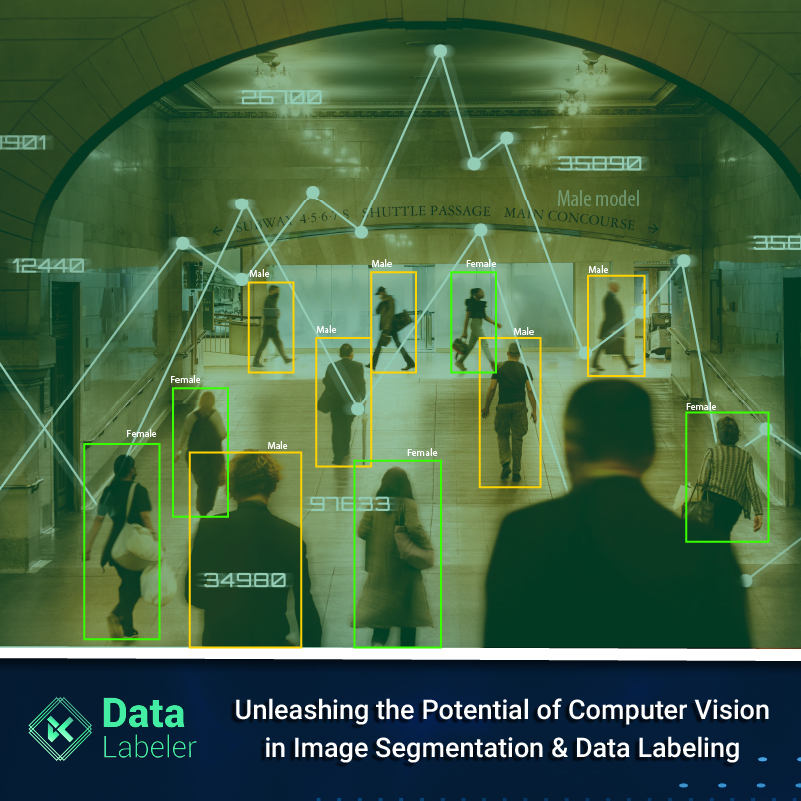
The partition of a digital image into several segments (objects) is known as image
segmentation. Segmentation aims to transform an image’s representation into one that is
more meaningful and understandable. 


Various Image Segmentation Types


Based on the quantity and type of information they communicate, image segmentation
tasks can be divided into three groups: semantic, instance, and panoptic segmentation.  
Semantic segmentation (not instance-based)


The process of semantic segmentation, often referred to as non-instance segmentation, aids
in describing the location of the items as well as their form, size, and shape. 


It is primarily applied when a model needs to know for sure whether or not an image
contains an object of interest and which portions of the image do not. Without taking into
account any further information or context, pixels are simply labeled as belonging to a
certain class. 


Segmentation by Instance 


The practice of segmenting objects by their presence, position, quantity, size, and shape is
known as instance segmentation. With each pixel, the objective is to better comprehend the
image. 
To distinguish between objects that overlap or are similar, the pixels are categorized based
on “instances” rather than classes.


Pan-optic segmentation


Since it combines semantic and instance segmentation and offers detailed data for
sophisticated ML algorithms, panoptic segmentation is by far the most informative task. 

Popular Image Segmentations with Computer Vision in Various Sectors
Due to the complicated robotics tasks that self-driving cars must undertake and the
need for a thorough grasp of their environment, it is particularly well-liked in the field of
autonomous driving. Geosensing for mapping land use with satellite imaging, traffic
control, city planning, and road monitoring are further geospatial uses for semantic
segmentation. 

  • Precision farming robotic initiatives are aided in real-time to start weeding by semantic
    segmentation of crops and weeds. With the use of these sophisticated computer vision
    systems, manual agricultural activity monitoring has been greatly reduced. 
  • Semantic segmentation makes it possible for fashion eCommerce firms to automate
    operations like the parsing of garments that are traditionally quite difficult. 
  • The recognition of facial features is another popular topic of study. By analyzing facial
    traits, the algorithms can infer gender, age, ethnicity, emotion, and more. These
    segmentation tasks get more difficult due to elements like various lighting conditions,
    facial expressions, orientation, occlusion, and image resolution. 


In the context of cancer research, computer vision technologies are also gaining ground
in the healthcare sector. When examples are used to identify the morphologies of the
malignant cells to speed up diagnosis procedures, segmentation is frequently utilized. 


Are you prepping to begin your Image Segmentation Use case? 


Reach out to our professionals in Data Labeler, so they can assist you in quickly and
efficiently producing data that is appropriately labeled.


Data Labeler increases your competitive advantage, provides you with Unlimited support,
and helps you grow exponentially. 


Contact us now!

Categories
Annotation

How Data Labeling & Annotation is aiding and advancing other Industrial Sectors?

Are you aware that almost 90% of data possessed by organizations is unstructured and is expanding
at 55-65% each year?


There is a ton of unstructured data out there. Furthermore, high-quality training data are essential
for completing AI/ML projects, and unstructured data poses security and compliance problems.
So how do businesses deal with this, especially when constructing an AI/ML model and needing to
supply the model with pertinent data so that it can process, give output, and draw inferences?


An AI & ML model’s output, however, is only as good as the data used to train it, as the model can
only produce useful results when the algorithm is aware of the input. As a result, the data must be
aggregated, categorized, and identified precisely. Data annotation is the term used to describe the
process of marking, attributing, or tagging data.


Data Labeling & Annotation with Human Intelligence

By using data annotation, an AI model would be able to tell whether the data it receives is in the
form of a video, image, text, graphic, or a combination of these formats. The AI model would then
classify the data and carry out its responsibilities in accordance with the parameters set and its
functionality.
Your models will be correctly trained thanks to data annotation. So, if you use the model for speech
recognition, automation, a chatbot, or any other operation, you will obtain a fully-reliable model
that produces the best outcomes.
Humans in the loop and human intelligence are vital in the process of identifying, validating, and
correcting problems with the model’s output in order to increase efficiency and allow for
improvisation. Thus, data annotation and labeling can significantly improve an AI or ML program’s
functionality while also reducing time-to-market and total cost of ownership.
As technology develops quickly, data annotations will be necessary across all company sectors and
industries to improve the quality of their systems.


Here is how Data Labeling Affects Different Sectors…

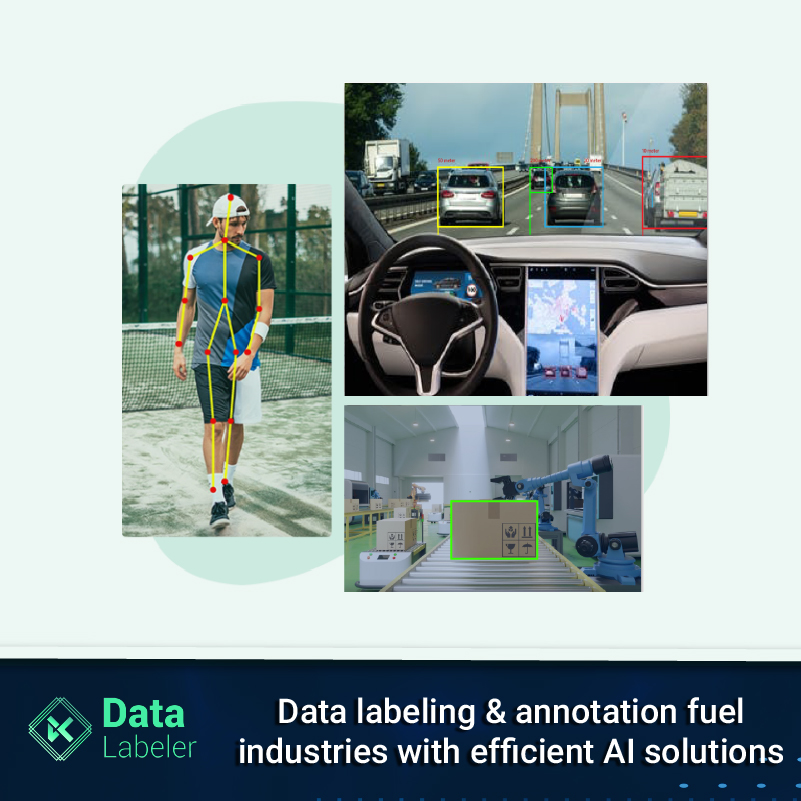
  • Automobile
    Supervised Machine Learning models are crucial to autonomous vehicles, including self-driving
    automobiles, long-haul trucks, and door-to-door delivery robots.
    Large volumes of annotated data are needed for these models in order to power fundamental
    features like lane detection, pedestrian detection, traffic-light detection, etc.

  • Manufacturing
    By 2035, it is predicted that 16 industries, including manufacturing, could experience up to a 40%
    rise in labor productivity because to AI-powered solutions. AI is transforming how manufacturing is viewed in the business, from automated assembly lines to defect identification and workplace security monitoring.

  • Healthcare
    The usage of AI in the healthcare sector is being adopted gradually. Huge amounts of labeled data
    have the potential to revolutionize industries as diverse as drug research and the detection of
    anomalies in MRI and X-ray images.

  • Insurance and Banking
    Banking is already undergoing a fundamental transformation, from automatic check verification to
    the use of AI for fraud detection. AI is being utilized in the insurance industry to automatically assess
    the degree of damage to vehicles, which is another interesting use.

  • Agriculture
    Another sector that is prepared for disruption by AI. Among the applications of AI in agriculture are
    weed detection, crop disease detection, and livestock management.

  • Retail
    The COVID incident revealed how retailers may utilize AI to track customer traffic. AI can also be
    utilized for self-checkout, cart-counting, and visitor sentiment analysis.


How Data Labeler helps in Data Labeling & Annotation Services:
For Machine Learning and Artificial Intelligence (AI) projects, Data Labeler specializes in providing
precise, practical, customized, accelerated, and quality-labeled datasets.

Our Services

  • Highly accurate labeled data
  • Get options for real-time labeling
  • Guidance on labeling instruction
  • Easily scalable
  • Sophisticated workforce management software


Contact us now!