Categories
Bounding Box Polygon

Bounding Box Vs Polygon: The Next Level of Label Engineering

Why do you think Labeling matters?

It matters as it improves accuracy and allows you to build a custom prediction model. Labeling helps you with enhanced accuracy as the machine learning models reflect user data and tailor the model to your specific business needs such as website or app. Moreover, a fully professional labeling solution provides the relevant type of labels according to the requirement of the brand or the software that prints the right labels effortlessly.

Why labeling solution is a critical component? 

  • Simplified Compliance

A professional labeling solution creates label changes very easily and helps in ensuring compliance. A centralized management portal and remote maintenance also make it easier for updating the label formats. This helps the companies cut costs of expensive fines or recalls.

  • Branding Standards

An advanced labeling solution offers a better chance of productivity and accurate labels on which brands could easily rely on which could be quite costly as well as unreliable in terms of supply. Hence, you need your labeling to reflect your brand needs properly. This includes a company’s certification, patents, trademarks, or other critical data expected from your label.

  • Enhanced Responsiveness and Flexibility 

Labeling solutions provide multi-language capabilities and other simple label changes that make the work of the employees easier. This would allow you to personalize your labels for your clients from other regions and deliver unique branding needs respectively.

There are several types of labels available, and based on your requirement you could utilize them.

Such as bounding boxes, Polygons, points, text, select, semantic segmentation, and more. All these data labeling are used for various user-specific purposes.

However, while setting up a project of object detection, you might have to choose the annotation tool. And one of the most commonly used tools in artificial intelligence and machine learning projects are bounding boxes. Apart from that, Polygons exist. Let’s discuss which one you should choose when you have an object detection project to handle.

Bounding Boxes Vs Polygon

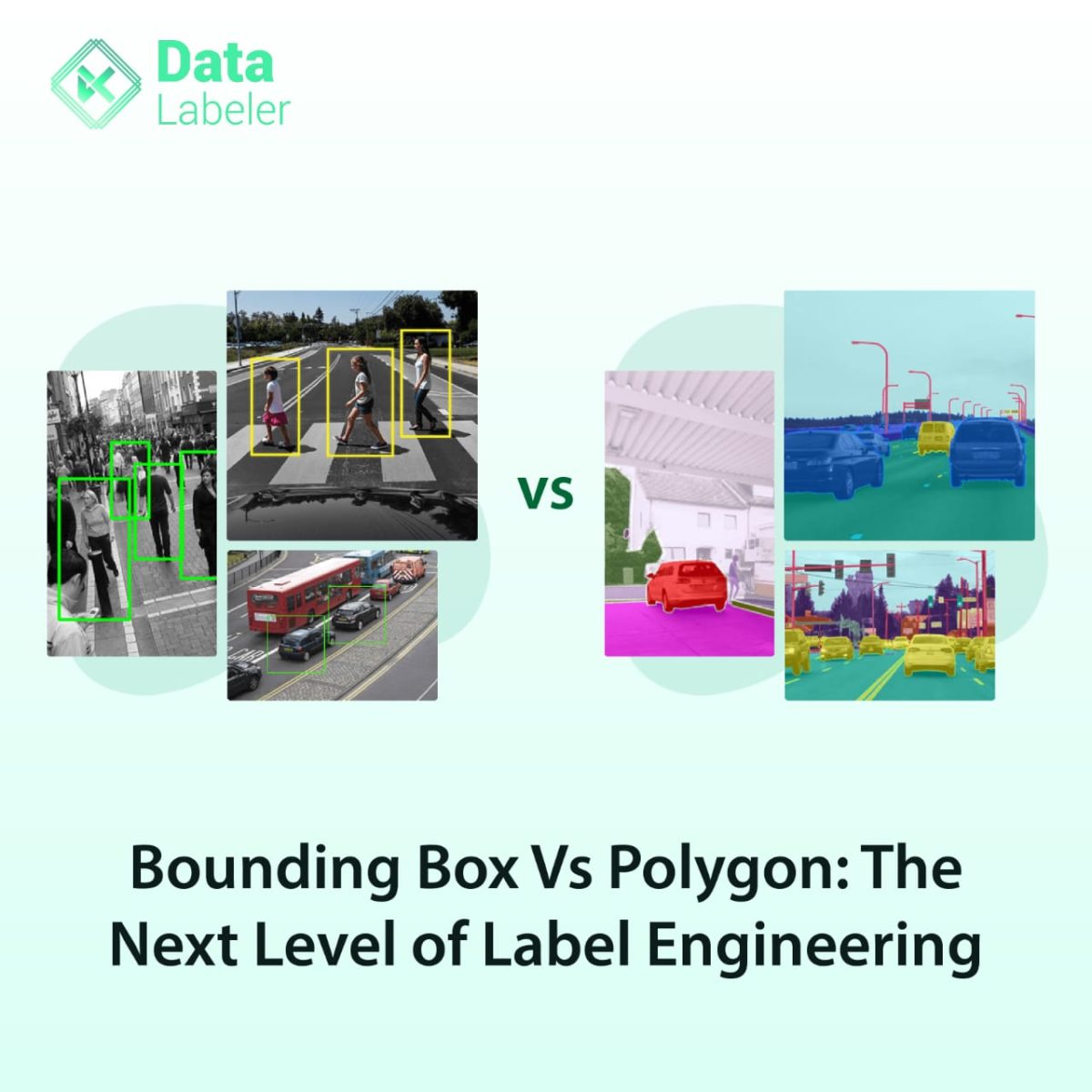
Bounding boxes are rectangles drawn by the annotators. Just like any rectangle, a bounding box is defined by two points. The user has to click at the given point and drag it to the second point while drawing a bound box. In other cases, a bounding box is sufficient for defining the position of an object on an image. But, when images are not rectangle-shaped, bounding boxes failed to detect it precisely, so you need something else.

While a Polygon tool is refined but, complex to draw. As Polygons have an arbitrary number of points they can accurately cover an object on an image. The only catch is, it is difficult to draw a Polygon and even more complex for an annotator to use.

Bounding boxes are apt for most cases, you could utilize them efficiently and it simple to draw. Moreover, it has been proved that utilizing Polygons for rectangular objects does not lead to the enhancement of the model’s performance. Hence, Polygons should be used for projects where objects do not fit in a rectangular box. This might be due to the irregular shape or orientation in the picture. Here are two use cases of Polygons, one is geospatial data and the other is autonomous driving. Geospatial data mostly comes from drones or satellites. It is one of the common tasks of annotators where the use of Polygon is a must. In the case of autonomous driving, multiple objects have asymmetric shapes and cannot be annotated with a bounding box.

If you are about to begin an annotation project, it is crucial to define the best tool for annotation. Most of the machine learning models provide good accuracy with bounding boxes and some require Polygons for best results.

Here’s how Data Labelers could help you:

Data Labeler specializes in building quality-labeled datasets for artificial intelligence and machine learning projects. We provide highly accurate labeled datasets, optional real-time bidding, effective guidance on labeling, and sophisticated workforce management software.

Contact us for seamless data labeling and annotation services – sales@datalabeler.com

Categories
Artificial Intelligence

How Government is planning to utilize AI in Modern Warfare?

Artificial Intelligence Technology is growing remarkably and capturing almost every industrial sector today. From commercial investors, defense intellectuals to policymakers, everyone is making the use of AI technologies in delivering effective operations worldwide. In the meantime, US National Defense Strategy has confirmed that they have identified Artificial Intelligence as one of the key technologies. And that AI would help them ensure future wins. Reportedly, Congress has multiple oversights, budgetary and legislative tools that would help them shape the rising of AI technology development. 

Brief Background of Artificial Intelligence Technology

What is an AI? It is an Artificial System developed via computer software that is designed for performing human-like functions such as perception, planning, cognition, communication, or even physical actions at fewer times. The research on Artificial Intelligence started back in the 1940s however; the world started taking an interest only in 2010. This is because of the increased availability of Big Data Sources, Computer Processing Power, and enhancement of Machine Learning approaches.

Now, this growth has triggered the wide use of Narrow AI, which includes algorithms that address specific problems like Image Recognition, playing games, and navigation. AI has many fine traits that are significant for consideration to enter the National Security arena. It also has the potential of integrating to be integrated across several applications enhancing the Internet of Things.

How Government is utilizing AI Technology? 

Several members of Congress have called for actions on various military AI. In the 2018 hearing, there were various comments passed on Artificial Intelligence Technology, and the Armed Services subcommittee was made due to multiple emerging threats. Joint Artificial Intelligence Center is establishing a center which will coordinate and develop mature, and transition of AI technologies into operational use. 

The committee is directed towards a strategic roadmap for AI development to provide proper guidance on appropriate legal, ethical, and other policies for the department governing the utilization and advancement of AI-enabled intelligence systems and technologies in several operations.

Also, Congress might consider and increase the funding levels for AI in Defense Advanced Research Projects Agency (DARPA). According to sources, in 2018 DARPA is allocated 2 billion USD multiyear investments in over 20 AI programs. Source

Use Cases of AI in Modern Warfare

Several AI applications are dual-use that means those apps that could be used both by commoner as well as defense people. For instance, image recognition algorithms are trained for recognizing cats in YouTube videos and terrorist activities in full-motion videos that are captured by y uninhabited aerial vehicles in various geographical areas. 

Another significant AI application is intended towards leveraging AI and computer vision algorithms into intelligence collection cells that would crawl through footage from uninhabited aerial vehicles to automatically identify hostile activities for targeting. This AI-enabled tech automates the work of human analysts who would have to keep a close eye on drone footages for actionable data.

Wrapping Up on AI and Modern Warfare

AI has been a relatively transparent enabling ability that is integrated into a product that cannot be immediately recognizable. However, AI will be developed for deploying in a larger system. Hence, it would be used for solving problems and there is an expectation that AI will be infused in various mechanisms of warfare.

Like various other fields where technology is important to ignite new growth, the Modern Warfare Market is becoming increasingly dependent on AI applications. In fact, AI has already been used in various government operations on several occasions. The market for AI is huge and now it is in the process of aiding the government bodies with some serious applications and technologies. 

What Does Data Labeler Do? 

We are a Human-Powered Data Labeling Services. At Data Labeler we offer accurate, and quality-labeled datasets for Artificial Intelligenceand Machine Learning based models. If you’re looking for Data Labeling Services, Contact Us – sales@datalabeler.com

Categories
others

Things you must know about your Social Media Data

Social Media forms part of almost all millennials today. It has also emerged as a thriving marketing channel and has proven beneficial for Return On Investment. Hence, Social Media data has a lot of importance. To begin with, you must understand the basics of Social Media data. 

What does Social Media Data mean? 

It is the raw information and insights collected from individuals’ Social Media activity who could be your customers and prospects. Social Media data tracks how your prospects engage with your content across channels like Facebook, LinkedIn, and Twitter. This helps in gathering the percentages, numbers, and statistics from which you can judge the performance of your Social Media Marketing strategy. 

Some of the insights or raw data monitored:

– Likes

– Shares

– Conversions

– Mentions

– Impressions

– Comments

– Clicks 

Why you need Social Media Data? 

Social Media Data is the raw ingredient and analytics are your recipes. From these insights you’ll be able to answer few important questions about the success of your Social Media activities like which post contributes in most lead generation, what kind of content gets the users engaged that includes proper click, share and engagement. Also, what are the top conversion posts, audience’s location and many more detailed can be collected in the marketing funnel, etc. 

When you get all these answers, you acquire Social Media intelligence to make decisions and take further actions. Therefore, the only way to align your Social Media Marketing activities with business results is by tracking lead conversions. Without the raw data points, it would be strenuous to make the next move in your strategy.  

Here’s how Social Media makes use of your data to learn more about you:

Social Media Platforms enable users to create accounts to meet and interact with other people across the world and also get to know more about the topic of their interests, recent news and trends etc. Behavioral, preferential, and demographical data is collected from your interactions on Social Media Platforms. Big data companies collect this data to create audience profiles based on their gender, age, interests, and more.

There are three ways by which Social Media collects data about you and your online character traits:

  1. Collects Information on your Interest 

When you access your Social Media accounts or surf on your web browser you must have come across ads. These ads are mostly about your favorite brands or pretty much anything you mostly look for. Have you wondered how? 

These media platforms can track audience behaviors and their browsing history. Hence, by tracking users on Social Media platforms like Facebook, Twitter, or Instagram and Google search, networks and media platforms generate a general idea of your interest.

2. Gathers Data related to your Friends

You know Facebook, Twitter and Instagram have the capability to keep up with your friends. How? By monitoring your status activity updates, tags, and comments, few media applications can predict who your close friends are and who you do not interact with at all. 

You must have noticed that these Social Media platforms let you categorize your friends while you add them to your network. Also, while creating profiles on these platforms you agree to their terms and conditions where you give them access to scan your contacts. 

3. Tracks your Location Updates While Travelling

While making use of the location as services provided by your smart devices, Social Media platforms track these location updates. Hence, utilizing the location data, several media platforms can market their offline stores and restaurants, and even friends can be tracked who are available in that area.  

Social media data is more than just likes and shares. It provides advanced insights into your audiences and allows you to engage with your prospects efficiently. Data has a huge role to play, be it your CRM data, social data, or other third-party data. Hence, leveraging it in the right way could uplift your business to new heights.

Do you know data labeling and annotation services could transform your business in a new way?

Connect with Data Labelers to Know how:

Data Labeler offers accurate, personalized, and quality-labeled datasets for Artificial Intelligence and Machine Learning initiatives. 

We at Data Labeler help you enhance your competitive advantage with unlimited support and exponential growth. Contact us for seamless Data Labeling Services – Sales@DataLabeler.com

Categories
Artificial Intelligence

Government leverages AI for delivering seamless public services

In 2021, we will surely witness some serious applications of artificial intelligence and machine learning across several industries which include manufacturing, finance, e-commerce, etc. There will be massive integration of AI and ML capabilities into several industrial sectors and multiple business operations to drive better insights and improved customer service. 

AI adoption is going to gain great traction with more emphasis on automating and augmenting core business processes where the desired results are well-bounded. 

As AI becomes a number one priority, here’s how the governments can make use of a robust AI ecosystem and redefine today’s real world:

As governments around the globe are striving to manage their budgets for the pressing needs of the public amidst the ongoing pandemic, AI can redefine the possibility by optimizing limited resources to address the complex issues effectively. 

Presently, most countries around the world are looking for scaling and spending on AI technologies for delivering seamless public services.

Deployment of AI technologies across the public and private sectors would enable the government bodies to function smoothly all through. Data is one of the most valuable resource and a strategic asset. Hence, governments are taking lead in optimizing their data assets to manage them through their lifecycle with a view of promoting openness and inter-working. 

Here’s how it is possible:

  • By developing an advanced AI-powered Ecosystem

AI has become very popular in decision systems. And AI-based decisions should be fair and free from potential bias. AI decisions are indeed beneficial on certain tasks such as loan applications, medical decisions that would be evaluated through a transparent and precise framework. 

Data governance for personal data and privacy are foundational in building trust and confidence in the AI application to enable secure data integration and sharing actionable insights.

  • Improving Stakeholder Value for AI Projects

Influence your stakeholders to perceive the value of a brand new AI project, be it a positive or negative expectation. It is also significant for managing these expectations and also makes it a clear value in justifying the project budget. Hence, promote the view of AI as a technology that enables computers and people to associate and enhance the speed, ease, and usefulness of selected work processes as well as data analysis. 

For instance, utilizing the AI chatbots for managing routine information requests during the ongoing pandemic represents a clear value to the community. In this way, the value continues as organizations are prepared to deliver enhanced services amid the unforeseen crisis. Also, when the community or public see positive results via AI-driven approaches, they would tend to show more support to the technology.

  • Starting an Enhanced Work Culture

Change in rigorous long working hours and tiring roles could give birth to unnecessary resistance among the employees. And employees’ burden of work would scale down when less important tasks could be taken care by artificial intelligence tools. 

Hence, the adoption of AI in the government sector could crack open the impact of scope and tasks of the employees’ work and will be evolutionary. The shift of culture would be gradual and ongoing. However, it will be helpful for the leaders as well as the employees to accept the changes.

The impact of pandemic recovery might require the public sector to continue deploying both technological as well as cultural developments for a better flow of work. Artificial Intelligence and machine learning are few of those technologies which would play a great role in aiding the government with multiple operational improvements and services. This involves skill shortages, manual processes, massive datasets, and other legacy systems. 

Making the right use of AI would automatically help them in better processing of data, managing routine tasks and inquires. As a result, employees can focus on higher-level tasks that require advanced skills and expertise.

Data Labeler could help with advance AI and ML Initiatives:

We assure high-quality labeled datasets with unlimited support that helps in increasing your competitive advantage. 

At Data Labeler, we provide pocket-friendly solutions for high-quality labels, ensuring constant quality checks with high flexibility in importing and exporting data.  Looking for a Labeling partner? Contact us now  – Sales@DataLabeler.com