Categories
Annotation Artificial Intelligence Artificial Intelligence Services Bounding Box Computer Vision Data Labeler Data Labeling Deep Learning Image Captioning Image Classification Machine Learning Machine Learning and Deep Learning Machine learning service Natural Language Processing Natural Language Processing and Deep Learning

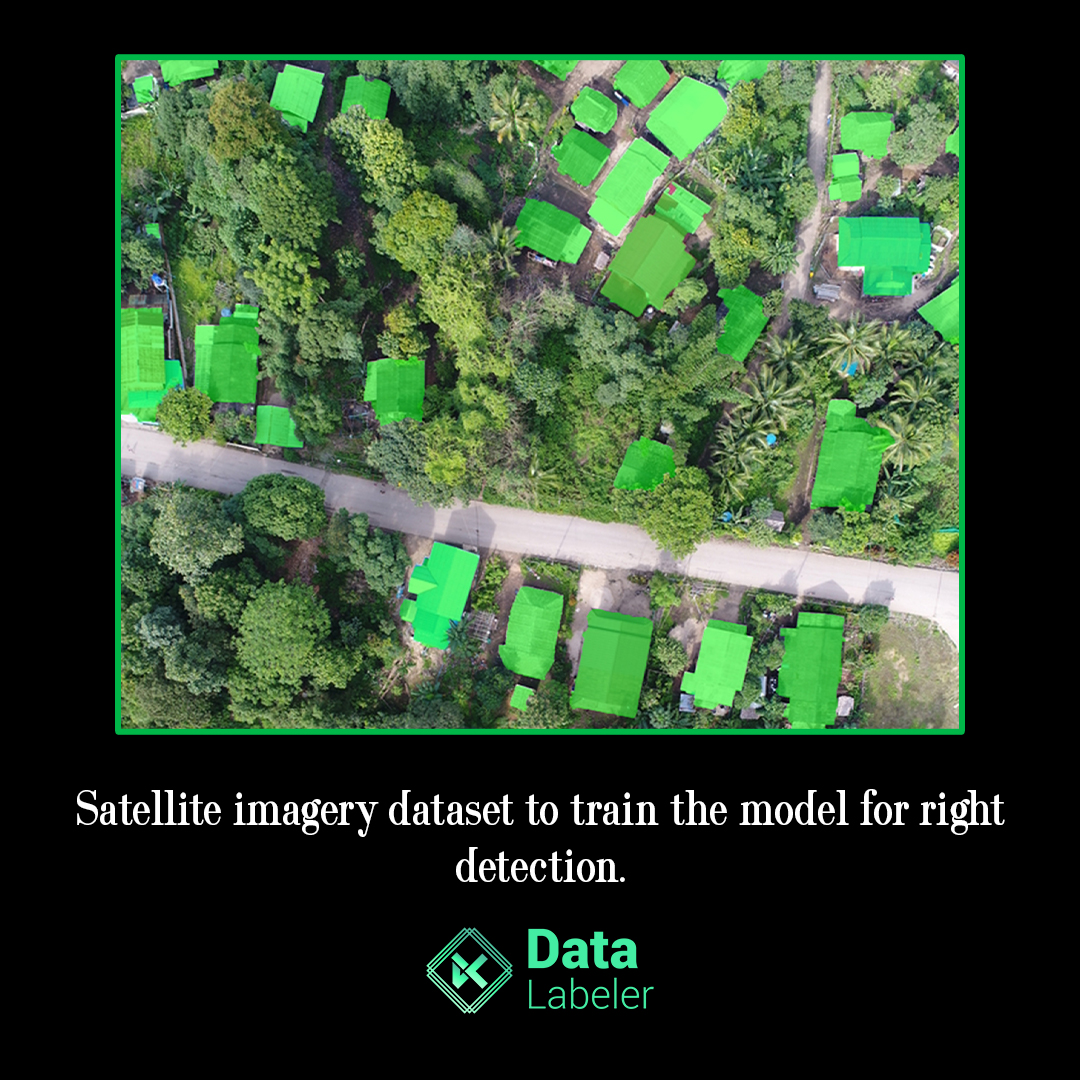
Satellite Imagery Dataset To Train The Model For Right Detection 

Datalabeler provides satellite imagery data sets with annotated images to make the varied objects recognizable from the Aerial view , at sky level heights , Drone images etc 

Datalabeler Annotation Technique

Bounding Box  – Utilizing data annotations to outline objects of interest within an image for object detection using bounding box annotations

Video Annotation  – Using annotated lines to capture each object in the video so that computers or machines can recognize the moving objects.

Objects Localization with 2D Polygon –  Using the polygon annotation technique to annotate unevenly shaped objects in drone and satellite imagery for object localization

Object counting

Object counting is one of the most common ways to use an object detection model. A newsroom might use object counting to estimate the size of a crowd in an ongoing  protest, while a retailer may use a similar model to predict the hours with the highest level of footfalls in a street . Other uses of object detection models include detecting and monitoring animal populations and identifying the valuation of houses for bank loans.

Inspection

Inspections are now characterised by drones, especially in industries. We label people, objects and other field equipment in aerial images captured by drones using various annotation techniques.

Disaster Management

We analyse pre and post aerial images of disaster-hit locations and label structures like buildings, ports, utility sheds, etc. for enabling smart and effective disaster management projects.

Field Analysis

We analyse aerial images of agricultural fields captured by drones and label them using semantic segmentation technique.

Why Outsource to Datalabeler ?

Datalabeler is a cutting-edge AI provider specializing in creating high-quality AI training data sets. With our dedicated team of annotators working 24/7 developing datasets for GIS  based projects. We ensure consistency in interpreting edge cases across the images where we classify every pixel in images containing buildings, flat surfaces, high and low vegetation, wires, masts, pedestrians, vehicles, etc.

Categories
Annotation Artificial Intelligence Artificial Intelligence Services Bounding Box Computer Vision Data Labeler Data Labeling Deep Learning Image Captioning Image Classification Machine Learning Machine Learning and Deep Learning Machine learning service Natural Language Processing Natural Language Processing and Deep Learning others Points Polygon

How AI Will Make the 2022 FIFA World Cup the Most Technologically Advanced Event Ever?

Computer vision servicesTechnology has a long-standing impact on football. For instance, goal-line technology and video-assisted replays both increase accuracy and do away with guessing. Additionally, both current and future AI-powered algorithms provide insights that should enhance the game.

Applications of AI on Sports Field

There are additional advancements that AI brings to the game. Utilizing AI technologies, certain applications evaluate athletes’ performances. These programmes analyse the playing style by providing precise real-time feedback to enhance performance and decision-making while playing. In order to portray athletes’ movements in three dimensions, the programmes make use of biomechanics sensors.

The hybrid system was developed by Loughborough University to examine player performance. It employs deep learning, computer vision knowledge, and automated camera-based decisions. These are the technology’s primary goals:

  • Detection of limbs and body pose
  • Evaluation of player performance data
  • Camera blending

A number of companies have emerged in an analogous effort to offer tools for monitoring player performance and obtaining scouting information. These instruments efficiently gather data for analytics, including as goals, fouls, free kicks, and shots from one player from one scene in a video to another.

AI Trends not to be Missed at FIFA 2022

  • Artificial intelligence is capable of creating and refining gaming strategies to produce exceptional, faultless decisions. Sports statistics are significantly impacted by AI tools like machine learning and deep learning as well. These are useful in a variety of gaming genres, but football in particular, where big businesses make a lot of money, is one of them.
  • One of the most basic applications of AI in sports is providing referees with a third set of eyes. The goal line and the video assistance referee are the two cutting-edge innovations that enhance the game with AI. These techniques support referees in their decision-making throughout games.
  • FIFA said this year that AI-powered cameras would be deployed to aid referees in making offside calls during the 2022 World Cup.
  • The AI semi-automated system uses machine learning to detect 29 spots on players’ bodies and consists of a sensor in the ball and 12 monitoring cameras placed beneath stadium roofs.
  • AI-powered facial recognition, the crew will now be able to zoom in on each of the 80,000 seats at Lusail Stadium
  • “connected stadium” idea will be employed for the first time at a World Championship. With the use of AI, security personnel will be able to foresee crowd swells and quickly address overcrowding.

How Datalabeler Can Help 

computer vision in sports

Data Labeler specializes in offering accurate, convenient, customized, expedited, and quality-labeled datasets for Machine Learning and AI initiatives. 

Player Tracking : Build real-time player tracking models with first-rate annotation tools, including bounding boxes, cuboids, polygons in both image and video.

Refereeing : Our annotation team can Train your AI to understand the game rules and assist referees to make the decisions where human senses lack accuracy.

Ball Tracking  : Datalabeler team can help in creating the most precise real-time ball tracking models to resolve disputes that may occur during the match.  

Categories
Annotation Artificial Intelligence Artificial Intelligence Services Bounding Box Computer Vision Data Labeler Deep Learning Image Captioning Image Classification Machine Learning Machine Learning and Deep Learning Machine learning service Natural Language Processing Natural Language Processing and Deep Learning others Points Polygon

Benefits of using Artificial Intelligence and Machine Learning

What advantages do artificial intelligence and machine learning offer?

One of the most crucial components in the growth of a contemporary economy based on cutting-edge technology is the development of machine learning services and artificial intelligence systems. With the help of this technology, transitions can be accelerated at various stages of business growth. We come into contact with instruments and equipment that employ artificial intelligence more frequently than we realise.

What are image recognition systems?

IT tools have long filled this void, but the rapid development of computer systems and individual economic sectors has brought it to light. Computerized image recognition enables a fresh perspective on a variety of subjects. We must understand that humans are perfectly capable of analysing what they perceive (image). Sizes, forms, colours, objects, and writings can all be distinguished. By retaining and remembering images, we learn.

Since computers lack the ability to analyse images, they are unable to differentiate between different sizes, forms, colours, objects, or inscriptions. They serve the purpose of maintaining, retrieving, and storing data. More complex computations are now possible thanks to advancements in computer system development. This has made it possible to analyse what is in the image from a developmental standpoint.

How do AI systems operate?

Systems for recognising images rely on algorithms that separate the image into its component parts. They then examine components like colour, shape, and so forth. Creating data aggregates and utilising them in later iterations of image recognition algorithms is one of their most crucial components. Models can learn from this process and improve their performance. The evaluation of the processed data serves as the foundation for determining the efficacy of each algorithm. The model can more reliably locate comparable things in other (unrelated) photos by using previous information about what was in the studied image. The input data serves as both the foundation and the framework for the algorithms.

The usage of image recognition technologies is popular.

starting with mobile devices (unlocking phones by face recognition, sorting collections of images by phrases). We can move more quickly by recognising cars by their licence plates in parking lots or on highways. Manufacturing is a crucial sector that enables maintaining a suitable level of quality while generating a huge number of items. Algorithms enable early detection and marking of production flaws. Because of this, the production process moves more quickly, which affects a decrease in production costs.

image recognition in the future.

The car sector appears to be one of the most well-liked uses of image recognition for consumers. Automakers already possess the autonomous control systems for passenger vehicles. They are closely followed by mass transportation initiatives (trucks and public transit). The human being who has not kept up with the adaptation of rules to technology possibilities is directly behind the dynamic development of this field.

About Data Labeler

Data Labeler aims to provide a pivotal service that will allow companies to focus on their core business by delivering datasets that would let them power their algorithms. – https://datalabeler.com/Contact us for high-quality labeled datasets for AI applications -Sales@DataLabeler.com
Categories
Annotation Artificial Intelligence Artificial Intelligence Services Bounding Box Computer Vision Data Labeler Data Labeling Deep Learning Image Captioning Image Classification Machine Learning Machine Learning and Deep Learning Machine learning service Natural Language Processing Natural Language Processing and Deep Learning others Points Polygon

Best approaches for data quality control in AI training

The phrase “garbage in, trash out” has never been more true than when it comes to artificial intelligence (AI)-based systems. Although the methods and tools for creating AI-based systems have become more accessible, the accuracy of AI predictions still depends heavily on high-quality training data. You cannot advance your AI development strategy without data quality management.

In AI, data quality can take many different forms. The quality of the source data comes first. For autonomous vehicles, that may take the form of pictures and sensor data, or it might be text from support tickets or information from more intricate business correspondence.

Unstructured data must be annotated for machine learning algorithms to create the models that drive AI systems, regardless of where it originates. As a result, the effectiveness of your AI systems as a whole depends greatly on the quality of annotation.

Establishing minimum requirements for data annotation quality control

The key to better model output and avoiding issues early in the model development pipeline is an efficient annotation procedure

The best annotation results come from having precise rules in place. Annotators are unable to use their techniques consistently without the norms of engagement.

Additionally, it’s crucial to remember that there are two levels of annotated data quality:

  • The instance level: Each training example for a model has the appropriate annotations. To do this, it is necessary to have a thorough understanding of the annotation criteria, data quality metrics, and data quality tests to guarantee accurate labelling.
  • The dataset level: Here, it’s important to make sure the dataset is impartial. This can easily occur, for instance, if the majority of the road and vehicle photos in a collection were shot during the day and very few at night. In this situation, the model won’t be able to develop the ability to accurately recognise objects in photographs captured in low light.

Creating a data annotation quality assurance approach that is effective

Choosing the appropriate quality measures is the first step in assuring data quality in annotation. This makes it possible to quantify the quality of a dataset. You will need to determine the appropriate syntax for utterances in several languages while developing a natural language processing (NLP) model for a voice assistant, for instance.

A standard set of examples should be used to create tests that can be used to measure the metrics when they have been defined. The group that annotated the dataset ought to design the test. This will make it easier for the team to come to a consensus on a set of rules and offer impartial indicators of how well annotators are doing.

On how to properly annotate a piece of media, human annotators may disagree. One annotator might choose to mark a pedestrian who is only partially visible in a crosswalk image as such, whereas another annotator might choose to do so. Clarify rules and expectations, as well as how to handle edge cases and subjective annotations, using a small calibration set.

Even with specific instructions, annotators could occasionally disagree. Decide how you will handle those situations, such as through inter-annotator consensus or agreement. In order to ensure that your annotation is efficient, it can be helpful to discuss data collecting procedures, annotation needs, edge cases, and quality measures upfront.

In the meantime, always keep in mind that approaches to identify human exhaustion must take this reality into consideration in order to maintain data quality. To detect frequent issues related to fatigue, such as incorrect boundaries/color associations, missing annotations, unassigned attributes, and mislabeled objects, think about periodically injecting ground truth data into your dataset.

The fact that AI is used in a variety of fields is another crucial factor. To successfully annotate data from specialist fields like health and finance, annotators may need to have some level of subject knowledge. For such projects, you might need to think about creating specialised training programmes.

Setting up standardised procedures for quality control

Processes for ensuring data quality ought to be standardised, flexible, and scalable. Manually examining every parameter of every annotation in a dataset is impractical, especially when there are millions of them. Making a statistically significant random sample that accurately represents the dataset is important for this reason.

Choose the measures you’ll employ to gauge data quality. In classification tasks, accuracy, recall, and F1-scores—the harmonic mean of precision and recall—are frequently utilised.

The feedback mechanism used to assist annotators in fixing their mistakes is another crucial component of standardised quality control procedures. In order to find faults and tell annotators, you should generally use programming. For instance, for a certain dataset, the dimensions of general objects may be capped. Any annotation that exceeds the predetermined limits may be automatically blocked until the problem is fixed.

A requirement for enabling speedy inspections and corrections is the development of effective quality-control tools. Each annotation placed on an image in a dataset for computer vision is visually examined by several assessors with the aid of quality control tools like comments, instance-marking tools, and doodling. During the review process, these approaches for error identification help evaluators identify inaccurate annotations.

Analyze annotator performance using a data-driven methodology. For managing the data quality of annotations, metrics like average making/editing time, project progress, jobs accomplished, person-hours spent on various scenarios, the number of labels/day, and delivery ETAs are all helpful.

Summary of data quality management

A study by VentureBeat found that just 13% of machine learning models are actually used in practise. A project that might have been successful otherwise may be harmed by poor data quality because quality assurance is a crucial component of developing AI systems.

Make sure you start thinking about data quality control right away. You may position your team for success by developing a successful quality assurance procedure and putting it into practise. As a result, you’ll have a stronger foundation for continually improving, innovating, and establishing best practises to guarantee the highest quality annotation outputs for all the various annotation kinds and use cases you might want in the future. In conclusion, making this investment will pay off in the long run.

About Data Labeler

Data Labeler aims to provide a pivotal service that will allow companies to focus on their core business by delivering datasets that would let them power their algorithms.

Contact us for high-quality labeled datasets for AI applications -Sales@DataLabeler.com