Categories
Annotation Artificial Intelligence Artificial Intelligence Services Bounding Box Computer Vision Data Labeler Data Labeling Deep Learning Image Captioning Image Classification Machine Learning Machine Learning and Deep Learning Machine learning service Natural Language Processing Natural Language Processing and Deep Learning Points Polygon

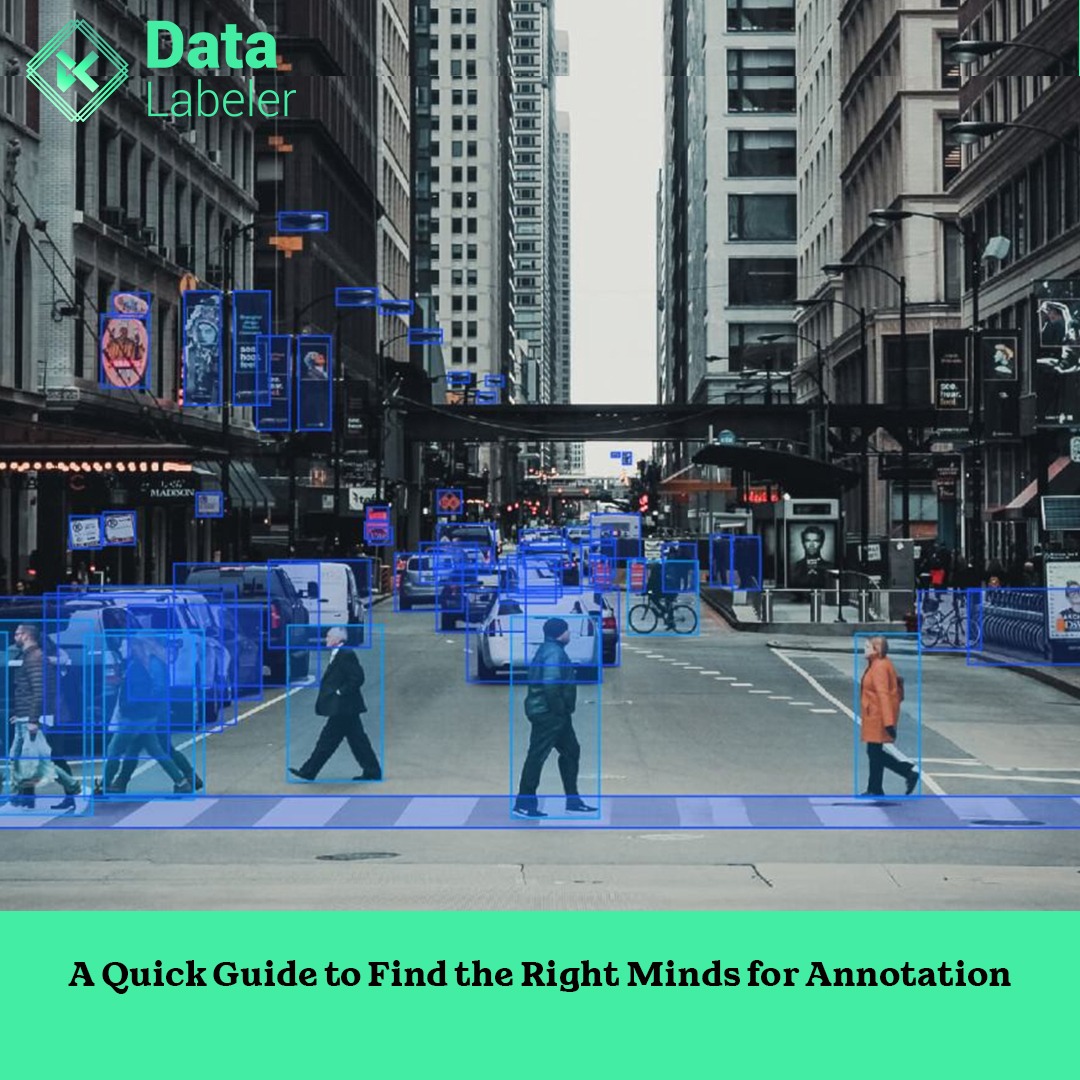
A Quick Guide to Find the Right Minds for Annotation

The amount of data involved in AI and machine learning integration is far too large to handle in-house. Finding outsourced data labeling professionals who can use their knowledge to create quality training data within a specific time limit is your best bet.

Outsourcing data annotation and labeling services to a professional firm that can deliver high-quality services is an option. Data annotation and labeling services can be outsourced to a professional firm that can provide high-quality services.

Communication is crucial to the success of your company. Maintaining communication between your data labeling team and your AI training team keeps the AI data integration plan and machine learning process on track.

1. Offers Access to a Sound Workforce

A solid group of professional training data specialists with years of industry experience ensures quality. The most important piece of advice here is to identify industry leaders and choose the one that offers the most relevant and high-quality training data for your AI and ML project.

2. Has Adaptable Ecosystem

AI training data requirements may change over time in terms of class, character, and volume. The perfect resource person for the job is someone who can meet your evolving AI training data needs.

3. Capitalizes on Cutting-Edge Technology

When it comes to offering a significant boost to your abilities for scaling up data annotation, data enrichment solutions can deliver quality resources. With higher workflow output, technology has the ability to boost performance.

4. Promises Productivity on a Budget

One of the primary indicators of a capable training data provider is performance output. When looking for a reliable training data company, look for three things: consistency, communication, and completed projects.

5. Has Uninterrupted Communication Channel

Communication is crucial to the success of your company. Maintaining communication between your data labeling team and your AI training team keeps the AI data integration plan and machine learning process on track.

Pick your partners wisely, as your collaborations with data labeling firms will determine the success of your AI implementation plan and the future of your machine learning project.

Increase your competitive advantage with unlimited support and exponential growth through our Data Annotation Services.
Categories
Annotation Artificial Intelligence Artificial Intelligence Services Bounding Box Computer Vision Data Labeler Data Labeling Deep Learning Image Captioning Image Classification Machine Learning Machine Learning and Deep Learning Machine learning service Natural Language Processing Natural Language Processing and Deep Learning Points Polygon

What is the scope of ML and Ai in the next 10 years

Many companies and the marketing teams that support them are rapidly adopting intelligent technology solutions to encourage operational efficiency while improving the customer experience. Through these platforms, marketers are able to gain a more nuanced, comprehensive understanding of their target audiences. Data labeler provides quality training data for ML & AI. The insights gathered through this process can then be used to drive conversions while simultaneously easing the workload for marketing teams. Machine learning is driven by artificial intelligence, and it involves computer algorithms that can analyze information and improve automatically through experience.

The world is progressing towards new technology. The adaptation rate of new AI and ML technologies is high. Artificial intelligence (AI) hopes to produce some of this century’s most important and revolutionary inventions. The products of the new AI revolution are self-driven vehicles, robot assistance and digital disease diagnostics that will affect how we live and function. And as demand for qualified engineers has more than doubled in recent years, professionals who want to take a lead in research and development in AI are providing endless opportunities. AI & ML engineering will produce an immense amount of career opportunities for the future.

Here is the list of some of the possible job roles for AI and ML engineering from which they can elevate their knowledge, experience and art of living.

1. Data Scientist:

Machine learning and artificial intelligence are central components of data science where insight generating approaches are applied from both, regression, predictive analysis and more.

2. Machine Learning Engineer:

Machine learning engineers come with applications, language analysis, statistics, math and more. In the creation and management of self-operating applications that promote machine learning projects, engineers are involved.


3. Business Intelligence Developer:

The market acumen of the Business Intelligence Developer must be considered in addition to AI. They identify various market patterns by analysing large data sets. The work pays well, and the market for it isn ‘t going anywhere anytime soon. 


4. Big data engineering:

A Big Data Engineer’s job is to build an environment that allows business processes to communicate effectively. The role is ideal for those who enjoy experimenting with modern technological tools.


In 10 years, AI/ Machine Learning will :

  1. Increase security:

Drones are going to change the way we live. Think of drones now as the equivalent of what phones were in the 90s. Drones open up the ability to transport things through the air over short distances and in complex spaces, which is just not something we have another solution for today.

 2. Generate new services

Artificial intelligence really means the extension of our ability to solve problems and generate new ideas. It’s quite possible that 10 years will get us to an inflection point, after which we will see advancement at an unprecedented rate. AI and robotics will have been assimilated into business operations and will be having a major impact on efficiency in organizations.

3. Empower businesses

The consumer-facing applications of AI and ML feel stuck to me, relegated to doing what humans can already do or, more critically, only what we trust them to do. Over the next ten years, we’ll start seeing trust barriers decrease, and as a result, dependence on AI-powered algorithms and machines will increase.

4. Improve healthcare

When it comes to healthcare, there’s a lot machines can do to help the doctor. We don’t see a future where we actually don’t have doctors guiding, but a lot of the busy work doctors have to do is better done using artificial intelligence. If you think about a doctor’s career, thirty or forty years, the number of patients you can see during that time period is very limited. 

About us:

We at Data Labeler believe in providing jobs to underserved communities and make them financially independent. We are on a mission to help them earn a living through the major changes brought by AI & ML , empowering businesses all over the world.

Increase your competitive advantage with unlimited support and exponential growth through our Data Annotation Services.
 

Categories
Annotation Artificial Intelligence Artificial Intelligence Services Bounding Box Computer Vision Data Labeler

AI Applications In Marketing

Artificial Intelligence must be perceived as a tool to drive marketing initiatives of achieving goals with a higher degree of precision. AI will inevitably help marketers combine advanced technology and human creativity to read, understand, and engage with modern consumers at the individual level with hyper-personalized, relevant, and timely communications. Data scientists may not understand marketing, and the marketer might not understand data science. But as the future paints the picture of an AI-driven world, the two will have to work together to understand the parameters of use cases, the data required to optimize them, and how that data will be acquired, governed, and used. We provide the best image annotation services for machine learning AI  companies.

There are around 15 applications in marketing. Some of the Applications and ways in which AI makes marketing better are:

Smart Content Curation

AI content creation governs machine-created content and automated personalization for the customer journey. AI-powered content curation allows you to engage visitors better and stay on top of their minds by providing them relevant content and extra value while putting forward your industry experience.

Voice Search

Everyone is familiar with Alexa, Cortana, and Siri. They are virtual assistants and work on speech recognition technology to assist users with their voice searches. Voice search is AI-based technology and can let marketers improve future SEO strategies. It is tremendously helpful in generating more traffic and enabling customer retention.

Ad Targeting

Machine learning algorithms on top of AI can analyze large amounts of customers’ historical data to establish which ads suit which customer and at what stage in the buying process. Using trends and data, AI can serve you as a marketer with the optimization benefits to deploy content at the right time. 

Dynamic Pricing

Dynamic pricing is when intelligent algorithms work behind a flexible pricing strategy based on current market demands and customer trends. Dynamic pricing also refers to time-based pricing or demand pricing.

Benefits of Leveraging Artificial Intelligence in Marketing

There is a myriad of use cases for AI in marketing efforts, and each of these use cases yields different benefits such as risk reduction, increased speed, greater customer satisfaction, increased revenue, and more. Benefits may be quantifiable (number of sales) or not quantifiable (user satisfaction). There are a few overarching benefits that can be applied across AI use cases:

Increased Campaign ROI

If leveraged correctly, marketers can use AI to transform their entire marketing program by extracting the most valuable insights from their datasets and acting on them in real-time. AI platforms can make fast decisions on how to best allocate funds across media channels or analyze the most effective ad placements to more consistently engage customers, getting the most value out of campaigns.  

Better Customer Relationships & Real-Time Personalization

AI can help you deliver personalized messages to customers at appropriate points in the consumer lifecycle. AI can also help marketers identify at-risk customers and target them with information that will get them to re-engage with the brand.

Enhanced Marketing Measurement

Many organizations have trouble keeping pace with all of the data digital campaigns produce, making it difficult to tie success back to specific campaigns. Dashboards that leverage AI allow for a more comprehensive view of what is working so that it can be replicated across channels and budgets allocated accordingly. 

Make Decisions Faster

AI is able to conduct tactical data analysis faster than its human counterparts and use machine learning to come too fast conclusions based on campaign and customer context. This gives team members time to focus on strategic initiatives that can then inform AI-enabled campaigns. With AI, marketers no longer have to wait until the end of a campaign to make decisions, but can use real-time analytics to make better media choices.

About us:

Data Labeler specializes in offering customized and quality-labelled datasets for Machine Learning and Artificial Intelligence projects. Data Labeler can help you empower artificial intelligence technologies in marketing for predicting the best possibilities and transforming them into the best business

We provide quality training data for ML & AI. If you too are looking for an innovative solution for your brand, Contact Us now!

Categories
Annotation Artificial Intelligence Artificial Intelligence Services Bounding Box Computer Vision Data Labeler Data Labeling Deep Learning Image Captioning Image Classification Machine Learning Machine Learning and Deep Learning Machine learning service Natural Language Processing Natural Language Processing and Deep Learning

Why AI-assisted content moderation will never be able to take the position of human moderators

Automation in content moderation is a broad concept. In certain aspects, AI content moderation systems use very little intelligence. AI in content moderation can refer to the use of a variety of automated approaches at various phases of content moderation. These techniques might range from simple keyword filters to machine learning and a wide range of tools and methodologies. AI looks to be the ideal response to the rising difficulties of content moderation on social media platforms, given the vast amount of data, the frequency of violations, and the need for human judgments without requiring people to make them. Consequently, most companies are outsourcing data labelling services to build robust machine-learning models. AI depends extensively on data and requires correctly annotated, classified, and anonymized data so that the machine learning algorithms can learn and get trained for better performance.

Consequently, most data labelling companies are outsourcing data labelling services to build robust machine-learning models. AI depends extensively on data and requires correctly annotated, classified, and anonymized data so that the machine learning algorithms can learn and get trained for better performance. Deep learning aims to mimic the way the human mind digests information and detects patterns, which makes it a perfect way to train vision-based AI programs. Using deep learning models, those platforms are able to take in a series of labeled photo sets to learn to detect objects like aeroplanes, faces and guns.

Technology and Human Moderators

While artificial intelligence (AI) has come a long way, and companies are continually refining their AI algorithms, we still require human moderators to maintain the brand online and ensure your content is of high quality. Humans are still the greatest at reading, comprehending, interpreting, and filtering information. As a result, for building an online presence and curating content, elite companies will combine AI and human expertise.

Humans can hold discussions

If you want to engage your audience in actual online conversations, you’ll need human moderators. No one is fooled just yet, even though AI is being trained to be more communicative. Chatbots, for example, maybe helpful in communicating with customers and giving simple information. They lack the compassion needed to properly engage with clients in a meaningful and personalized conversation. Human-in-the-loop moderation is ideal for connecting with customers. They can respond to comments and messages quickly, allowing for a two-way conversation.

Humans can decipher hidden meanings in sentences

Human moderators are better at reading between the lines, which is one of the most essential reasons for utilizing them. Hidden meanings will occasionally elude an AI, even though a human could usually grasp the meaning in a fraction of a second.

Humans have a better chance of learning about business.

Human-in-the-loop moderation also gives moderators a greater understanding of what their clients are thinking. They’ll be able to see any notable trends that arise. Human moderators understand the value of social listening and are skilled at posing questions to customers and requesting feedback on products and services. Human moderators may help your company go forward by engaging customers, reading between the lines, and taking suggestions seriously. The information they receive may be put to good use in your organization and used to guide future marketing strategies and activities.

Artificial intelligence has the potential to mistake an inappropriate post for an appropriate one, and vice versa. Humans are still necessary for the content moderation process to parse apart those nuanced and subjective images, videos, and posts that artificial intelligence might miss due to its lack of true human understanding. Human content moderators are called upon to employ an array of very high-level cognitive functions and cultural competencies to make decisions about the appropriateness of such content for a site or platform.

About Us:

Humans are still a long way from being entirely replaced by AI. On the other side, using AI as a preliminary screening for human moderators can offer you the best of both worlds. However, if you too want to increase your competitive advantage and grow your Artificial Intelligence projects, a collab with Data Labeler will be the right choice. Data Labeler is an excellent platform to grow your AI initiatives. With 1000+ expert data labelers, we aim to empower brands around the globe.