Categories
Annotation

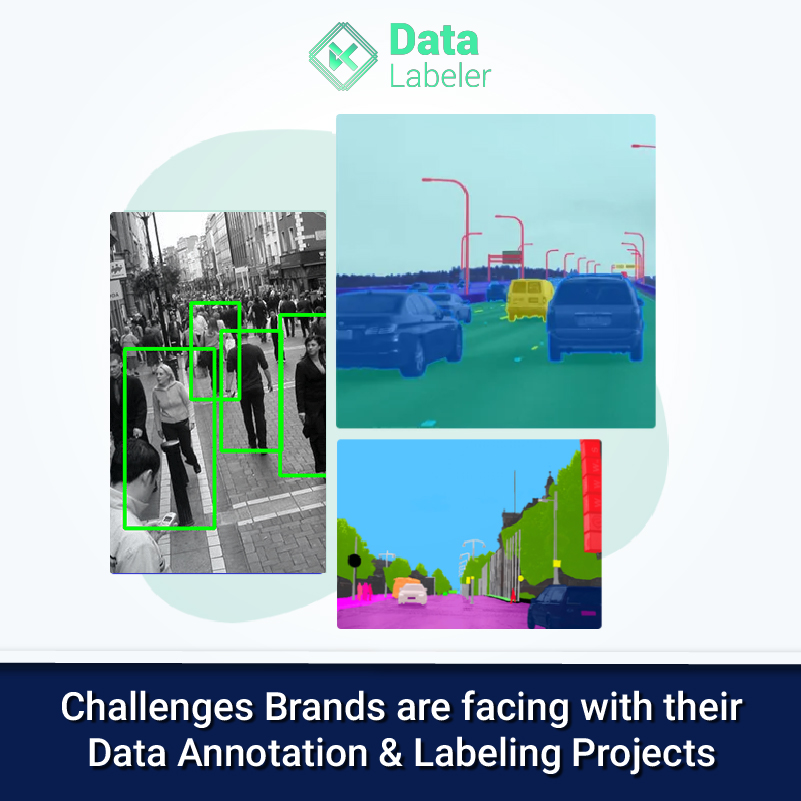
5 Challenges Brands are facing with their Data Annotation and Labeling Projects

Today the Artificial Intelligence industry is full of opportunities that every business wants to leverage. This is why there is a huge implementation of Artificial Intelligence in almost every industrial vertical today. Starting from automotive, retail, entertainment, manufacturing, and more industries for deploying in their businesses. The introduction of artificial intelligence in a business could bring a whole lot of competitive advantages and also help you flourish. The industry is today facing a lot of challenges regarding big data labeling and annotation processes.

Today Artificial Intelligence Models power big data and it requires massive data. Data should be big and the more you feed into a Machine Learning Model the more accurate predictions you’ll get from it. The data must also be relevant and complete which will let you achieve your goals effectively and also we divide off by blind spots and biases. This should also be labeled properly and undergo several rounds of quality checks to ensure its usability in the process.

Check out Five challenges that Data Annotation and Labeling Industries are facing today:

  1. Data Privacy and Compliance

The number of use cases for Artificial Intelligence is increasing rapidly and businesses are rushing to ride the wave and develop new solutions which would love its life and experience. However, on the other hand, the spectrum lies challenges businesses of all sizes are facing data privacy concerns. This is why the government has come up with various solutions like GDP, CCPA, DP, and other guidelines, however, there are new laws and compliances which are being developed and implemented by other nations around the world to protect data privacy.

Huge amounts of data generation are causing privacy concerns and are becoming a wide sensation in all industry verticals. Sensors and computer vision generate data that have the confidential details of the people, KYC documents, license numbers, and more. This has pushed for the need of having proper privacy standards and compliance to ensure the fair usage of confidential data. Law governing bodies have already come up with several data protection and privacy laws to avoid legal consequences in the future.

2. Workforce Management

Data annotation experts spend on cleaning and structuring data and making it machine-readable. At the same time, they also ensure that the data annotation processes are of high quality. Hence organizations are facing a big challenge of balancing both quality and quantity and churning out the solutions that would make a big difference and solve a purpose.

In such cases managing a workforce becomes tremendously difficult and tiring. Most of the companies today outsource people or they have dedicated in-house teams to avoid certain challenges like employee training distribution work and performance, more.

3. Tracking Financial Cost

Most often companies struggle to budget appropriately for their AI projects. According to a survey, 26% of enterprises have complained of a lack of budget to onboard an AI solution. Hence, without metrics, responsible monitoring and objective standards of data labeling success are limited in their ability to track results concerning spending time on work.

As a result brands are either paying for their data labeling projects, in-house or contracted. And as data continues to grow exponentially prices are increasing too. Hence, most brands and organizations are facing huge trouble accommodating data labeling into their budgets.

4. Ensuring the Data quality

One of the important aspects of ensuring data quality is assessing the definition of labels in every data set. For starters let’s understand two major types of data sets. One is objective data that is universally true regardless of who looks at that? Objective data that have several perceptions based on who is accessing and for what purpose they are using. Hence, considering various circumstances, you must be smart enough to understand the true meaning of the data.

This also involves a sentiment analysis module that will be processed based on what an operator has labeled. Here’s how businesses enforce guidelines and rules for eliminating the differences and bringing a significant amount of objectivity in various subjective data sets. This is how brands are facing challenges for maintaining the consistency of data quality as well as quantity.

5. Smart Tools and Assistance

Two distinct types of annotation methods are automatic and manual and now comes a hybrid annotation model which is ideal for the future. This is because artificial intelligence systems are good at processing massive amounts of data efficiently and humans are great at pointing out errors and optimizing the results efficiently.

This is why annotation techniques are catering solutions to the challenges that more or less every industrial vertical is facing today. Smart tools enable businesses to automate work assignments, pipeline management, and quality control of auditor data and offer more convenience. Hence without smart tools, employment would be still working on old techniques and pushing humans significantly for completing the work.

About Us:

Data Labeler offers a cost-effective solution for high-quality data labels. At Data Labeler we undergo constant quality checks as we intend to become your advanced and trusted labeling partner.

We also offer advanced workforce management software which is easily scalable with highly accurate labeled data. Contact Us for more information.
Categories
Artificial Intelligence

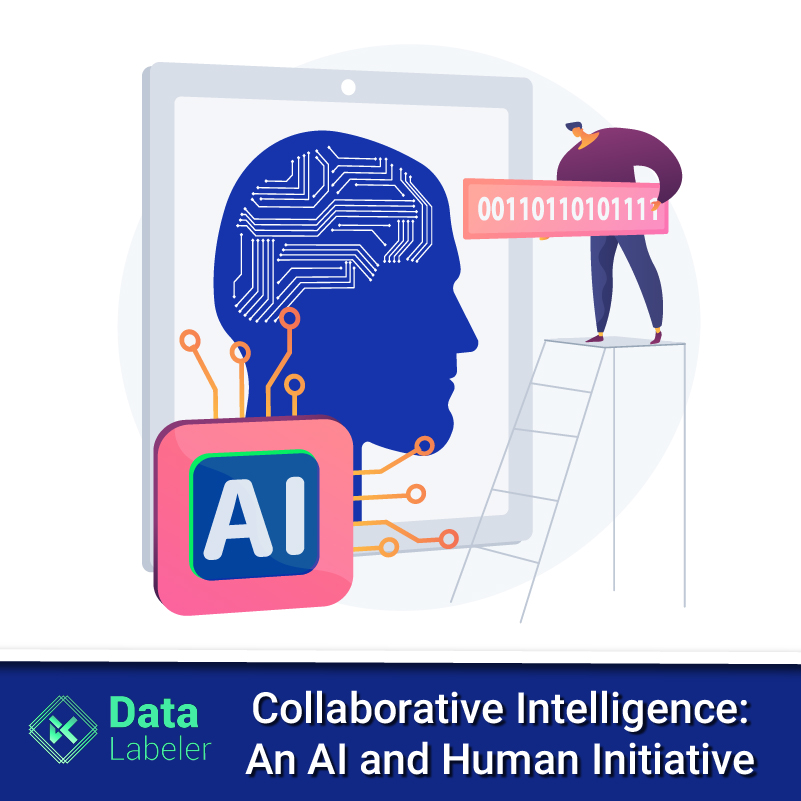
Collaborative Intelligence – An Artificial Intelligence and Human Initiative

Do you know humans and machines are complementary to each other and they enhance each other’s strengths?

Artificial Intelligence has become a wonderful aid to human jobs. Diagnosing disease, translating languages, or providing customer services has enhanced human life in a whole lot better way. And this has become a fear amongst the millennials that artificial intelligence might replace the human workforce in the coming years. However, it is not at all inevitable or the outcome in any way.

Artificial intelligence radically alters how work can be done easily and most simply without human intervention. But, the technology is always operated via humans. AI could simply ease or advance the day-to-day work but will never replace them.

At present various companies utilize artificial intelligence for automating the processes. However, those that leverage it mainly to displace the employees will realize short term gains. Harvard Business Review shows that 1500 companies found the most significant performance improvements happen when humans and machines work together. This enhances collaborative intelligence as artificial intelligence and humans contribute effectively with their combined effort. Creativity, leadership, teamwork, speed, scalability, and other quantitative capabilities enhance the collaborative effort of humans and machines.

For instance, what comes naturally to humans could be a bit tricky for machines which is why machines are straightforward and analyses data and then again which remains virtually impossible for human beings. Therefore, businesses require both kinds of capabilities: humans as well as machines.

Here’s how companies could benefit from the collaborative intelligence of humans and AI:

Now take full advantage of artificial intelligence and the human intelligence brands must understand how humans could effectively augment machines and how machines could enhance what humans do best. Starting from how to redesign business processes to support the partnerships, brands need to understand the value of collaboration.

Let’s check out four simple ways to make the best out of human and collaboration

  • Human Assisting Machines

Humans need to perform specific roles such as training machines how to perform particular tasks explain the outcomes of this task and most importantly when the results are counted as intuitional or controversial to sustain the responsible use of machines for example preventing robots from harming humans.

  • Training the Right Way

Training then comes training coma machine learning algorithms should be taught how to perform a specific test as they are designed to do. To do so, massive training data sets must be gathered for teaching machine translation apps to handle metric expressions such as medical apps to detect diseases and recommend engines for supporting financial decision-making. Artificial intelligence systems must be trained to interact with humans in an effective way. And organizations across various industrial verticals must learn in the early stages of filling trainer roles starting from tech companies and research groups which have much of the trained staff.

  • Explaining it the right way: The Explainers

As their trends tend to increase and reach conclusions via various processes which are opaque they require human experts in the field to explain their behavior to non-expert users. Depending on the industrial sector explain is becoming very important such as medicine or law where a practitioner needs to understand how an artificial intelligence tech provides input or comment.

Explainers are also important in helping insurance or law enforcement bodies such as how an autonomous car acts and leads to an accident. Today it has become an integral part of the regulated industries in any consumer-facing vertical where machine output could be challenged as illegal or unfair. This is another area where artificial intelligence will contribute to generating 75,000 new jobs for administering the GDP requirements.

  • The Art of Sustaining

Brands also need sustainable people who will explain the outcomes. Employees must continue their work to check that artificial intelligence systems are functioning safely, responsibly, and effectively. Artificial intelligence technologies are used around analytic and decision-making ability to heighten creativity to the maximum level. For instance, an area of experts is sometimes referred to as safety engineers who focus on anticipating and trying to prevent any homes that could be led by AI.

The development of the industrial robot industry is also working parallelly to focus on ensuring that they recognize humans and do not endanger them. The experts may also review analysis from explainers when artificial intelligence technologies could harm such as a self-driving car being involved in a fatal accident.

Most activities at the human-machine interface have enhanced and gained proper enhancement with the human-machine interface that requires people to do new and different things or to do things differently.

About Us

Data Labeler provides accurate customized and quality label datasets for various types of artificial intelligence projects. Hence, if you are looking to enhance your competitive advantage and want to trigger your exponential growth level, Data Labeler is your go-to guy! Contact Us to know more.

Categories
others

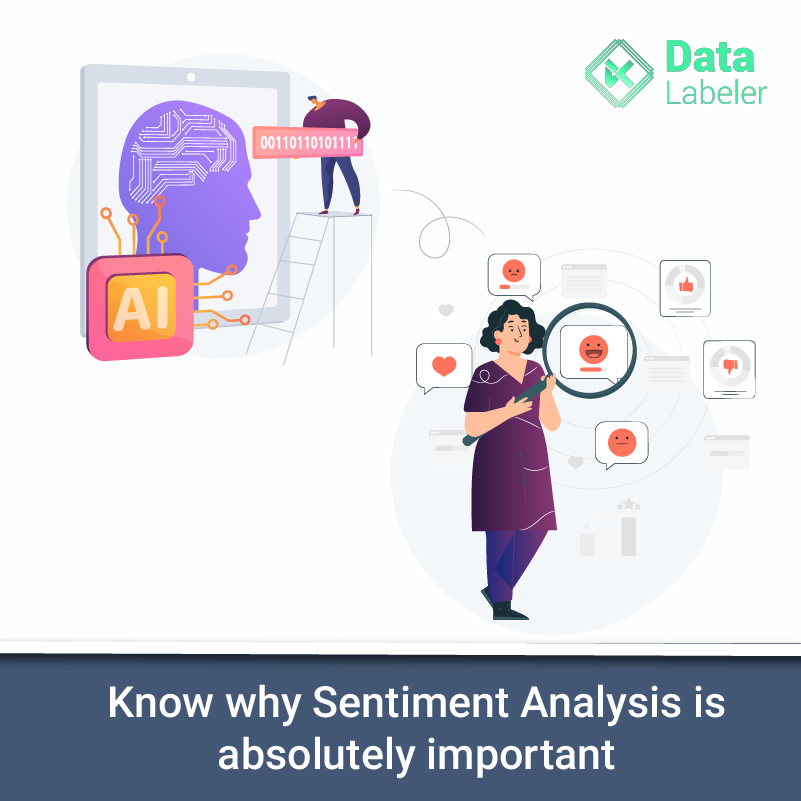
Know Why Sentiment Analysis Is Absolutely Important

Humans have opinions but, what about Machines? How can you teach machines to read people’s opinions and their preferences? And above all why does it matter? Well, these are the questions that are raised on a daily basis on the upcoming news to Machine Learning Technologies. Today Sentiment Analysis, which is a subset of Natural Language Processing (NLP), has made a completely different impression on the millennials.

Let’s dive in and understand why Sentiment Analysis matters:

Sentiment analysis is also called opinion mining which is the technique to identify and extract subjective information from text or audio. Online reviews and customer support requests are a few of the best examples of sentiment analysis. In simple words sentiment analysis determines whether subjective data is negative, positive, or neutral. However, thanks to the advancement of machine learning technologies, now brands can also use sentiment analysis for challenging use cases which are like understanding less conventional language uses, monitoring online behavior, and identifying emotions.

Sophisticated recommendation engines are used by online stores like Amazon’s which rely heavily on sentiment analysis to predict the preferences of their customers. Today, highly sophisticated technology goes above and beyond for utilizing product ratings such as learning how popular a specific product is and why.

At present brands are making use of Sentiment Analysis also to prioritize customer support tickets or to determine the most effective communication channels and preplan product improvements in the future. Altogether this value will aid in leading the brands for improving and enhancing customer experience profitability and new opportunities in business.

This vast amount of already available public information, social media, and other media platforms are helping the brands to implement sentiment analysis seamlessly and achieve greater transparency and drive citizen engagement by figuring out what and how people are responding to various matters. Reviewing sentiment analysis also enables the government and policymakers to identify widespread societal and epidemiological issues before they break out.

Here’s the best way to approach Sentiment Analysis Training

  • For building a relevant sentiment analysis algorithm, analysis model developers need massive amounts of labeled data for training the model.
  • They must focus on context and quality assurance while choosing a data preparation team.
  • Also, they must have access to a better team that ensures improved quality and assurance that are aligned to the project goals.
  • And on the other hand, the outsourced model manages the workforce and provides greater scalability and flexibility which matches crowdsourcing for teaming up with the gig workers.

About Us:

Data Labeler can be your ideal partner for data annotation and data labeling procedures. We specialize in offering convenient accurate customized and quality labeled datasets for your Machine Learning and Artificial Intelligence Initiatives.

Data Labeler possesses sophisticated workforce management software which enables you with seamless labeling and training experiences. With cost-effective solutions and being a highly efficient labeling partner, Data Labeler is your one-stop shop for all your data annotation and labeling needs. Are you still deciding on how to make the best of your AI technologies? Contact Us now.

Categories
others

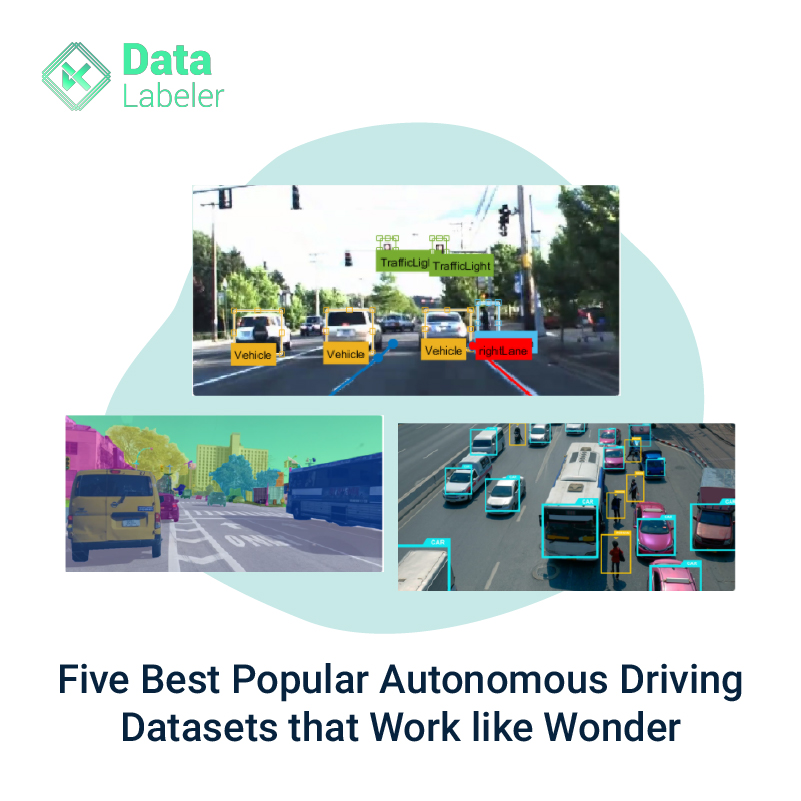
Five best Autonomous Driving Datasets that work like Wonder

More and more companies and research organizations are making their efforts into Autonomous Driving Datasets making them viable for the public. However, the best autonomous driving sets are not always easy to find. It takes its own sweet time to be found while scouring the internet.

As automotive companies are competing to achieve level 5 autonomy for vehicles and high-quality drivers training has acquired a vital status in the development process. Multiple players are closer to training or labeling data because we all are aware that artificial intelligence and Machine Learning models are the best for training datasets. Labeled datasets are designed specifically for autonomous problems which tend to help Machine Learning teams to achieve better success in solving the predefined problems.

However, it is also understandable that everyone could not afford to invest heavily in creating special training datasets.

Here is a list of the top five open datasets which you can start using immediately:

  • Oxford Radar Robot Car

The Oxford Radar Robot car dataset is made up of more than a hundred repetitions of a consistent root via Oxford the UK which has been captured for over one year. This data set is nothing but a combination of several different combinations of pedestrian traffic weather along with long-term changes like road works and constructions.

  • Waymo Open Dataset

The Waymo Open dataset is an open-source high-quality multi-modal censored date of death for autonomous driving. This data set is extracted from more self-driving vehicles which cover a wide variety of environments starting from dense urban centers to Suburban landscapes. It comprises multiple timeframes which include sunshine, rain, dawn, and dusk. This dataset also contains a thousand types of multiple segments where each segment captures 20 seconds of continuous driving which is corresponding to 2,00,000 frames at 10 Hz per sensor.

  • Level 5 Open Data

It is a comprehensive large-scale data set that features LiDAR sensor cameras that feature autonomous vehicles in several restricted geographical areas. This dataset also includes high-quality labels 3D bounding boxes of multiple traffic agents. Level 5 open data includes more than 55k human-label three-dimensional surface maps underlying high definition spatial semantic maps which are captured by seven cameras and 3 LiDAR sensors that are used to contextualize the data.

  • Google Landmarks Dataset

Google published landmark status in 2018. Google landmarks dataset is further divided into two sets of images for evaluating the organization and ritual of human-made or natural landmarks. The original dataset comprises more than 2 million images depicting 30 thousand unique from across the world. In 2019 Google marked landmark version 2 as an even more massive data set with 5 million images and 200k landmarks.

  • ApolloScape Open Dataset

It is part of the Apollo project which is an evolving research project that aims to Foster innovations across all aspects of autonomous driving. Starting from perception to navigation as well as control. Through the website, users can explore several simulation tools and more than 100K street-view frames, 1000 km trajectories for urban traffic, and 80k lidar point cloud.

Final Thoughts:

Global directions are onwards making more data available and accessible to the research and Machine Learning experts. In turn, new data experts will continue to grow and make data accessible to the crowdsource, and computer science experts would continue to create innovative solutions for everyday life.

About Us:

Data Labeler could help you with convenient, customized, expedited, and quality-labeled datasets for Machine Learning and AI initiatives. Data Labeler helps you enhance your competitive advantage and increases your exponential growth.

Want to know more about training datasets for Machine Learning? Contact Us