Categories
Artificial Intelligence

Artificial Intelligence in Space

As super computers have become a reality, science fiction caters to several examples of artificial intelligence, machine learning, or smart robots in outer space. From star wars to hitchhikers’ guide to the galaxy, it seems that AI and space go hand in hand. Since these are fiction, we are trying to find examples in the real world which make use of artificial intelligence to help in commercializing space.

Astronauts were trained both physically and psychologically for dealing with extreme space situations. Living in a confined space without gravity could be stressful and might hamper the decision making processes. This is where artificial intelligence which came into the picture.

Multiple years after the first moon landing, experts are looking for emerging technologies to realize space exploration in a better way. And recent breakthroughs and discoveries have led to show the immense potential in space exploration like global navigation, earth observation, and other communication from both sides. Machine (Learning) algorithms have been used in monitoring the spacecraft, controlling systems, autonomous navigation of the spacecraft, controlling systems, and smartly detecting objects in the road path. Hence in this way, to help astronauts meet their goals to in reaching mars and beyond, AI-based assistants are created. These assistants are primarily created to understand and predict the crew’s needs and apprehend the astronaut’s emotion and mental health.

What emerges as a Game Changer in Space Exploration? 

Artificial Intelligence has positioned itself as a game-changer in the present society and also  the space industry. Government and agencies have been leveraging artificial intelligence technologies for a long time to gather imaging data related to space explorations. Robotics has been utilized by government agencies to conduct modern surveillance, identify and mitigate risks for by analyzing a substantial amount of data collection.

The European Space Agency (ESA) report reveals that satellites could produce more than 150 terabytes of data every day. Now, with the use of artificial AI technologies, one could reduce the mission’s costs, extend battery (any other form of resource) life, and analyze  massive amount of imaging data which is produced by the satellites.

Another significant utilization of artificial intelligence in the space industry is the process of increasing the spectrum efficiency and connectivity through real-time adjustments. So, in this case of space exploration, as the satellites could learn to transmit data using the appropriate frequencies, deep learning technology could simplify the communications furthermore. Reports reveal that AI technology is utilized for RLAN to reduce the chance of interference and increase spectral efficiency.

These technologies would aid in telemetry and controlling the geostationary orbit as well as non-geostationary orbit’s frequency and physical coordination. Deep learning technologies are not only meant to reduce the interference burden for satellite networks but also avoiding co-channel interference at various stages of the satellite orbit.

Artificial Intelligence on the basis of Exploration

For navigating space travel profoundly, NASA is continuously making strides towards artificial intelligence applications. Moreover, NASA has also developed an AI update, which aids in automating the laser-firing capabilities of the rover. Hence, with an increased pace in data collection, a trained AI system is a perfect match for monitoring the spacecraft and lowering the downtime and possible risks.

Also, with the help of Google’s trained model, NASA manages to discover other planets like Kepler-90i & Kepler-80g.

European aerospace company Airbus has introduced artificial intelligence in space exploration. AI-powered 3D printed spherical robots (Crew Interactive Mobile Companion CIMON) were also being developed for helping astronauts and their accuracy in everyday tasks at the International Space Station with uniform empathy level of human. A second version of this technology was developed with various extended functionalities and capabilities known as CIMON 2.

Artificial intelligence led by Space Race

The modern space race, with the help of artificial intelligence, is different from the 20th-century completion between two Cold War rivals, namely the Soviet Union and the United States, who gave their first spaceflight capabilities.

According to reports, the space industry is set to reach a worth of 1 trillion USD by 2040 and become one of the most prominent businesses in the world. And big names like Jeff Bezos, Elon Musk, and Richard Branson.

Conclusion

The space technology would be secure with the influence of artificial intelligence. It will also show clear potential for exploring the interstellar space with multiple innovative machines and projects. For each and every innovation, technology is coming a step closer to provide newer insights and proving a major advantage.

About Data Labeler

Data Labeler caters to world-class annotation services. From offering bounding boxes, polygons, points, texts to select or multi-select services, Data Labeler provides advanced quality training data sets for using a knowledgeable workforce. We also cater excellent data services for building data sets that you need to power your algorithms.   
Categories
Artificial Intelligence

AI in Healthcare

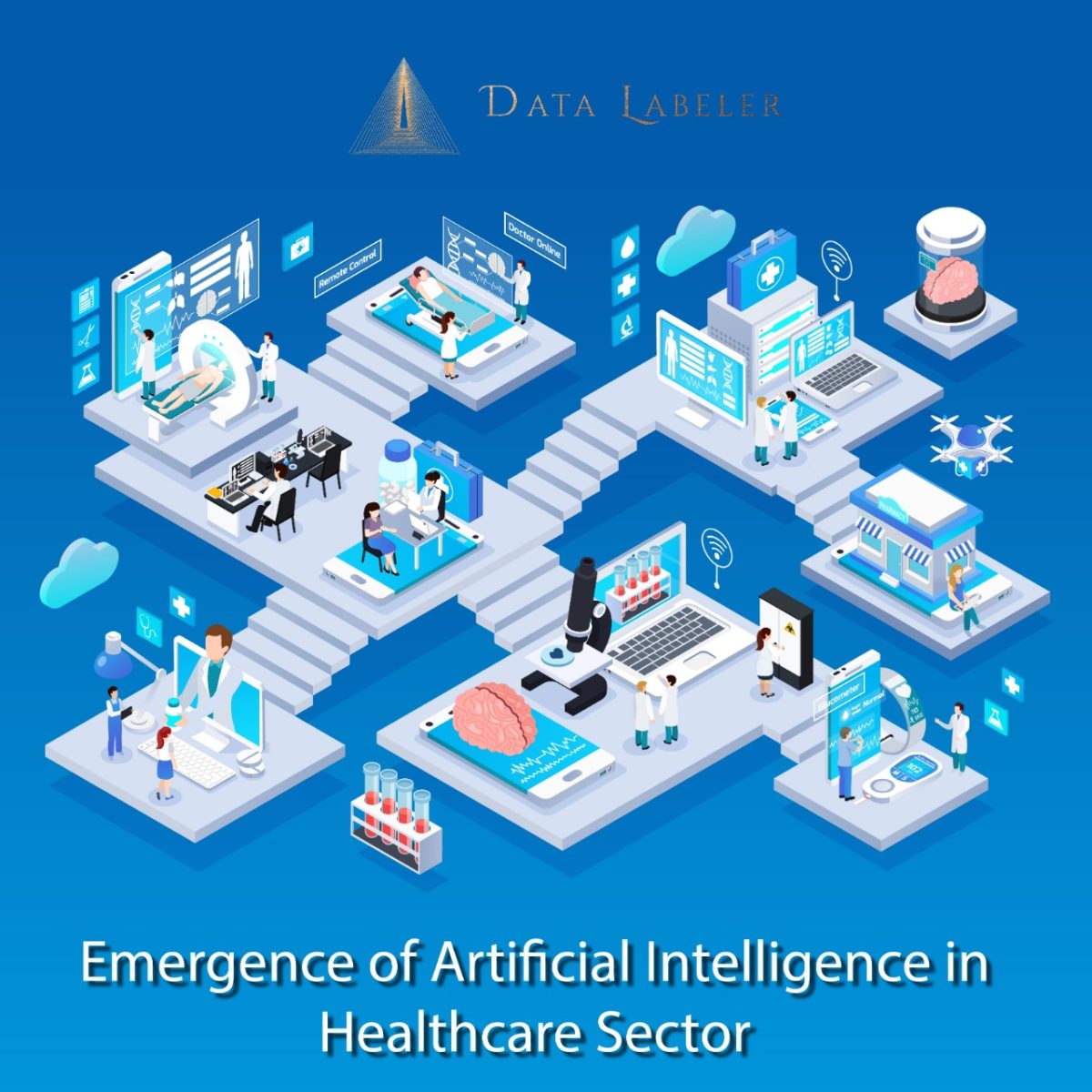
Artificial Intelligence has smartly transformed industries around the globe and has the potentiality to alter the field of Healthcare which is ready for some serious changes. From radiology and risk assessment to chronic diseases and cancer, there are numerous opportunities for leveraging technology and deploying more precise, efficient, and strong interventions in real-time treatment.

Treatment structures are evolving, and patients are expecting more from their providers. Hence the amount of data is increasing at a constant rate, and artificial intelligence is the primary driver of all these improvements across the Healthcare spectrum.

Artificial Intelligence in the field of Health-care Sector

Artificial Intelligence offers multiple advantages, like improved data-driven decisions, increase disease diagnosis efficiency, reduce unnecessary hospital visits and help time-saving administrative duties. Learning algorithms have become more accurate and precise as they interact with the training data, which enable humans to gain outstanding insights into diagnostics, treatment variability, care processes, and patient outcomes. 

Various surveys have revealed that the current status of AI applications in the healthcare sector can be applied to multiple types of Healthcare data (Structure or unstructured). And there are few Machine Learning methods for structured data like modern deep learning, support vector machine, neural network, and natural language processing for unstructured data.

Moreover, major disease areas which use AI tools include Neurology, Cancer, and Cardiology. For instance, experts can review a case of Stroke in detail through AI applications. AI enables the experts to have a detailed look at the three primary areas such as detection, treatment, and as well as prognosis evaluation and outcome prediction.

The areas of the Healthcare industry are most likely to realize a major change by Artificial Intelligence in the next decade. But, the question is, how? 

Top 5 ways how artificial intelligence is going to revolutionize the Healthcare sector: 

  1. Unifying machine and mind through brain and computer interfaces 

Making use of computers for communicating is not a relatively new idea. But, creating interfaces bridging the gap between technology and the human mind without any significant applications is the cutting edge area of research. 

Such as in a few cases, neurological diseases take away the ability to move and interact. This is where AI kicks in. Brain-computer interfaces backed by AI could restore those fundamental experiences for them. 

  • Developing Next-Gen Radiology Tools 

Radiological images can be obtained by CT scanners, MRI machines, and X-rays, which offers non-invasive visibility into the inside of a human body. But, several diagnostics processes might rely on many physical tissue samples that are obtained through biopsies and carry risks like a potential infection. 

Artificial Intelligence will empower in building advanced radiology tools which will provide detailed reports and might replace the need for tissue samples in a few cases. 

  • Reducing the burdens of electronic health record use 

Electronic Health Records have played a major role in the healthcare industry. But, the journey towards digitalization has given birth to unforeseen problems and cognitive overload.

So, EHR developers are now turning towards artificial intelligence for creating more intuitive interfaces and automate the processes which consume most of the users’ time. 

Apart from that, dictations and voice recognition aids to improve the clinical documentation, sorting through the in-basket, and order entry. AI could also help in processing the medication refills, routine requests from the inbox and result in notifications. It can also prioritize the task of a clinician that truly needs his attention.

  • Building precise analytics for pathology images

Studies reveal that 70% of the decisions in pathology is made on the basis of pathology results. And 70-75 % of all data in an EHR are from a pathology result. Therefore, the more accurate the results would be, the sooner you would arrive at the right diagnosis. And this way, digital pathology and AI will deliver a better service in the future. 

Analytics will concentrate on the pixel level on extraordinarily large digital images, which would let the experts identify the nuances in a better way which might escape the human eye. 

Artificial Intelligence will improve productivity by identifying the features of the interest in slides a human clinician could review. 

  • Taking the Intelligence to medical devices and machines

As smart devices are taking over rapidly, offering everything from real-time video to the car’s interiors, it can detect when the driver is distracted. 

Health sectors are not lagging from the touch of Artificial Intelligence.From critical monitoring patients in the ICU to suggest sepsis is taking hold, AI has significant contribution in this sector.

Inserting intelligent algorithms into these devices could reduce the probable burden for the physicians, and patients will receive better and timely care as well.

About Data Labeler

Data Labeler’s team of experts offer end-to-end Machine Learning and software solutions for organizations of all market segments. From Data collection, data labeling, annotation and machine learning applications, Data Labeler has got everything you need.

Data Labeler specializes in building quality datasets for machine learning and artificial intelligence initiatives.

Contact us for high-quality labeled datasets for AI applications.

Categories
Natural Language Processing

Natural Language Processing

Natural Language Processing (NLP) is a branch of AI that helps machines understand natural language and enables interaction between machines and humans using the natural language. NLP helps the machines to read, understand and manipulating human language in a valuable way.

How NLP Works?

The first step in NLP depends on the type of application being developed. A voice-based system for instance involves the use of Hidden Markov Models (HMM)for converting words into text. HMM utilizes math models for interpreting natural language and converting it into text. The NLP system then processes this text further.

The next step involves understanding the context and language by dividing each part of a sentence into parts of speech. The algorithm that performs this step is trained on grammar rules. These algorithms use statistical Machine Learning to help NLP system to interpret the word context.

In scenarios like above where speech-to-text is involved, the NLP system avoids the first step using HMM and interprets the words based on grammar rules using algorithms.

NLP uses two methods mainly to interpret the human language; Semantic and Syntax analysis.

Syntax involves arrangement of words using grammar rules. This method enables the NLP system to use grammar rules and extract meaning from language.

Syntax Techniques

  • Parsing – checking sentences for grammar
  • Sentence breaking – placing boundaries around large texts
  • Word segmentation – divide larger texts into smaller fragments
  • Morphological segmentation – grouping of words
  • Stemming – Use inflection to convert words to its root forms

Extracting meaning from the text forms the crux of Semantic Analysis. The NLP system utilizes semantic analysis to understand the meaning and review the structure of a sentence for logically interpreting the human language.

Semantic Techniques

  • Sense disambiguation – using context to derive word meaning
  • Named Entity Recognition –  divides words into groups as per the category
  • Natural Language Generation –  extracts hidden semantics within words using a database

Technical Approaches for Developing NLP Systems

To develop an NLP system, two main technical approaches are used. They are Machine Learning and Rules-based methods

ML-based method uses algorithms that has the ability to interpret natural language based on previous encounters. In this method, text annotation services are used to train the ML algorithms on how to co-relate an input with its respective output. When you consider the previous example of Sentiment Analysis, an algorithm is specifically created for the automatic classification of reviews into positive, negative or neutral. The algorithms undergo training to accomplish the task by leveraging human labeled text data and to predict for unseen data without manual intervention.

Rules-based method applies linguistic rules to text. Each rule has a prediction and an antecedent. When performing sentiment analysis on product reviews for instance, it lists out the positive and negative words. Each review is analyzed to get the count of positive and negative words that in-turn helps to determine the sentiment of the overall text.

NLP Use Cases

Email Assistants

NLP has been used for everyday activities in some form or the other like auto-complete, grammar, spell-check and auto-correct. Email filters also use NLP to keep the spam emails away from the inbox.

Chatbots

NLP is utilized for training chatbots on specific behaviour and to enhance their performance before deployment. NLP algorithms enable chatbots to answer customer queries. They help the chatbots to interpret the meaning behind a query raised by customer and answer without human intervention in real-time.

Sentiment Analysis

Sentiment analysis is a common application of NLP that helps to determine the positive or negative polarity of a text. It empowers businesses to get customer views on their services or products. It is mainly used for categorizing product or company reviews and collect customers’ opinions from their social media posts or comments.

NLP requires the help of ML/DL algorithms to perform this task and also to perform back-end computation and data analytics for understanding huge data volumes.

About Data Labeler

Data Labeler specializes in providing best-in-class labeled datasets that help to power Machine Learning algorithms for Computer Vision projects. Contact us to get high-quality labeled datasets for AI applications.

Categories
Machine Learning

Top 5 Machine Learning Trends to Watch in 2021

Machine learning is going to revolutionize the industries in the coming years, in 2020 we have seen tremendous growth in the Machine learning and AI technologies. In 2021 machine learning will drive many business including medicine, health, E-commerce, agriculture and others. Here we are going to present you the machine learning trends for 2021 that will shape the industries in this year.

Increasing usage of Machine Learning

As per a research study, 77% of the devices that are in use presently utilize ML in some form or other. From virtual personal assistants like Siri, Alexa & Google to online transportation networks that estimate the price of the ride, email spam and malware filters, and social media platforms like Facebook that uses facial recognition to help recognize a friend instantly, Machine Learning has been leveraged by organizations and for day-to-day activities. The usage of ML will continue to increase in 2021.

Hyperautomation

Hyperautomation, a trend picked by Gartner refers to the possibility of automating each and every process within an organization. Being the next major phase of digital transformation, Hyperautomation can be used to automate even the legacy processes. Being one of the key components of Hyparautomation, ML helps to create automated business processes that can adapt and react to changing conditions and circumstances. With the current pandemic looking to continue into the next year, digital transformation powered by Hyperautomation seems to be the way forward for many businesses.

Intersection of ML and IoT

AI/ML and IoT need each other to flourish. ML algorithms require more data to learn, adapt and operate efficiently whereas IoT devices need to become more smart and secure. IoT devices provide the data required to train machines while integrating ML algorithms into IoT devices makes them smarter and more secure. We will continue to see the culmination of ML and IoT in many devices in 2021.

Reinforcement Learning

Reinforcement Learning is a technique that involves the use of deep learning algorithms that can learn from its own experiences. The machines perform on the basis of conditions set to perform a specific activity. Reinforcement Learning enables machines to find the best possible path it should take to achieve the ultimate objective.

Business Forecasting and Analysis

Whether you want to predict the trend in financial markets or forecast peak consumption in electricity during the day, time series is the best data science technique to leverage. Time Series Forecasting makes use of the best fitting model essential to predicting the future observation based on complex processing current and previous data.

Machine learning proved to be the most effective in capturing the patterns in the sequence of both structured and unstructured data and its further analysis for accurate predictions.  

About Data Labeler

At Data Labeler, we provide fully managed data labeling services and specialize in the production of high-volume and best-in-class training datasets for AI and ML initiatives. Reach out to us at sales@datalabeler.com for high-quality data labeling services.