Categories
Artificial Intelligence

Myths of AI

Artificial Intelligence (AI) has raised a lot of curiosity and excitement in recent times. What used to be a topic of discussions in academic institutions has now become a buzzword with everyone talking about it. Various industries have shown interest in adopting AI and its development is happening at a brisk pace. In addition to the interest in technology, a lot of myths of AI have surfaced leading to misunderstandings and confusions surrounding it.

Here are the top 5 myths of AI;

AI Works Like a Human Brain

AI comprises of software tools, math, and logic that works to solve a problem. Current AI is nowhere near or equivalent to human intelligence even though some forms of AI give this impression. The AI that is been developed nowadays can perform only a specific task. But if the conditions change it fails. For instance, the AI developed to perform image recognition cannot be used to perform other tasks like solving math problems.

Intelligent Machines Cannot Be Biased

AI machines are trained using data generated by humans and they perform tasks based on rules created by humans which again influences the behavior of every algorithm. Hence, AI is going to be intrinsically biased. Companies must ensure to eliminate social bias from the data used for training Machine Learning algorithms. Also, they should ensure diversity in teams developing AI and have a peer review system to significantly reduce AI bias.

AI Will Replace Only the Manual and Repetitive Jobs

In addition to automating the mundane tasks, AI can also carry out technically complex works which are generally reserved for highly-trained professionals such as doctors, financial analysts, lawyers, and others.

In the field of radiology, there have been instances of imaging AI identifying diseases quickly than the highly-trained radiologists. AI has also entered in the legal field where it is used to scan a large number of documents to present the facts and points relevant to an ongoing case.

AI has surfaced in the financial and insurance sector as well where it helps to detect fraud and advise on wealth management. But AI is not going to completely replace the human efforts but rather it helps to enhance the work and leave the unusual tasks to be carried out by humans.

Super-Intelligent Machines Will Outpace the Humans

When it comes to calculation speed and recall capacity, machines can easily outpace humans. But, when you consider strategic thinking, emotional ability, and creative intelligence, machines are nowhere near humans. Moreover, machines can only be as intelligent as the data that is available to them.

When pursuing the best possible answer, machines pursue infinite possibilities and may end up in a proverbial rabbit hole without the possibility of coming out of it. Humans, on the other hand, pursue the countless possibilities and if something doesn’t work, will pause and reconsider their strategy and will pursue a different path.

Not Every Business Requires an AI Strategy

AI is a transformative technology that can do wonders for your business. It can help you focus on your core business objectives and help you gain a competitive advantage. But if you decide to have a no AI strategy, then you should make this decision after enough research and consideration. The decision should be revisited regularly so that you are not left behind in the competitive market.

About Data Labeler

Utilizing the complex tools and technologies, Data Labeler offers best-in-class image annotation and video annotation services that help you build sharper models with great precision. Reach out to us @ sales@datalabeler.com for high-quality datasets for your ML and AI initiatives.

Categories
Image Captioning

Visual Search – Images for a Better Search Experience

Gone are the days when plain text used to be the only option to look for information on search engines. Nowadays, people have started using images as search query inputs to quickly find information related to the image or similar images. Innovations are being made to enhance the visual search experience of users by using Artificial Intelligence.

The retail industry will benefit the most from visual search. It helps to enable frictionless retail experiences to buyers by allowing them to shop the look. This means buyers can search with influencer’s photo or with the snapped picture of a person and find the exact product or the relevant ones.

How Visual Search Works?

Like text-based search, visual search also interprets and understands a user’s query which in this case is an image and finally delivers the relevant search results. AI is used to detect elements in an image which are then used to identify and show similar images.

Text-based search forces people to think hard to get their search query right and find what they are looking for. But visual search powered by AI helps to interpret images and take visual cues from it thereby reducing the burden for the searcher.

Optimizing Images for Better Search Experience

Structured Data

Use of structured data helps to take the visual search experience to an entirely new level. It helps the visual search engines to return more relevant results by allowing them to more accurately scan a web page content.

Image Categorization

Tagging and annotation of images help to improve the image search experience. Labeling and categorization of images help to surface the best images for searchers and makes it easier for them to find what they are looking for.

Alt Attributes

In addition to improving the accessibility of images, a descriptive alt text helps the search engines to understand the image better and provide the relevant search results.

Image Quality

The quality of the image has to be good enough for the visual search engines to see the individual components within an image and the image shouldn’t be pixelated.

At Data Labeler, we combine technology with human care to provide image annotations and video annotations with pixel-level accuracy. Our data labelers maintain quality while processing & labeling the image data which can be used efficiently for various AI and ML initiatives.

Categories
Artificial Intelligence

New Trends in AI & Sports

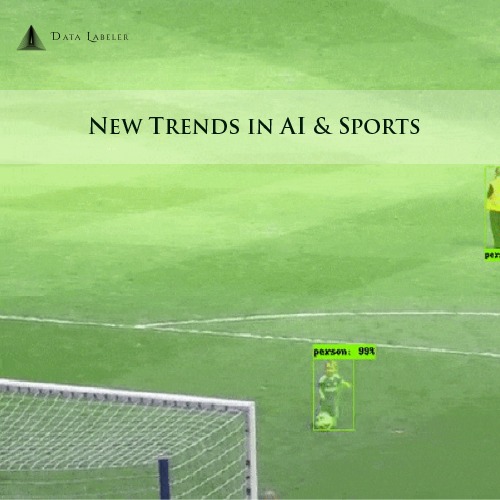
Artificial Intelligence is a cutting-edge technology that empowers machines to perform tasks which would normally require human intelligence such as decision making, speech recognition, and visual perception. It has had an impact on various industries from the past few years and the sports industry is no exception. It can be applied to almost all areas of sports from predicting game plan to coaching the players and assisting in winning the game.

Here are some new trends in AI and Sports:

Machine Referee

AI has already been used to assist referees when giving out judgments in tennis matches about whether the ball was in or out. But they have not completely replaced humans. Advancements in AI will lead to a situation where AI technology will fully replace the human element involved in officiating sports matches. Computer vision helps the machines to analyze the video footage in real-time and make judgments more effectively and quickly.

AI Coaches

Artificial Intelligence can assist coaches in developing and improvising game strategies. This can be achieved by training machines to fully understand the game. While devising a game plan, AI can help to predict the chances of winning for diverse game tactics. AI can also provide coaches and players with data on common mistakes and helps them to analyze the data with improved accuracy and enhances their game at a faster rate.

Automated Press

AI helps to pick up highlights of a match and can distribute it to television broadcasters. Its capabilities have been extended to the print media as well where AI can generate pieces of content related to sports. Since most of the sports-related news is stats-based, AI can structure these data and convert it into an article automatically with ease.

Sports Chatbots

Chatbots can be used to answer the queries of fans which can range from franchise history and team stats to player stats. It helps the event organizers to communicate with people about the sporting event and helps in managing the event logistics.

Engaging Fans

Artificial Intelligence can be used to enhance the gaming experience for the fans. Using this technology, fans can be provided with better and faster access to video clips and highlights of the live matches which in turn keeps them excited throughout the game. AI can be used to streamline the security checks and also assist in providing expedited lanes for fans entry into stadiums.

AI will continue to impact the sports industry and as the technology improves, it will play a major role in enhancing the capabilities of the sporting events at the highest levels.

About Data Labeler

Data Labeler specializes in providing best-in-class labeled datasets that help to power Machine Learning algorithms for Computer Vision projects. Contact us to get high-quality labeled datasets for AI applications.

Categories
Bounding Box

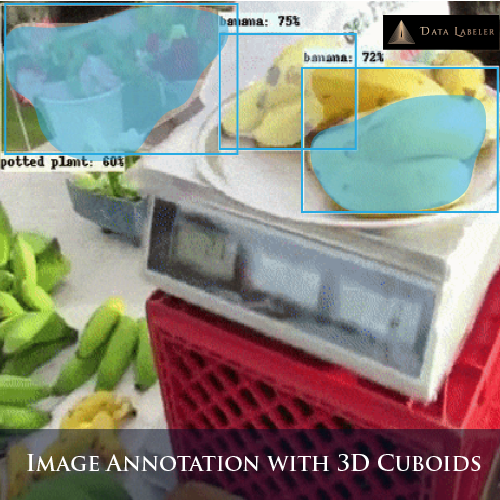
Cuboid Annotation – Annotating 3D Objects with 2D Data

Building a 3D representation of the world from 2D images is one of the major concerns in Computer Vision. The initial step that helps to achieve this is annotating 3D objects with 2D data using Cuboids.

What is Cuboid Annotation?

Cuboid Annotation is the task of labeling objects in 2D images with cuboids. The 3D cuboids help to determine the depth of the targeted objects such as vehicles, humans, buildings, etc.

Cuboid Annotation is used for building a 3D simulated world from 2D information captured by cameras. The 3D cuboidal training data helps to train the Cuboid Detection models which aid in localizing the objects of interest in the world and in estimating their pose.

Use Cases

Autonomous Vehicle

Cuboid Annotation helps autonomous vehicles to understand the real-world environment. It mainly aids in detecting vehicle movement and its dimension for autonomous vehicles. It helps the self-driving cars to measure the distance of each obstacle from the vehicle and calculate the spacing.

Identifying Indoor Objects

You can build the model perception for detecting indoor objects using the 3D cuboid annotated images. This helps to train your Computer Vision models to have in-depth object detection capabilities. Cuboid Annotation helps to identify indoor objects like couch, table and other furniture with precision and best quality.

Training Robots

Cuboid Annotation can be effectively used for training robots that are deployed in different industries such as automotive, warehousing, etc. It helps to create better perception models that enable the robots to work continuously without the need for human interference. The 3D Cuboid Annotation of images captured from 2D cameras, powers perception of the robots and drone imagery which have applications in various fields.

At Data Labeler, our main focus is on creating quality labeled datasets for Machine Learning and Artificial Intelligence initiatives. We offer a diverse range of services which include Bounding Boxes for object detection, polygons for semantic and instance segmentation, key points for facial and body pose detection, image captioning texts, and image classification.

Cuboid Annotation helps to achieve annotation of 3D objects with 2D data and plays a critical role in Computer Vision projects. To know more, click the link – https://datalabeler.com/cuboid-annotation-annotating-3d-objects-with-2d-data/

For high-quality data labeling services, click the link – https://datalabeler.com/