Categories
Machine Learning

Exciting Use Cases of Machine Learning

Machine Learning has been one of the most significant technological advancements in recent times. ML is a subfield of Artificial Intelligence that gives the machines the ability to learn without the need for explicit programming by employing large datasets and training algorithms. The accelerated development of this technology has resulted in many exciting and innovative use cases which will become mainstream in the coming years.

Let’s take a look into some of the exciting use cases of Machine Learning;

Autonomous Vehicles

Self-driving cars have created a lot of curiosity and buzz in recent years. Early reports have also indicated that autonomous vehicles can reduce traffic-related fatalities and lead to a safer future for transportation. However, it will take some time for the wide-scale adoption of these autonomous vehicles.

How do these self-driving cars work?

Self-driving cars are powered by Machine Learning and Deep Learning algorithms. Unstructured data from raw images are converted to structured data by annotating objects in the images. These labeled images are then used to train the ML and DL algorithms. 

Computer Vision models are developed based on the trained ML & DL algorithms which process data points from different sensors such as radars, lidar, camera to detect the obstacles and operate the vehicles autonomously.

Moderating Content on Digital Platforms

Most of the industries have become digital leading to an exponential rise in the number of digital platforms. This has led to a situation where a heterogeneous mix of content is added to the digital platforms daily and there is a need to identify unacceptable content quickly thereby adding complexity to the review process.

Machine Learning tools such as image recognition is already being put to use by companies like Facebook, Twitter, etc., to recognize objects within images. These tools also take into account other factors such as user experience and risk involved to classify them as content to be reviewed by humans. This eliminates the large volumes of content from reviewer’s queue allowing them to see the flagged-content and take a decision on whether to publish or remove the content.

Influence Customers’ Experience in Retail

The retail companies have been gathering customer behavior data such as their age, gender, spending habits, and their preferences. But the main challenge for these companies is to extract valuable insights from the data available both offline and online to improve their business.

Machine Learning helps retailers to discover patterns in the data on which they can act upon to improve the customer buying experience and enhance their brand. Retailers can use Machine Learning models to predict which products to offer and when to give discounts from previously acquired data and provide a more personalized experience to their customers.

Efficient Healthcare

Machine Learning algorithms can be used to analyze and understand diagnoses and risk factors and give recommendations for treatment of diseases. IBM’s Watson has been deployed in various hospitals where it has proven its ability to make highly accurate recommendations for the treatment of certain cancer types. Google has also ventured into this space with a Machine Learning algorithm that helps in identifying cancerous tumors in mammograms.

Cybersecurity

Cyber-attacks are skyrocketing globally and companies are investing in huge numbers to overcome this looming threat. It is estimated that companies will spend more than $1 trillion from 2017 to 2021 in countering cyber-attacks.

Researchers worldwide are of the idea that ML can be leveraged to prevent and defend against cyber-attacks. There already exists an overabundance of big data which can be used to train the ML algorithms to improve the state of cybersecurity. Defense systems are being developed which can run for 24 hours a day and easily spot any suspicious activity and act against it based on the past data.

Machine Learning has numerous use cases in various fields. Businesses have huge amounts of data with them. By understanding core business challenges, companies can use this data to train the ML models and transform their business with intelligent systems and gain a competitive edge.

At Data Labeler, we combine technology with human care to provide annotations and labeling of images and videos with pixel accuracy. Our data labelers maintain quality while processing & labeling the image data which can be used efficiently for various AI and ML initiatives.
Categories
Bounding Box

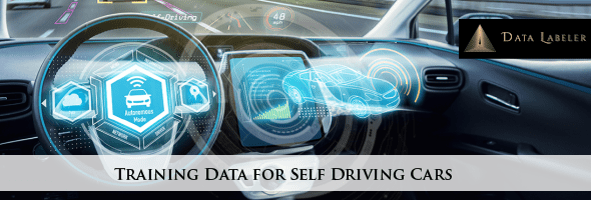
Training Data for Self Driving Cars

Self-driving cars also known as autonomous cars have captured the imagination of the people and mark a major change in the automotive industry. With all the major players in the automotive industry from the Tesla to Volvo, BMW, Mercedes Benz, and others investing heavily in developing self-driving cars have heated the autonomous vehicle race.

The self-driving cars which are complex machines are powered by machine learning algorithms. These algorithms help the car to process a lot of visual data similar to how a human driver does while driving. For the vehicles to identify an obstacle such as a tree or a pedestrian, it should be capable of assigning meaning to large volumes of data.

Machine Learning algorithms have to be trained with labeled data to help the self-driving cars to understand its environment. Manual labeling of objects in images is a time-consuming process. Hence Artificial Intelligence is used for image processing and labeling of data. Labeling with AI is quicker and more accurate than manual labeling.

Few things have to be considered when annotating and labeling autonomous vehicular data;

Clarity

There should be proper clarity on what objects to capture. For instance, there may be many objects at a traffic intersection. In this kind of scenario, it is best to have guidelines on what objects can qualify for labeling and capturing the right criteria for them. This helps to annotate and label the right objects and leads to efficiency and consistency.

Select the Right Toolsets

Each annotation task requires a different set of toolsets. Bounding Boxes work well for object localization and detection whereas applying text labels & drawing cuboids are required for metadata attribution. Polylines are used to outline roads and lane markings. The tools that you may use for these annotation tasks will not work for segmentation tasks. The segmentation tasks require outlining of overlapped objects and the ones that share boundaries.

Economy

The scale of data annotation need increases in the production environment. This, in turn, increases the risk of bad data. The exponential increase in training data needs at the production level has turned out to be a challenge for companies.  They have to hire enough internal resources to handle the data labeling tasks at a scale which is not feasible for a single company.

The best option is to outsource your data annotation and labeling needs to third-parties like Data Labeler who with a team of more than 1000 full-time data labelers can manage your annotation needs at scale.

At Data Labeler, we combine technology with human care to provide annotations and labeling of images and videos with pixel accuracy. Our data labelers maintain quality while processing & labeling the image data required to train and test your self-driving cars effectively.

Categories
Image Classification

Image Processing Applications

One can define Image Processing as a means of converting an image into its digital form and perform some operations using computer algorithms to get an enhanced image or to extract useful information from it.

Image processing helps to identify what’s present in an image and used in the development of most of the Computer Vision applications. It is one of the rapidly growing technologies with an increasing number of applications in various fields.

Image Processing Applications

Below is a list of major fields in which Image Processing is widely used:

Image Sharpening and Annotation

Image sharpening and annotation refers to the process of enhancing an image to achieve the desired output and includes sharpening, blurring, zooming, detecting of edges, recognition, and retrieval of images.

Biomedical Imaging

In the medical field, Image Processing has various applications from UV and X-Ray imaging to the gamma-ray image, PET Scan, and medical CT. Image Processing techniques help to improve the diagnosis of heart diseases, identify lung disease using X-Rays and detect breast tumors.

Remote Sensing

Image processing techniques are applied to process the images of the earth’s surface captured by the remote sensing satellites. It helps to detect infrastructural damages caused due to an earthquake, analyze the situation for flood control, monitor agricultural production, interpreting objects and areas for city planning and in resource mobilization.

Machine Vision

Training the robots to see and identify the objects and hurdles. Robots can be trained on hurdle detection by helping them to identify various objects in an image and calculate the distance between them and the hurdles. Image Processing can also be used to train a line follower robot to move in a specific path and perform tasks.

Microscopic Imaging

Image Processing helps to process, analyze and present microscopic images and enhances the ability of the scientists and researcher in understanding the microscopic world.

Video Processing

Image Processing helps to improve the quality of the videos and can be used for performing various tasks such as noise reduction, motion detection, detail enhancement, rate conversion, and color space conversion.

Pattern Recognition

Pattern Recognition involves the combination of Image Processing and machine learning to identify objects in an image and train the system to identify the pattern changes. It is mainly used in the recognition of images, computer-aided diagnosis and handwriting recognition.

Categories
Polygon

Understanding Semantic Segmentation

Development of most of the Computer Vision projects involves inferring knowledge from an image. Semantic Segmentation plays a key role in image analysis and helps a machine to recognize objects in an image. It is one of the high-level tasks that help to understand the complete scene in images.

What is Semantic Segmentation?

Semantic segmentation is the task of associating every pixel of an image with a corresponding class label. It is a type of pixel-level image classification which not just marks an image with labels and bounding box parameters but also gives a high-resolution image as the output.

Applications of Semantic Segmentation

Semantic segmentation has been successfully applied to tasks that involve segmentation of images. Below are a few key applications of Semantic Segmentation:

Autonomous Vehicles

Semantic Segmentation helps in equipping self-driving cars with the needed perception to understand the constantly changing environments and plan & execute the tasks with utmost precision.

It helps the autonomous vehicles to know exactly where other vehicles are and the free spaces on roads in addition to traffic signals and lane markings to safely navigate through the roads.

Medical Imaging

In the field of medical imaging, Semantic Segmentation helps to identify pixels of lesions or organs from CT or MRI images which in turn helps to understand the shapes and volumes of the organs. This aids the radiologists to perform better analysis and run diagnostic tests without delay.

Geo-sensing

Multi-class semantic segmentation helps to monitor land areas for deforestation and urbanization. It helps to recognize the type of land cover at the pixel level in satellite images. It also aids in city planning, road monitoring, and traffic management through detection of roads and buildings.

Precision Agriculture

Semantic Segmentation can help farming robots by assisting them in triggering weeding actions in real-time. It helps the robots to identify the right time for spraying out herbicides in the fields thereby reducing the need for manual monitoring.

Semantic Segmentation thus plays a crucial role in understanding images through the classification of each pixel in images. Pixel-level classification helps to achieve detection and delineation of objects thus enabling computers to perform accurate image analysis.