Categories
Bounding Box

how to bridge the gaps of Large-scale Projects with a Scalable Data Annotation Strategy

Human intelligence will always be necessary for data annotation and artificial intelligence. The margin of error for this job is quite small and gets smaller with time. This is because algorithms intended for public use frequently amplify minor mistakes. This increases the visibility of errors.

Artificial intelligence must be taught on inclusive and varied datasets to realize that utopian goal. That is accurate even if your next brilliant AI has a very narrow and singular goal in mind. You would be well to outsource to a seasoned data annotation service provider to realize your next great breakthrough in automation, machine learning, or artificial intelligence.

What are the biggest challenges for large-scale data annotation projects?

  • At-Scale Accuracy and Quality

Internal AI project teams eventually face a quantity vs. quality problem as the need for AI dataset volumes increases for training or instructing the model to make future decisions. Teams working on AI projects must set up and evaluate quality control procedures to ensure that annotation at scale doesn’t compromise quality.

  • Speed

The majority of AI initiatives have deadlines. Annotating datasets with millions of data points can quickly turn into a bottleneck that causes delays or gives a rival company more time to launch a solution. Time and resources for project-specific training as well as sufficient time set out for annotation itself are essential components of a successful data annotation strategy.

  • Human Resources

Hiring inside personnel for data annotation is a possibility when projects get bigger. However, it takes months for new hires to become capable of meeting quality requirements and working autonomously.

It could be alluring to put other members of the AI project team in charge of data annotation in an all-hands-on manner. But data labeling requires particular abilities, such as consistency, outstanding short-term memory, patience, and attention to detail. 

  • Agility

Many businesses lack the manpower to finish large-scale data annotation projects internally within the timeframes that they would like.

Teams working on agile AI projects need to budget for tasks after the initial round of annotations. Building AI models is an iterative process that requires updating or changing datasets to improve the model’s output. Increasing agility in response to changing requirements can be achieved by automating certain human-supporting tasks, including results validation.

  • Various Challenges for Multiple Data Annotation Types 

There are many different kinds of data and also many different kinds of data annotation. Each comes with various challenges. Additionally, various use cases and project goals provide their unique problems. Unique problems that may require customized solutions. For example, the image and video annotation required for computer vision and machine learning comes in different forms to provide solutions for different applications.

Types of data annotation and labeling services include:

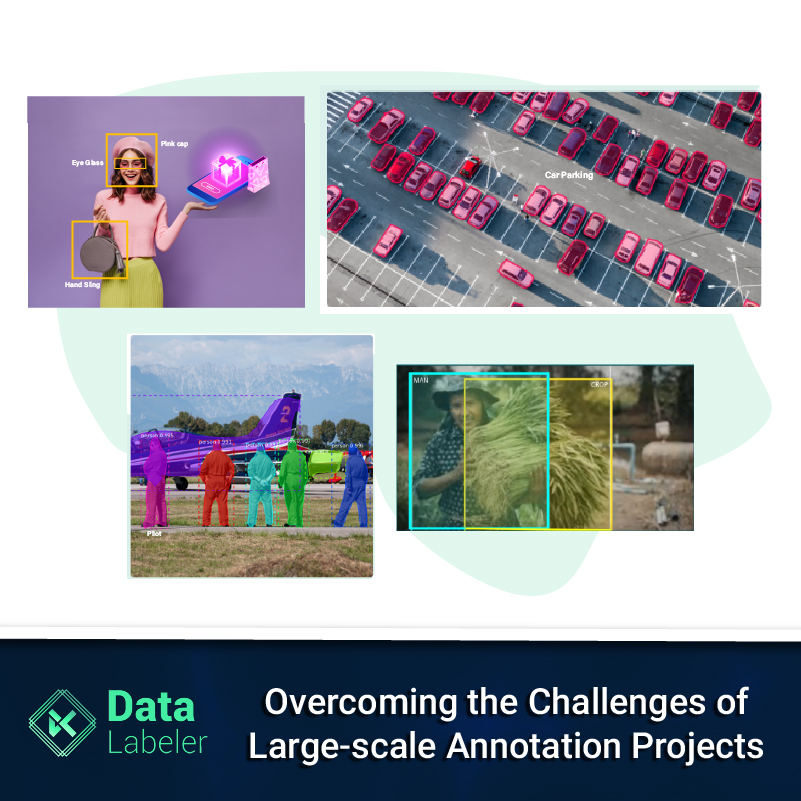
  • Bounding Boxes for Object Detection
  • Polygons for Semantic & Instance Segmentation
  • Points for facial recognition & body pose detection
  • Texts for image captioning
  • Select for image classification
  • Semantic Segmentation for complex image classification

How to overcome the challenges of Data Annotation? There is a solution for every problem

You can overcome the ethical and technical obstacles in the way of developing your revolutionary AI. Science fiction of the past is the science reality of the future. There is no need for your business to handle it alone. One excellent way to handle your data annotation project is to outsource it. While, your team and resources can be freed up to focus on your key objectives.

A top-notch platform-equipped data labeler or annotation service provider can create personalized remedies for your particular issues. You don’t need to experience knowledge overload. It’s okay to delegate collecting, safely storing, and processing of that massive amount of data to others.

Here’s where Data Labeler comes into the picture!

While you concentrate on developing algorithms that will benefit you, let Data Labeler concentrate on your data labeling & annotation techniques. 

Still, wondering how Data Labeler can help you? Or have a Use Case in mind? Let’s Discuss. Contact us

Categories
Machine Learning

Image Recognition: A Guide to Label Images for Your Machine Learning Projects

A variety of sectors employ image recognition technology to verify different types of data. Prominent corporations in the fields of healthcare, e-commerce, retail, automotive, and advertising are swiftly embracing picture recognition-driven applications. 


These apps assist businesses in increasing their level of productivity. Image analysis, gesture recognition, autonomous car vision, and medical face detection are among the common uses for image processing. The size of the global image recognition market is expected to increase at a compound annual growth rate (CAGR) of 17.4% from $43.60 billion in 2023 to $134.41 billion by 2030.

What is Image Recognition? 


Often referred to as processing, transcribing, or tagging, image annotation is a kind of data labeling. Also, videos can be annotated frame by frame, constantly, or as a stream. The most popular uses for picture annotation include object and boundary recognition, as well as image segmentation for purposes like meaning or whole-image comprehension. To train, validate, and test a machine-learning model for any of these purposes and get the intended result, a sizable amount of data is required.

Types of Image Recognition:

1. Image Classification

One type of image annotation is image classification, which looks for the existence of comparable objects in photos throughout a dataset. A machine can be trained to recognize an object in an unlabeled image if it resembles an object in previously labeled images that were used for the machine’s training. Tags are used to describe the process of preparing images for image classification.

2. Identification of Objects

One type of image annotation called object recognition aims to precisely identify and name one or more things in a picture by determining their existence, location, and number. It is also useful for identifying a particular object. Bounding boxes are another object recognition method that can be used to classify different things inside a single image.

3. Segmentation

Depending on the feature sets of your data annotation tool, image annotation may entail one or more of these methods.

Methods for Image Recognition:


Depending on the feature sets of your data annotation tool, image annotation may entail
one or more of these methods.


Bounding box :


These are used to draw a box around the desired object, particularly symmetrical things like cars, pedestrians, and street signs. Additionally, it is employed in situations where occlusion is less of a concern or when the object’s shape is less interesting.


Polygon:


This is used to annotate the target object’s edges and mark each of its highest points, or vertices: These are employed in cases where the shape of the object—such as houses, land, or vegetation—is more asymmetrical.


Select:


Image classification for Machine Learning and AI is done with the perspective to make the images easily recognizable to machines without any error. To provide datasets that empower your models to characterize an image and classify it efficiently and effectively, tagged by expert annotators.


Texts:


The process of creating an image captioning for an image is known as texts for image captioning. In the field of deep learning, it is a basic task that transforms images—which are thought of as a series of pixels—into a series of words. First, using tags to identify the image, the technology creates a human-readable text description by tokenizing the captions.


Points:


Through the use of dots placed across the image, the point annotation tool allows users to label minor items and shape changes. To identify face features, emotions, body parts, and stances, this kind of annotation is helpful.


Semantic Segmentation:


Semantic segmentation
identifies related things with the same identification while drawing boundaries between them. When attempting to comprehend an object’s presence, location, and occasionally its size and shape, this strategy is employed.

About Us:
We at Data Labeler offer the best Data Labeling services for your Artificial Intelligence and Machine Learning Projects. 


For any further information, contact us.

Categories
Bounding Box

Here’s how to efficiently Streamline your Data Labeling & Annotation Operations

Modern organizations rely heavily on data, which also serves as the cornerstone for AI-powered
solutions. But raw data is exactly that—raw—when it comes to that. For it to be useful at all, it must
be properly labeled and organized.

“Data is the new oil”- Clive Humby

Data labeling fills that need. Among the many advantages of labeled data are increased machine
learning algorithm accuracy, improved user experiences, and improved decision-making.

Machine learning engineers and data scientists are not magicians. A lot of labor is required to get
computer vision projects production-ready, and data operations teams—a group of dedicated
professionals—work tirelessly behind the scenes to make this happen.


Teams dedicated to data operations, also known as data labeling operations teams, are essential to
the successful execution of computer vision and artificial intelligence initiatives particularly in data-centric projects. An automated, AI-backed labeling and annotating tool is useful and vital, but a project needs a team and a strategy to make sure the work gets done.


In a different context, a data labeling operations function is crucial to guaranteeing that data labels
and annotations are of the highest caliber.

Why is Data Labelling Necessary for Computer Vision Projects?

Data labeling, sometimes referred to as data annotation, is a collection of operations used in
computer vision and other algorithmic models to take unlabeled, raw data and apply labels and
annotations to image or video-based datasets (or other data sources).


Accuracy and quality are essential for computer vision applications. Inaccurate results will be
produced if you input movies or photographs that are of poor quality, incorrectly tagged, and
annotated.


There are various approaches to implementing data labeling. Your annotation team may be able to
handle manual annotation if you only have a small dataset. Going frame by frame through every
picture or video. To speed up the procedure and enhance quality and accuracy, automated
workflows and an automated data annotation tool are helpful in most circumstances.

Why is it that data labeling operations are so important?

An algorithmic model, such as a computer vision model or anything contained in an image or video, is displayed using annotations and labels. Algorithms are blind. We must demonstrate to them. Algorithms are trained by people through labels and annotations to recognize, comprehend, and place objects in photos and movies.


All of this is made possible by data labeling operations. Making data training and subsequently, production-ready requires a lot of labor, including quality control, data pipeline setup and maintenance, data cleaning chores, and testing models for bias and mistakes.

How to select an efficient Data Labelling Partner?

Many teams and project managers debate whether to design or purchase data labeling solutions.
Creating your own data labeling and annotation software could seem like a benefit. The fact that it
requires a significant amount of time and money is a drawback.


After developing software internally, you’ll need engineers to keep it updated and maintained. What
happens if you require more features? You have less freedom to scale and adjust. Although, many
tools are available under an open-source license. Most, however, don’t fit the proper requirements
for commercial data operations teams. Associating with an effective data labeling partner, such as
Data Labeler is far more apt and time-efficient than developing your solution.

About Us:

Developing a workflow for data labeling activities that work well first requires starting small, learning
from minor setbacks, iterating, and then scaling.


Now utilize Data Labeler to Create More Efficient and Streamlined Data Label Operations You can create data labeling operations more efficiently, safely, and at scale with Data Labeler, an automated tool used by top AI teams globally.


Wondering how to contact us? Click here!

Categories
Data Labeling

An Extensive Guide to Data Labeling & Data Annotation

This guide is exactly what you need if you have a tonne of unlabeled data or are new to data labeling. This extensive reference offers a detailed grasp of the principles of data labeling, covering everything from different types of data labeling to the best practices for outcomes.


What is Data Labeling?


Data labeling provides machine-readable labels for unprocessed data. It entails including crucial
annotations and tags, such as qualities, categories, and keywords. This aids in the self-training of
algorithms and other artificial intelligence tools. Because it enables machines to reliably identify
patterns in data, it is essential to machine learning. It is essential to the efficient operation of
machine learning technologies.


Types of Data Labeling


Data labeling can be broadly classified into Computer Version (CV) and Natural Language Processing
(NLP).

  1. Data Labeling Types in CV –
  • Image Labeling: Image labeling is the process of giving pertinent tags or labels to certain elements within an image. It helps distinguishing objects and identifying properties with machine learning techniques. One example is image classification, in which photos are labeled according to particular standards, improving the comprehension of images by computers.
  • Video Labeling: Video labeling is the process of giving video data labels or annotations. It facilitates the tracking and identification of items, actions, or events in videos. Video labeling tasks can improve the capabilities of machine learning algorithms in video analysis. Examples of these tasks include item detection, activity recognition, and scene classification.
  • Audio Labeling: This type of labeling involves adding appropriate metadata or tags to audio files, including voice snippets or recordings. To help algorithms comprehend and analyze audio input, this can involve tasks like speech-to-text transcription, speaker identification, or emotion recognition.

2. Data Labeling Types in NLP –

  • Text Labeling: This method enriches written resources such as essays, blogs, articles, and social media postings with useful information. It entails giving the text labels and tags that define particular characteristics. This can involve classifying subjects, recognizing names, and evaluating feelings.
  • Optical Character Recognition (OCR): Businesses still operate well nowadays on paper. Still, as more and more individuals see the benefits of electronic processes, their use is growing. This is an excellent illustration of how OCR data annotation helps with job switching. Text images can be transformed into machine-readable text, including handwritten and typed text. OCR is not limited to business use; it is also used in many other AI initiatives. This technique is used by common cameras on the road to scan license plates.

Best Practices for Data Labeling


The following are some of the top data labeling techniques:

Clearly State the Labeling Requirements: Prior to labeling the data, it is necessary to establish precise guidelines and criteria for labeling. Accuracy and uniformity will be ensured throughout the procedure by doing this.


Give Thorough Training: It’s critical to give labelers thorough training on standards and criteria to maximize accuracy in data labeling. This will make it possible to clearly understand the criteria, guaranteeing accurate data labeling. Giving thorough real-world examples and scenarios facilitates understanding the subtleties of the task.


Reviewing Labeled Data: To make sure labeled data complies with labeling regulations, it must be reviewed regularly. These reviews aid in identifying errors or discrepancies in the labeling procedure. You can identify and correct mistakes by carrying out these tests.


Balanced Quantity and Quality: It’s critical to maintain a healthy balance between the two types of labeled data. While more labeled data might lead to more accurate results, having high-quality labeled data readily available is just as crucial.


About Us:
Do you have requirements for labeling data or have a use case in mind?


Data Labeler could be all the support for your data labeling needs. Visit our website or get in touch with us.