Categories
Artificial Intelligence

How Artificial Intelligence and Machine Learning are Changing the Way Intelligence Services Collect and Process Data?

Machine Learning, in conjunction with Data Labeling, is bringing about revolutionary improvements in the intelligence community by improving essential skills. In today’s complicated environment, the combination of intelligence operations and cutting-edge technology holds considerable promise for
strengthening national security.

Here are some examples of how Machine Learning plays a pivotal role in the Intelligence field:

Improved Fusion and Analysis of Data


Large datasets can be sorted by using Machine Learning models, which are excellent at revealing hidden patterns and insights. This skill is crucial to the intelligence community since it allows for the quick processing and analysis of a wide range of data sources, such as social media, satellite photography, and intercepted communications. Analysts can make better decisions by connecting the dots with ML-driven data fusion.


Using Predictive Analytics in Threat Evaluation


Predictive analytics is where Machine Learning shines, assisting intelligence services in identifying possible dangers. Through the examination of both past and current data, Machine Learning models are able to spot new trends and irregularities, which makes it possible to take preventative action. This is especially important for thwarting cyberattacks and foreseeing changes in the geopolitical landscape.


Open-Source Intelligence (OSINT) using Natural Language Processing (NLP)


Large volumes of unstructured text data, such as news stories, reports, and social media messages, can be sorted by using NLP-powered technologies. They help analysts obtain intelligence by extracting useful data, entity recognition, and sentiment analysis from publicly accessible sources. This is essential for keeping an eye on world events and spotting possible threats.


Fraud Prevention and Anomaly Detection


Algorithms for Machine Learning are good at identifying odd patterns and behaviors. This capacity is critical to the intelligence community as it enables the detection of financial irregularities, insider threats, and espionage activities. Security protocol enhancements can be substantial when using ML-driven anomaly detection.


Autonomous Decision Making


Autonomous systems are incorporating Machine Learning models to support intelligence operators’ decision-making. These technologies free up human analysts to work on more complex jobs by processing data in real-time, evaluating possible actions, and making recommendations. The combination of AI and human knowledge improves productivity and speeds up reaction times.

Artificial Intelligence’s Prospects in Military Intelligence

AI technologies will probably become more and more important to military intelligence as they develop. According to some analysts, Artificial Intelligence systems will be incorporated more and more into military operations. This will give decision-makers access to real-time information and help them react to threats faster and more skilfully.


Armed forces may expect to use AI in a variety of ways as long as Machine Learning models and computer research continue to advance. The potential for application in autonomous and semiautonomous vehicles is one upcoming breakthrough. These consist of naval boats, fighter planes, and land vehicles. These cars would be able to detect their surroundings, and impediments,sensor data, plan navigation, and communicate with one another more effectively with the aid of AI technologies.


AI can also be utilized to enable vehicles to follow soldiers on the ground while carrying out autonomous missions. Prototypes and plans for Robotic Combat Vehicles (RBCs) with various autonomous capabilities like IED disposal, navigation, and surveillance have been developed by the Army and Marine Corps.


Lethal Autonomous Weapon Systems (LAWS), are specialized weapons that deploy the weapon system to engage and destroy a target without human supervision. They do this by using sensors and algorithms to detect a target independently. With these weapons, autonomy would be possible while retaining human control and judgment over the appropriate uses of force.

Conclusion:

Artificial Intelligence has proven to be a useful instrument in the military intelligence domain. The advantages of Artificial Intelligence with the use of Machine Learning and Data Labeling are
numerous and extensive, ranging from increased speed and accuracy to better situational awareness and lower risk to human life. Artificial Intelligence is assisting military intelligence services in making better, more informed decisions and in reacting to threats faster and more efficiently.


If you are interested in using the full potential of Machine Learning using Data Labeling, please visit our Data Labeler website. Or drop your questions at Contact Page, we will get back soon.
Categories
Artificial Intelligence

How Artificial Intelligence is Revolutionizing the Approach to Disaster Prevention ?

For millennia, many natural calamities such as storms, earthquakes, wildfires, and floods have caused immense damage to our globe. These devastating occurrences frequently leave communities in ruins and have the potential to cause unimaginable loss of life and property. Effective and informed disaster management is necessary to address the scale and impact of disasters. In recent years, it has been leveraged by advances in Machine Learning (ML) and Data Labeling (DL).


Big and complicated datasets can be used with the help of Machine Learning and Data Labeling to create systems that can anticipate natural disasters, aid in their reaction and recovery, and produce useful decision-support tools.


Importance of Disaster Prevention


Although the effects of natural disasters are always unpredictable, they can be lessened by early action and good preparation. These occurrences may have disastrous effects on the environment, society, and economy. It is vital for the world to either prevent or lessen the harm caused by natural disasters. AI is transforming our approach to catastrophe prevention with its capacity to handle massive volumes of data, evaluate trends, and make predictions in real-time.


Use of Artificial Intelligence to Prevent Natural Disasters


It is not completely possible to forecast or prevent a natural disaster. However, the effects of catastrophic calamities can be reduced by utilizing innovation and technology. The amazing powers of Artificial Intelligence (AI) are making it a powerful tool for averting disasters.


Below are ways AI can aid in managing and preventing disasters.


Early Alerting Mechanisms


Giving vulnerable populations advance notice of impending disasters is one of the most important parts of disaster prevention. To identify early warning indicators of approaching disasters, AI-powered systems can process data from a variety of sources, such as weather sensors, satellites, and social media.
Artificial intelligence (AI) algorithms, for instance, are capable of reliably predicting the direction and strength of storms by analyzing atmospheric data. Numerous lives are saved by the authorities’ ability to issue warnings in advance and evacuate high-risk regions due to these projections.


Forecasting Seismic Activity


With Artificial Intelligence (AI), earthquakes—another terrible natural disaster—can now be better understood and forecasted. To predict seismic events, Machine Learning algorithms with the use of
Data Labeling can examine past seismic data, track ground motions, and identify minute alterations
in the Earth’s crust. Even while we might not be able to completely stop earthquakes, early detection
can provide individuals valuable seconds or even minutes to seek shelter and minimize losses.


Preventing Forest Fires


Climate change has led to an increase in the frequency and intensity of wildfires in recent years.
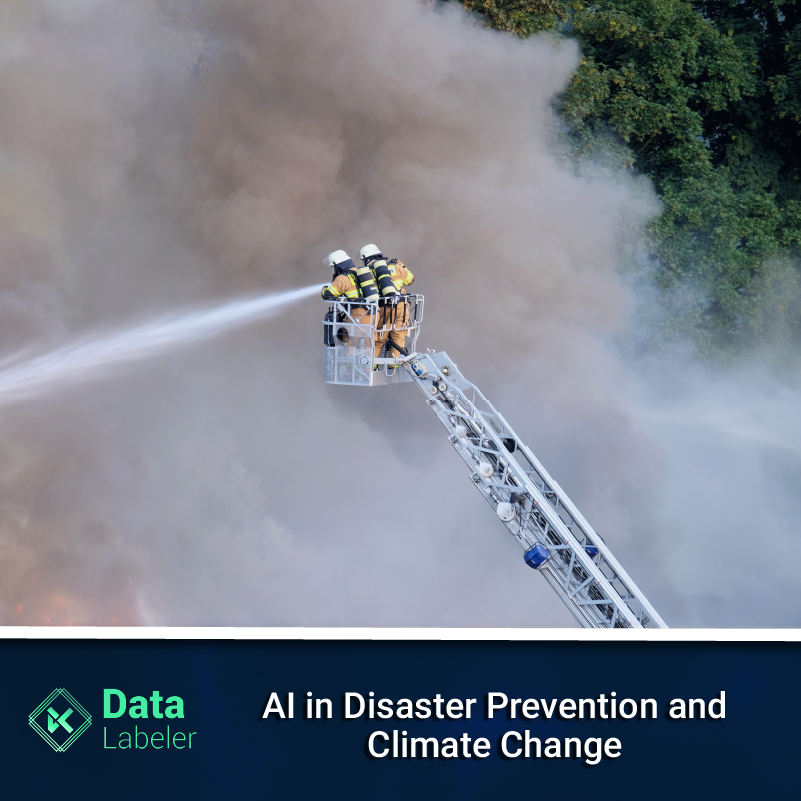
Systems with AI capabilities can be extremely helpful in averting these catastrophes. Drones with AI
algorithms installed may scan forests for indications of possible ignition sources, such as lightning

strikes or bonfires. AI can also forecast the spread of fires by analyzing weather data, which helps
firefighters plan their operations more efficiently.


Forecasting and Managing Floods


One common tragedy that strikes many places in the world is flooding. To forecast when and where
floods are likely to occur, artificial intelligence algorithms can process data from rainfall gauges, river
levels, and soil moisture sensors. To lower flood risk and damage, improved infrastructure and urban
planning can be designed with the use of AI-driven flood modeling.


Mitigating Climate Change


Though AI cannot directly avoid natural catastrophes, it can aid in addressing climate change, which
is the main cause of many of them. Algorithms that use Machine Learning and Data Labeling may
examine climate data, spot patterns, and create plans to cut greenhouse gas emissions. AI is also
capable of supporting sustainable land use practices, promoting renewable energy sources, and
optimizing energy consumption.


Coordination of Disaster Response


Coordination of disaster response activities can be enhanced using AI. Emergency responders, government organizations, and impacted communities can communicate more efficiently with each
other thanks to chatbots, virtual assistants, and automated systems. To better distribute resources
and determine the extent of a crisis, AI may also evaluate data in real-time.


About Us:


Want to use the full potential of AI in your field of concern?


Data Labeler
can help and support you in achieving the same with any kind of data labeling services
or data labeling annotations. For any further queries, please reach out to us!

Categories
Artificial Intelligence

How Healthcare Industry is utilizing the power of Artificial Intelligence effectively?

The global AI in healthcare market is anticipated to grow at a compound annual growth rate (CAGR) of 46.1% to reach USD 95.65 billion by 2028. The primary cause of development is the growing need for better, quicker, more precise, and individualized medical care. Furthermore, the expanding potential of artificial intelligence in genomics and drug discovery is the reason behind the increased use of modern technology in healthcare.


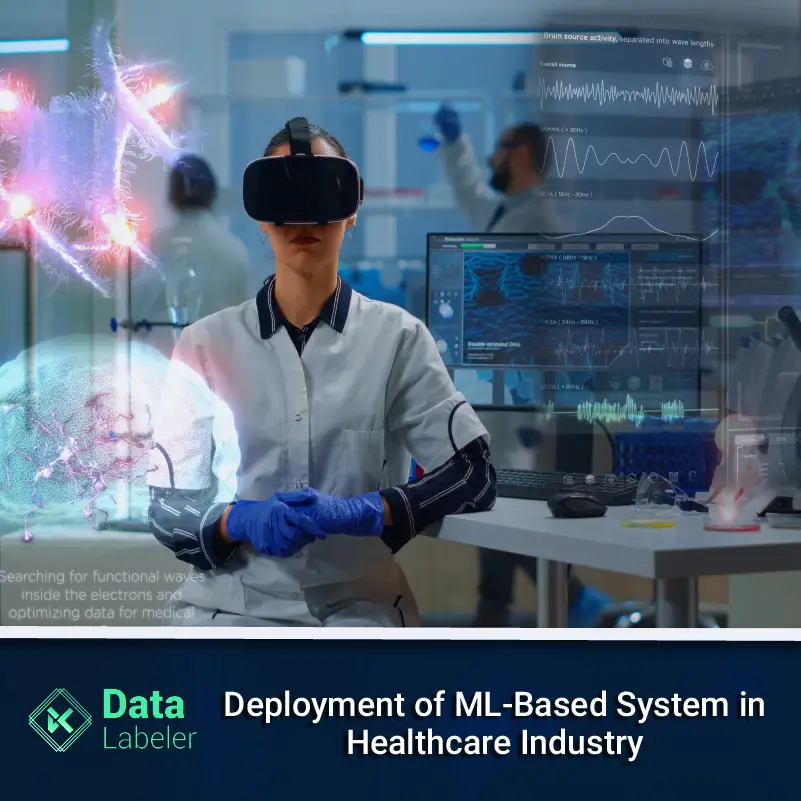
The healthcare sector is changing thanks to artificial intelligence (AI), which offers cutting- edge solutions that improve patient care, diagnosis, and treatment.


The safe and effective use of technology is being facilitated by IEC Standards. Artificial intelligence (AI) has the potential to revolutionize healthcare delivery by automating processes, improving clinical decision-making, and analyzing enormous volumes of data.


Producing high-quality training data for AI-assisted healthcare requires expert data labeling.


Let’s examine some of the most well-liked applications of AI in healthcare and how data
annotation & labeling supports their expansion.


Surgery: Robotic surgery employs precision data labeling.


Medical: Advanced research, drug discovery, and individualized medication therapy are all facilitated by the application of pattern recognition systems.


Diagnosis: Object recognition on thermal pictures is employed for early illness diagnosis (e.g., breast cancer); medical image annotation of MRIs, X-rays, and CT scans is used for diagnostic support.


Virtual Assistance: Conversational robots, chatbots, and virtual assistants are trained using labeled data to perform tasks such as appointment scheduling, medication reminders, and health status monitoring and assessment.


Patient Engagement: Using entity recognition for chatbot creation and audio and text transcription to digitize record management, annotated data enhances patient follow-up and maintenance following therapy.

How Is Machine Learning Changing the Medical Field?

Trustworthy ML – Physicians and patients alike must have faith in the results of machine learning systems for effective implementation in the healthcare industry.


Therefore, to guarantee that the results are trustworthy and suitable for clinical decision-making, machine learning must be implemented consistently in healthcare settings.


User-friendly and efficient machine learning – The usability of machine learning measures how well a model can assist in achieving particular objectives most cost-effectively to meet the demands of patients. Such machine learning needs to be adaptable to various healthcare environments and enhance conventional patient care.

Clear ML – Completeness and interpretability are the two primary needs implied by the reasonability of machine learning in the healthcare industry. To do this, it is necessary to make sure that data processing is transparent and that different methods are used to make inputs and outputs visible. Therapeutics and diagnostic test development depend on the development of ML healthcare that is understandable and transparent.


Ethical and responsible machine learning – The ML systems designed for clinical contexts are predicated on the notion of advancing healthcare to the point where technology can save lives, hence benefiting humanity. Machine learning has a lot of responsibility here. 


ML that is safe, meaningful, and responsible requires an interdisciplinary team made up of several stakeholders, including users, decision-makers, and knowledge experts.


A series of fundamental procedures are established by responsible ML practices in medicine, including:
 

  • Identifying the issue
  • Defining the solution 
  • Thinking through the ethical ramifications
  • Assessing the model
  • Reporting results
  • Deploying the system ethically


Defining the Future of Healthcare with AI


Bringing artificial intelligence and healthcare together requires striking a balance between the benefits of technology and human life. Healthcare professionals need to get the right training to understand the fundamentals of machine learning and recognize potential hazards, as the use of these algorithms in clinical and research settings grows.


Therefore, developing the most effective and dependable machine learning systems for better patient care requires cooperation between data scientists and doctors. However, we must never lose sight of the fact that data is the foundation of any AI project, particularly when working with supervised algorithms. As a result, data annotation becomes more crucial in healthcare systems that use machine learning.


Here’s where Data Labeler can provide you the ultimate support in labeling your data, hence, helping you go the next mile in your journey of implementing AI. For further details please visit our website Data Labeler. You may also reach out to us!

Categories
Data Labeling

Present Day Use Case Scenarios of Data Labeling in Insurance Sector

AI’s application in the insurance industry is expanding rapidly, covering everything from risk mitigation and damage analysis to compliance and claims processing. For example, repetitive activities are performed by Robotic Process Automation (RPA), freeing up operational personnel to work on more complicated duties.


AI is radically altering the long-standing practices of insurance. The sector is predicted to surpass $2.5 billion by 2025 because of its quick growth. This benchmark suggests a 30.3% compound annual growth rate from 2019 to 2025.


Use Cases of AI ML & Data Labeling in Insurance Sector


Fraud Detection in Insurance Claims:


Research conducted by the FBI on US insurance firms found that the annual cost of insurance fraud, or non-health insurance, is around $40 billion. This indicates that the average US household pays an additional $400 to $700 a year in premiums as a result of insurance fraud. These alarming figures highlight how urgently insurance firms need extremely accurate automated theft detection systems to improve their due diligence procedures.


Analysis of Property Damage:


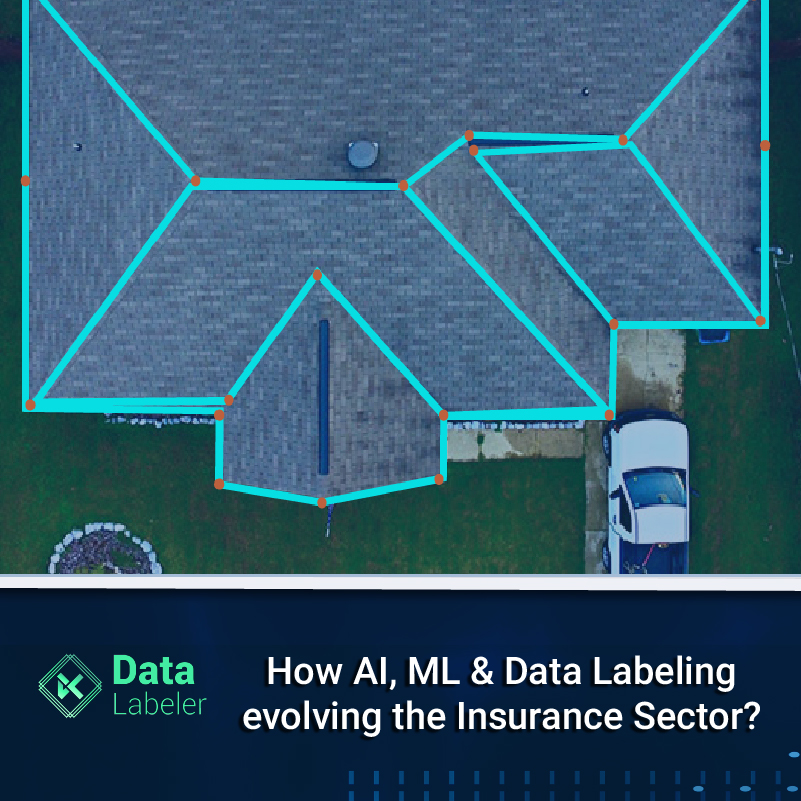
Insurance companies face a difficult problem when calculating repair costs through manual intervention in damage assessment. According to a PwC analysis, using drones and artificial intelligence in the insurance sector can save the sector up to US$6.8 billion annually. By combining automated object detection with the power of drones, claim resolution times can be shortened by 25% to 50%. Vehicle parts deterioration can be identified using machine learning models, which can also assist in estimating repair costs.


Automated Inspections:


The procedure of filing a damage insurance claim begins with an inspection, regardless of the asset—a mobile phone, a car, or real estate. Manual inspection is an expensive proposition because it necessitates the adjuster/surveyor to travel and engage with the policyholder. Inspections can cost anything from $50 to $200. Since creating and estimating reports takes one to seven days, claims settlement would also be delayed.
Insurance firms can examine car damage with AI-powered image processing. After that, the system produces a comprehensive assessment report that lists all vehicle parts that can be repaired or replaced along with an estimate of their cost. Insurance companies can reduce the cost of estimating claims and streamline the procedure. In addition, it generates reliable data to determine the ultimate settlement sum.


Automated Underwriting :


Traditionally, the analysis of past data and decision-making in insurance underwriting relied mostly on employees. In addition, they had to deal with disorganized systems, processes, and workflows to reduce risks and give value to customers. Intelligent process automation offers Machine Learning algorithms that gather and interpret vast volumes of data, streamlining the underwriting process.
Moreover, it minimizes application mistakes, controls straight-through-acceptance (STA) rates, and enhances rule performance. Underwriters can concentrate solely on challenging instances that may necessitate manual attention by automating the majority of the procedure.


Pricing and Risk Management:


Price optimization uses data analytic techniques to determine the optimal rates for a particular organization while taking its goals into account. It also helps to understand how customers respond to various pricing strategies for goods and services. Generalized Linear Models, or GLMs, are primarily used by insurance companies to optimize prices in areas such as life and auto insurance. By using this strategy, insurance businesses can improve conversion rates, balance capacity, and demand, and gain a deeper understanding of their clientele.
Automation of risk assessment also improves operational effectiveness. Automation of risk assessment increases efficiency by fusing RPA with machine learning and cognitive technologies to build intelligent operations. Insurance companies can provide a better customer experience and lower turnover because the automated procedure saves a lot of time.


Here’s how Fraud Detection can be achieved from Data Labeling?


Fraud detection systems that use machine learning (ML) rely on algorithms that can be taught with historical data from both legitimate and fraudulent acts in the past. This allows the algorithms to autonomously discover patterns in the events and alert users when they recur.
Large volumes of labeled data, previously annotated with specific labels characterizing its main attributes, are used to train ML-based fraud detection algorithms. Data from both genuine and fraudulent transactions that have been labeled as “fraud” or “non-fraud” accordingly may be included in this. The system receives both the input (transaction data) and the desired output (groups of classified examples) from these labeled datasets, which is significantly a laborious manual tagging process. This allows algorithms to determine which patterns and relationships link the datasets and use the results to classify future cases.


In addition to the areas highlighted above, there are a few more in the insurance industry
where AI & Data Labeling are essential to delivering the best possible client experience.

  • Customer segmentation
  • Workstream balancing for agents
  • Self-servicing for policy management
  • Claims adjudication
  • Policy Servicing
  • Insurance distribution
  • Speech analytics
  • Submission intake and many more

If you want to create a faster and better experience for your customers in the Insurance
field, please visit our website Data Labeler, and contact us.